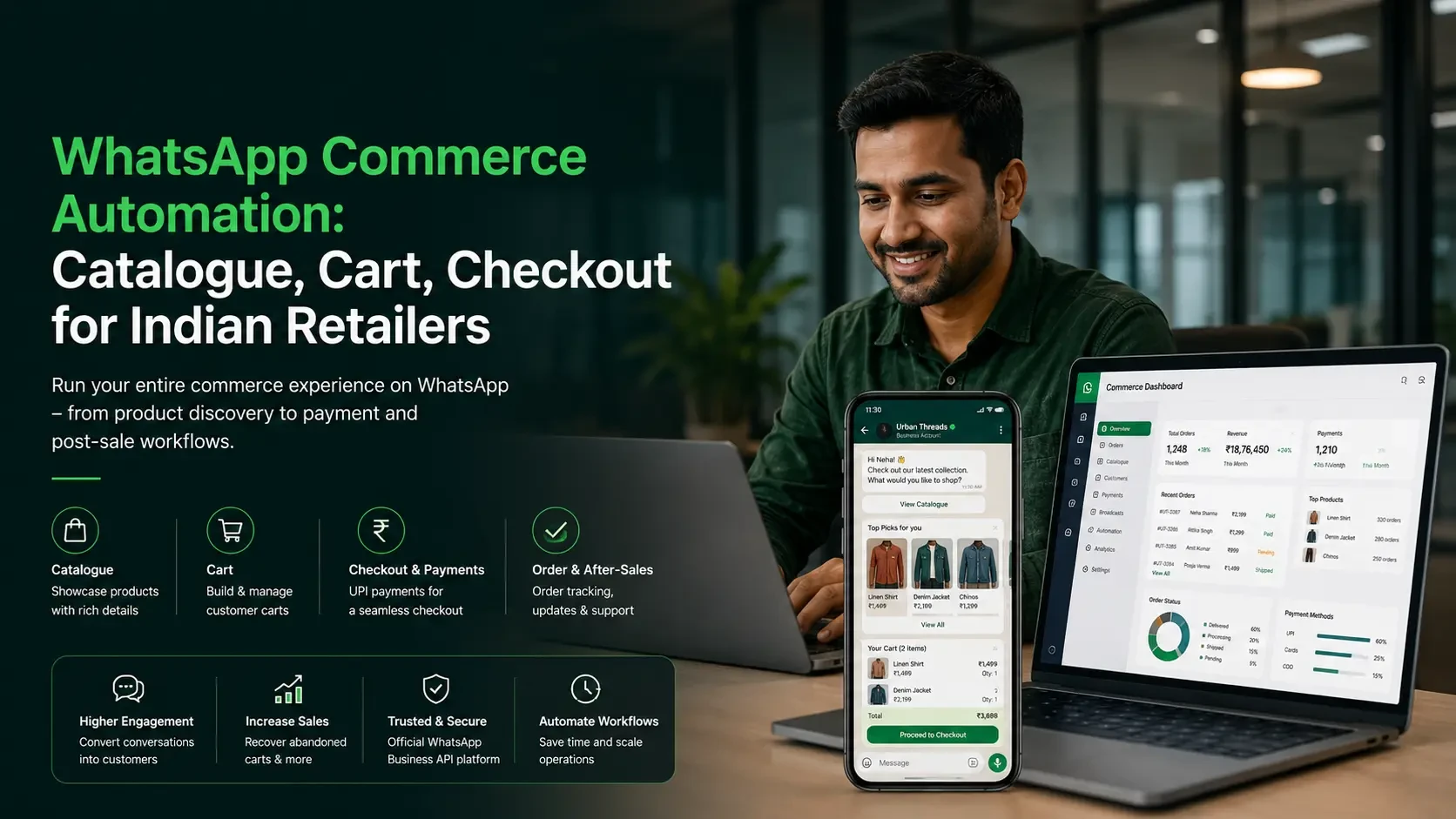
Most Indian retailers use WhatsApp for chat.
A customer messages. A staff member replies. Maybe a product photo gets sent. Maybe an order gets confirmed manually. The conversation lives in the WhatsApp Business app on someone's phone. Orders get tracked in a notebook, a spreadsheet, or in someone's head.
This works at small scale. It breaks the moment volume rises.
The retailers who are actually winning on WhatsApp in India are running something different - a full commerce experience inside the conversation. Catalogue browsing. Cart building. Checkout with UPI. Order tracking. Cart abandonment recovery. Returns. Post-sale customer service. All of it inside WhatsApp, all of it automated, all of it integrated with the back-end systems that fulfil the order.
This is what WhatsApp commerce automation actually means. And it is one of the highest-leverage shifts an Indian retailer can make in 2026.
Why WhatsApp commerce works in India specifically
Three structural reasons most retailers underestimate.
First - the channel fit. Indians already live on WhatsApp. Asking a customer to download your app, register, log in, search, add to cart, check out is a five-step funnel that loses customers at every step. Doing the same thing inside the conversation they were already having is a one-step funnel.
Second - the trust layer. WhatsApp conversations have implicit trust that web checkout pages do not. A green-tick verified business sending a catalogue and a UPI payment link inside a conversation feels safer to most Indian customers than a checkout page on a domain they have never visited.
Third - the payment ecosystem. UPI made India the highest-volume real-time payment market in the world. Sending a UPI payment request inside a WhatsApp conversation closes the loop between intent and payment in seconds. No card details. No OTP fatigue. No drop-off.
Western WhatsApp commerce content rarely captures these three. They are India-specific and they are what make WhatsApp commerce work at scale here.
The full WhatsApp commerce funnel
Six stages. Most retailers do one or two well and lose value at the others.
Stage 1 - Discovery
How does a customer get into your WhatsApp conversation in the first place?
The strongest answer in India is click-to-WhatsApp ads - Meta's ad format that opens WhatsApp directly when a user clicks the ad. These have become the single highest-ROI ad format for many Indian D2C brands and small retailers because they bypass the website entirely. The customer goes from seeing the ad on Instagram or Facebook to a live conversation with the brand in one tap.
Other discovery paths - QR codes on packaging, in-store, on receipts. Website chat widget that opens WhatsApp. wa.me links in email and SMS. Social media bio links. Referral codes shared inside WhatsApp itself.
Stage 2 - Catalogue browsing
Once the customer is in the conversation, they need to be able to browse what you sell.
WhatsApp's native catalogue feature lets businesses upload products with images, descriptions, prices, and inventory. Customers can browse the catalogue inside the chat. The catalogue is also viewable on the business profile.
Practical reality - the native catalogue works well for businesses with 50 to 500 products. Beyond that, the browsing experience strains. For larger catalogues, businesses often use a dynamic catalogue served through WhatsApp Flows or through a linked mini-storefront triggered from the chat.
What makes catalogue browsing convert - clear product photos with consistent framing, prices in INR, descriptions that handle the most common objections, and variants (size, colour) handled in a way that does not force the customer through five clicks per product.
Stage 3 - Cart and selection
Adding items to a cart inside WhatsApp works through interactive messages, buttons, lists, or a Flow-based selector.
Two design choices matter here. One - whether to show running cart totals as the customer adds items, or to summarise at checkout. Showing totals reduces sticker shock at checkout but adds chat noise. Most strong implementations summarise at checkout with item-by-item confirmation.
Two - how to handle quantity changes and removals. Force the customer to type, and you lose many. Provide buttons or a flow-based cart editor, and you keep them.
Stage 4 - Checkout and payment
The single most underdone stage in most Indian WhatsApp commerce setups.
The checkout needs to handle - name, delivery address, contact number, payment method. Done well, this is a Flow-based form that captures all of it in one structured interaction. Done badly, it is a free-text exchange where the customer types their address into a chat and the business pulls it out manually.
Payment options that work in India - UPI link (the most common, instant, no app switch required for many users), payment gateway link (for cards, netbanking, and digital wallets), and cash on delivery (still the largest share for many Indian retailers, especially in Tier 2 and Tier 3 cities).
WhatsApp Pay - Meta's in-app UPI payment feature - has had a measured rollout in India. Where available, it lets customers pay directly inside the chat without switching apps. Most Indian retailers still send a generic UPI link or payment gateway link as the dominant flow.
Stage 5 - Order confirmation and tracking
Once payment is received, the customer expects acknowledgement immediately and ongoing updates through delivery.
Strong implementations send - order confirmation within seconds, an order tracking link or status updates, dispatch notification with logistics partner details, delivery confirmation, and a feedback request after delivery.
All of this should be automated. None of it should require staff to manually send each update.
Stage 6 - Post-sale and retention
The retailer who treats post-sale as where the relationship ends loses most of the lifetime value.
Post-sale workflows that work - proactive support reach-outs at 3 days and 14 days, replenishment reminders for consumables, returns and refund handling inside the chat, cross-sell and upsell based on purchase history, festive and seasonal re-engagement, and loyalty rewards.
Each of these is a campaign or an automated workflow, not a manual task.
Cart abandonment on WhatsApp - the highest-ROI single workflow
A significant share of customers who start a WhatsApp commerce journey do not complete the order on the first attempt.
They get distracted. They want to compare prices. They are not ready to pay yet. They are not sure about the size or colour. They got pulled into something else.
The cart abandonment workflow on WhatsApp is far more effective than the equivalent on email or web for one specific reason - the conversation thread is already open. The customer does not need to find an email. The reminder appears in the same chat where the original interest was expressed.
Practical cart abandonment workflow - first nudge at 30 minutes after the cart was abandoned (gentle, contextual, with a clear next step), second nudge at 24 hours (offering help, answering objections), third nudge at 3 days (with an incentive if margins allow), and stop after that.
Get the timing wrong and the workflow feels like spam. Get it right and it recovers a meaningful share of orders that would otherwise have been lost.
WhatsApp Flows - the structured experience
WhatsApp Flows is Meta's structured form-and-screen experience inside WhatsApp. Customers can fill in details, pick from lists, navigate multi-screen forms - all inside the WhatsApp interface.
What Flows enables in commerce - full multi-step checkout forms, address collection with validation, complex product selection with multiple variants, loan or insurance applications, appointment booking with structured fields.
What they replace - long awkward back-and-forth chat exchanges where customers have to type their full address, name, email, and order details into free text.
For any retailer running serious commerce on WhatsApp, Flows are not optional. They are how the experience stops feeling like a chat and starts feeling like a checkout.
Integration with the back-end - where most setups fall apart
WhatsApp commerce that is not integrated with the systems that fulfil the order produces chaos.
Orders sit in a chat dashboard. Inventory does not update. Logistics does not know what to ship. Returns get lost. The whole experience that felt smooth to the customer becomes painful to the business - staff manually copying orders from WhatsApp into the inventory or order management system, mistakes compounding, customers waiting longer than they should.
What integration looks like when done right
WhatsApp commerce platform connects to - order management system or ERP (orders flow in automatically), inventory system (real-time stock check before confirming orders), payment gateway and reconciliation (payments flow back to accounting), logistics aggregator (shipment label generated automatically, tracking link sent back), customer database or CRM (customer history available in conversation), and returns and refunds system (returns initiated from chat flow through to the same system).
When all of this works, WhatsApp commerce stops being a separate channel and becomes the primary customer-facing surface for an integrated back-end.
What size of business is WhatsApp commerce for
All sizes - but with different patterns.
Micro and small retailers (1 to 5 employees)
Often start on WhatsApp Business app. The right time to graduate to API and automation is when conversation volume crosses a few hundred per month or when human staff are spending more than a few hours daily replying manually.
Mid-market retailers and D2C brands
The sweet spot. Catalogue size manageable. Customer base large enough for WhatsApp to be a primary channel. Often see the highest revenue contribution from WhatsApp commerce - frequently 20 to 40 percent of total orders for D2C brands that have invested in the workflow.
Large retailers and marketplaces
Use WhatsApp for the customer service layer, order updates, post-sale, and increasingly for re-engagement. The full checkout on WhatsApp is less common at this size - usually the main checkout still happens on app or web, with WhatsApp handling the surrounding workflows.
Costs - what an Indian retailer should actually budget
Three cost layers.
WhatsApp conversation costs - per-conversation rates set by Meta, in INR, varying by conversation category. For most Indian retailers, this is the smaller share of cost.
BSP and automation platform fees - fixed monthly subscription plus possible per-conversation handling charges. This is usually the larger share.
Integration and one-time setup - connecting to your order management system, payment gateway, logistics, and CRM. Can be done in-house if you have engineering resources, or done by the automation platform's services team.
Practical reality - for most mid-market Indian D2C brands, the all-in cost of running WhatsApp commerce well sits between a fraction of a percent and a few percent of WhatsApp-originated GMV. The economics work because conversion rates on WhatsApp are typically substantially higher than on web for the same audience.
What good Indian WhatsApp commerce looks like
-
click-to-WhatsApp ad opens a conversation with personalised greeting
-
catalogue browsing inside the chat with clear photos and INR prices
-
cart selection through buttons or a Flow-based selector
-
Flow-based checkout that captures name, address, phone, and payment in one structured form
-
UPI payment link that closes payment in under 30 seconds
-
order confirmation within seconds of payment
-
dispatch notification, tracking link, delivery confirmation — all automated
-
cart abandonment recovery with 3-step nudges over 3 days
-
post-sale support, returns, and replenishment all in the same conversation thread
-
the entire stack integrated with order management, inventory, payment, logistics, and CRM
What bad Indian WhatsApp commerce looks like
-
WhatsApp Business app on one staff member's phone
-
catalogue is a PDF the staff member sends each time
-
address taken in free text and copied manually into a spreadsheet
-
payment is a UPI ID sent in a message and the customer is told to send proof of payment
-
no order tracking - customer has to ask for an update
-
no cart abandonment workflow
-
no integration with anything - every step is manual
-
marketing campaigns blasted to phone number lists that did not opt in
-
number gets quality-rated low or banned within months
The shift to make
Stop treating WhatsApp as a chat channel for sales.
Start treating it as a primary commerce surface - with a full funnel, integrated back-end, structured checkout, and automated post-sale workflows.
For most Indian retailers, this is the highest-leverage software investment of the next two years. The customers are already there. The technology is mature. The payment ecosystem (UPI) is unmatched globally. The only question is whether your business shows up on the channel where your customers already live, or keeps trying to drag them to a website or app where they would rather not go.
Frequently asked questions
Do I need a developer to set up WhatsApp commerce?
For the basics - catalogue and chat - no. Most automation platforms offer no-code setup for catalogue, simple cart, and standard workflows. For deeper integration with your order management, inventory, and payment systems, some technical work is needed - but most of it is configuration, not custom code.
Will Meta let me run a full e-commerce store on WhatsApp?
Yes, with the standard commerce policy boundaries - no restricted goods (alcohol in some categories, tobacco, weapons, regulated substances, certain financial products without licensing). Meta has been pushing WhatsApp commerce as a strategic direction. Compliance with their commerce policies, opt-in rules, and conversation pricing categories matters.
Should I move my whole e-commerce business to WhatsApp?
Usually no. Most Indian retailers run WhatsApp alongside their app, website, and marketplaces. WhatsApp captures a specific portion of customer journeys - particularly first-time discovery via ads, repeat purchase, and high-touch sales. The web and app handle other portions. The strongest results come from treating them as complementary.
How do I handle returns on WhatsApp?
Through the same chat thread. A return request triggers a structured flow - reason for return, pickup address confirmation, refund method. The automation platform connects this to your returns management system, generates a return shipping label, and updates the customer at each step. Done well, returns on WhatsApp are smoother than returns on most Indian e-commerce websites.
What about COD orders?
Fully supported. The checkout flow includes a COD option. The order proceeds without a payment step, the logistics partner collects payment on delivery, and the customer receives the standard tracking and confirmation messages. For many Indian retailers, particularly outside Tier 1 cities, COD remains the dominant payment method.
How do I measure the ROI of WhatsApp commerce?
Standard commerce metrics - conversion rate, average order value, cart abandonment rate, customer lifetime value - measured against the cost of conversations and platform fees. Most well-run Indian WhatsApp commerce programmes show return-on-investment within 3 to 6 months because the conversion lift compared to web traffic is meaningful and the conversation costs are low.
Internal linking
Link this article to:
-
WhatsApp Catalogue Setup for Indian Retailers - What Actually Sells
-
UPI on WhatsApp - How to Accept Payments Without Friction
-
WhatsApp Order Management - From Confirmation to Delivery
-
Click-to-WhatsApp Ads - Meta's Highest-ROI Ad Format in India
-
Small Retailer WhatsApp Playbook - Kirana to Garment to Jewellery
-
Pillar 11 - WhatsApp Business API: The Complete Guide for Indian Businesses
-
Pillar 2 (existing) - Appointment Booking and Scheduling Automation
About the Author

Tanishka Raina
Ready to orchestrate your AI future?
Converiqo AI helps you design, deploy, and scale automation workflows that move your business faster, leveraging specialized solutions like our AI bot platform for lead generation, customer self-service AI bot platform, employee self-service AI bot platform, retail omnichannel automation, and our detailed guides on how agentic AI bot platforms work in enterprises and cost structure of enterprise AI bot platforms. Connect with our team to see the platform in action and co-create the next chapter of intelligent operations.
Read More Blogs
Discover more insights and product updates curated by the Converiqo AI team.

Real ROI of Field Force Automation - Beyond the Activity Dashboard
Four metrics that show real field force automation ROI in India - productivity, data reliability, throughput, and field attrition - not just the activity dashboard.

Beat Planning Is the Highest-Leverage Field Force Capability - Here Is Why
Beat planning decides coverage, call frequency, and whether field time is productive. Why it is the single highest-leverage field force automation capability.
Why an Indian Field Force App Has to Work Offline - and Be Built for Real Devices
Field work in India happens where connectivity is intermittent. A field force app that assumes constant connectivity fails exactly where field work is done.