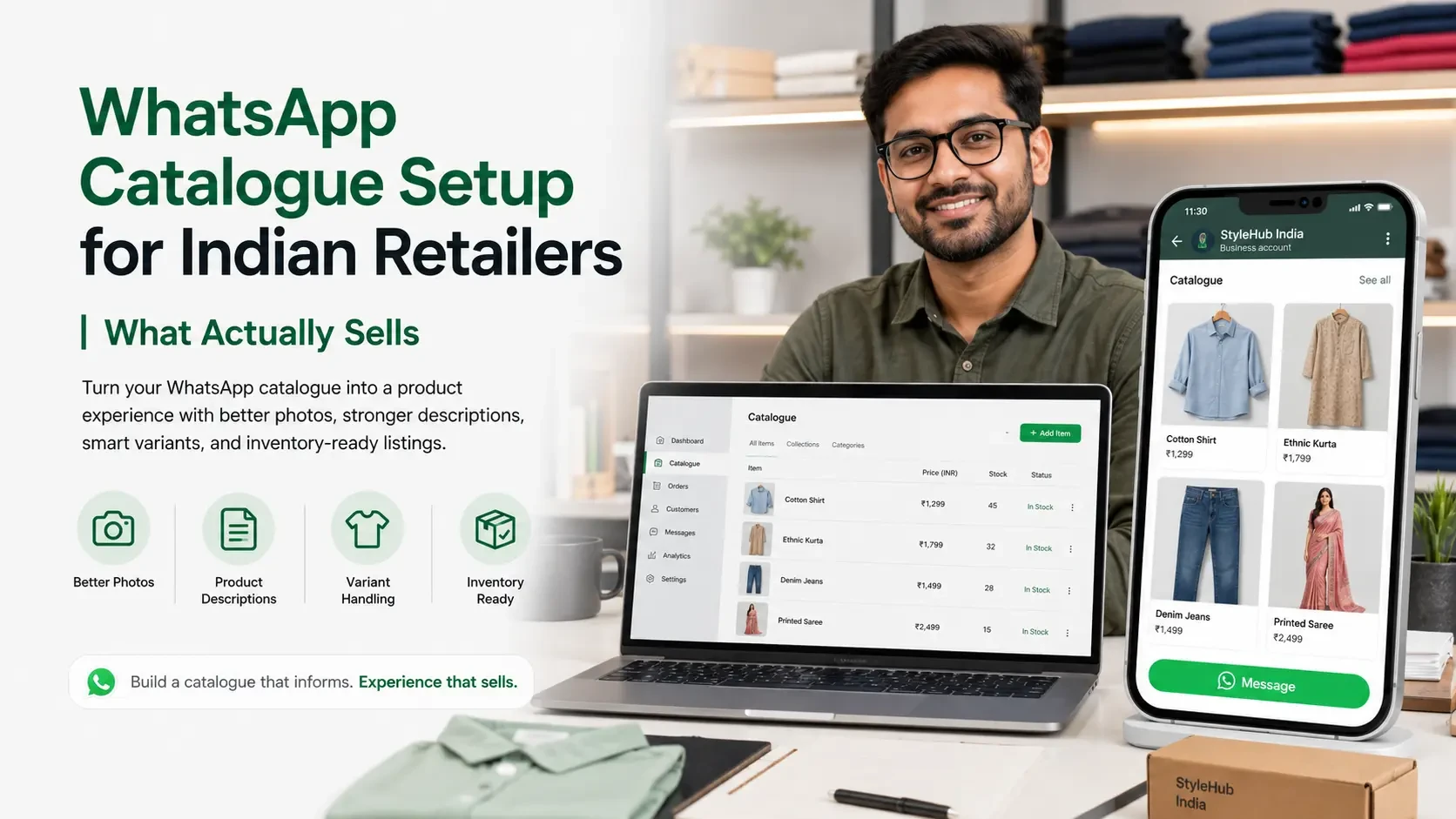
Most Indian retailers set up a WhatsApp catalogue and treat it as a digital PDF a list of products with photos and prices that customers scroll through.
The catalogues that actually sell are set up differently. They are treated as product pages - with the same care for photo quality, descriptions, variants, and conversion psychology that a real e-commerce listing gets.
Here is what changes when you take catalogue setup seriously.
Photos that convert in catalogue context
The catalogue image is the first thing the customer sees. Most products on Indian WhatsApp catalogues have one of three photo problems.
Problem 1 - low resolution. Photos taken on a phone in shop lighting and uploaded directly. Customer cannot see detail. They scroll past.
Problem 2 - inconsistent framing. Some products full-frame, some at angles, some with backgrounds, some without. The catalogue looks chaotic.
Problem 3 - single angle only. For products where multiple angles matter (apparel, jewellery, furniture, electronics) - only one view. Customer cannot evaluate.
What works - high-resolution photos, consistent white or neutral backgrounds, consistent framing across the catalogue, multiple angles for products that need them, and human models or scale references for size-sensitive categories.
This is not photography expertise. It is photography consistency. A standard phone, decent lighting, a plain backdrop, and the same setup for every product produces a catalogue that looks professional.
Descriptions that handle objections before they happen
Most catalogue descriptions in India are one or two lines listing features. That is not enough.
The description is doing the job that a salesperson or product page would do - telling the customer what they need to know to buy with confidence.
What to include - what the product is, what it is made of, what size or quantity, what use case it suits, what makes it different from cheaper alternatives, who it is for. All in 3 to 5 short lines.
Indian customer-specific signals that help - fabric weight in GSM for apparel, gold purity for jewellery, RAM and storage for electronics, capacity in litres for appliances. The information the customer would have asked the shopkeeper if they were in the shop.
Prices that customers can actually compare
Show MRP and selling price. Show GST inclusive or exclusive clearly. Show variants priced separately when relevant (size up costs more, larger pack costs different per-unit).
What hurts - single prices with no anchoring. Customer does not know if they are getting value. Hidden GST that surprises at checkout.
Variants - the trap most catalogues fall into
Products with multiple sizes, colours, or specifications need variant handling. Most WhatsApp catalogues do this badly.
Bad version - each variant listed as a separate product. Customer scrolls past 10 entries for the same shirt in different colours, gets confused, leaves.
Better version - one product entry with variants handled through a Flow-based selector at the point of selection. Customer sees the product once. Picks size and colour from a structured interaction. Adds to cart cleanly.
Inventory honesty
If an item is out of stock, the catalogue should reflect it. Customers who select an out-of-stock item lose trust when they find out at checkout.
Strong implementations connect the catalogue to real-time inventory. Out-of-stock items either show as unavailable or come with a notify-me option.
Catalogue size - how big should it be
WhatsApp native catalogue handles 50 to 500 products comfortably. Beyond that, the browsing experience starts to strain.
For larger inventories, the right pattern is a curated catalogue in WhatsApp linked to a dynamic catalogue served through Flows or a linked mini-storefront. Customer sees the bestsellers or relevant categories in the native catalogue and can drill into the full inventory through a Flow when needed.
The shift to make
Stop treating the WhatsApp catalogue as a digital PDF of your inventory.
Start treating it as a curated, well-photographed, well-described, inventory-aware product surface - the equivalent of your best Amazon listings or your best shop window.
The customers are already in the conversation. The catalogue is what closes the sale or loses it.
About the Author

Himani Chaudhary
Ready to orchestrate your AI future?
Converiqo AI helps you design, deploy, and scale automation workflows that move your business faster, leveraging specialized solutions like our AI bot platform for lead generation, customer self-service AI bot platform, employee self-service AI bot platform, retail omnichannel automation, and our detailed guides on how agentic AI bot platforms work in enterprises and cost structure of enterprise AI bot platforms. Connect with our team to see the platform in action and co-create the next chapter of intelligent operations.
Read More Blogs
Discover more insights and product updates curated by the Converiqo AI team.

Real ROI of Field Force Automation - Beyond the Activity Dashboard
Four metrics that show real field force automation ROI in India - productivity, data reliability, throughput, and field attrition - not just the activity dashboard.

Beat Planning Is the Highest-Leverage Field Force Capability - Here Is Why
Beat planning decides coverage, call frequency, and whether field time is productive. Why it is the single highest-leverage field force automation capability.
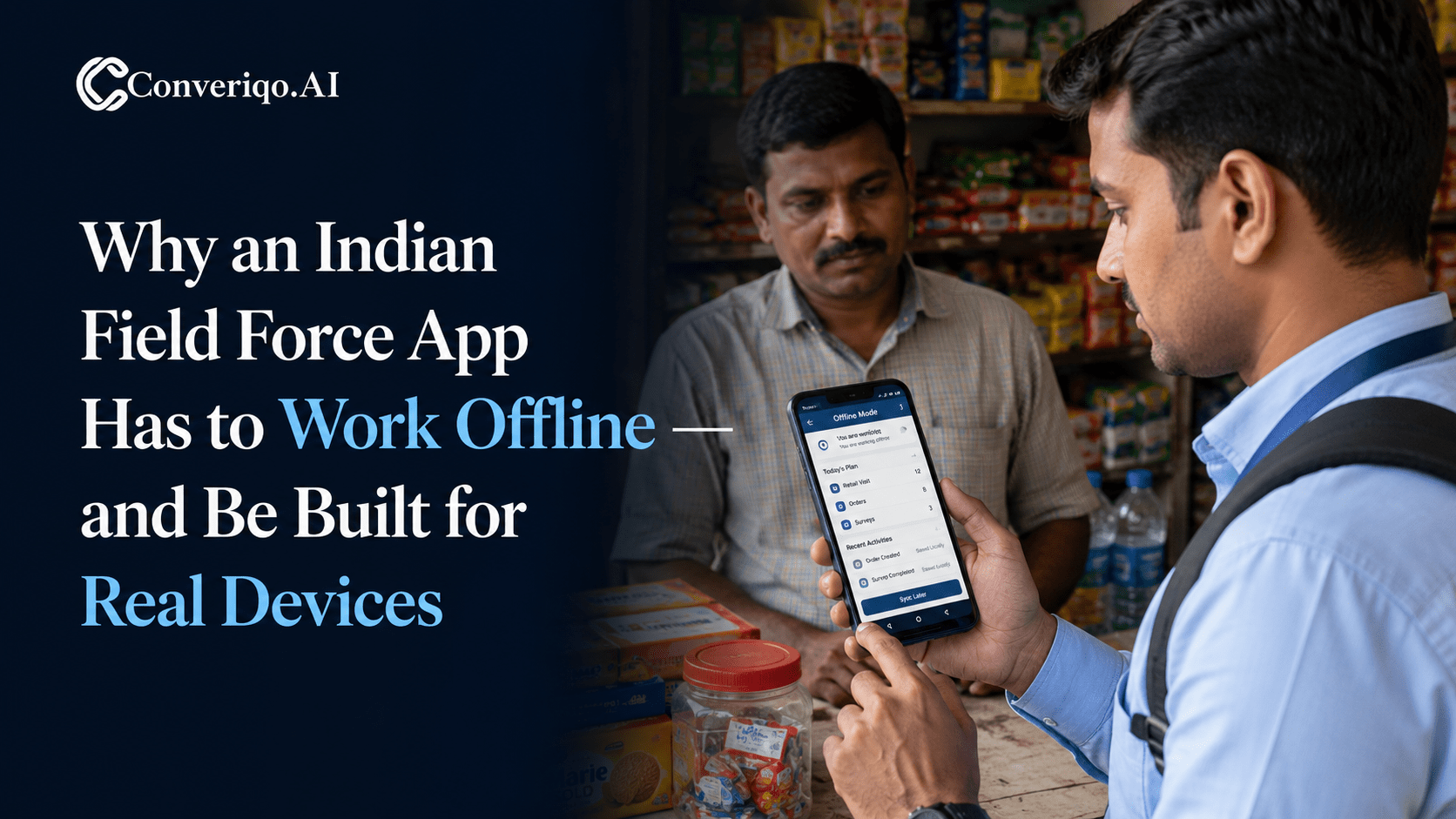
Why an Indian Field Force App Has to Work Offline - and Be Built for Real Devices
Field work in India happens where connectivity is intermittent. A field force app that assumes constant connectivity fails exactly where field work is done.