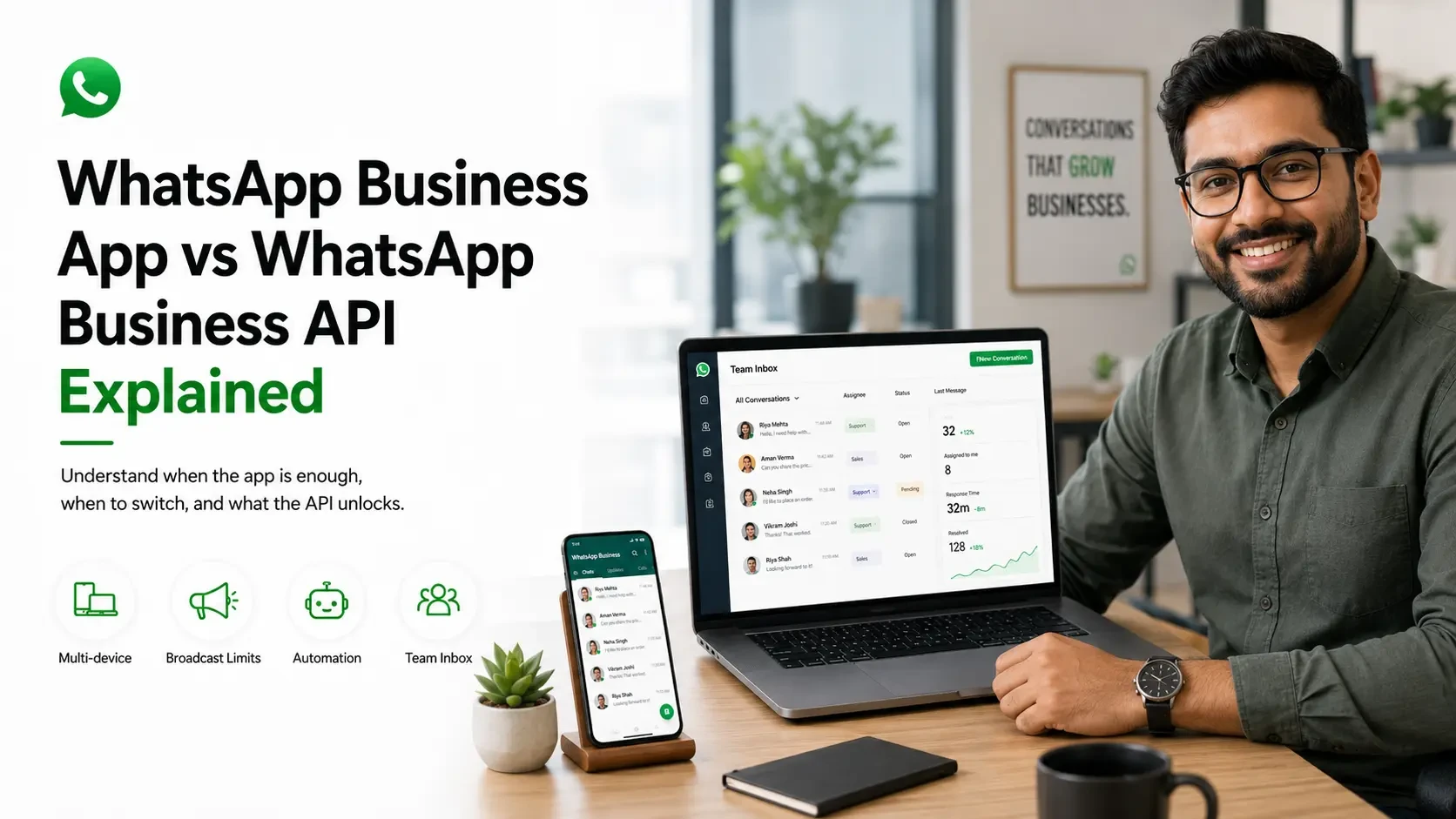
Most Indian businesses outgrow WhatsApp Business app well before they switch to the API.
They keep adding people to the same number through companion devices. They send broadcasts that get blocked at 256-contact limits. They miss customer messages because only one person can be active at a time. They use personal phones for business in ways that put the account at risk.
All of these are signs the switch is overdue.
What WhatsApp Business app does well
Free. Quick to set up. Basic features that work for very small operations.
-
business profile with hours, address, website
-
product catalogue you can share in chats
-
quick replies for common questions
-
labels for organizing customer chats
-
auto-reply messages (away message, greeting)
-
basic broadcast lists (up to 256 saved contacts)
For a solo founder, a single-person shop, or a small business handling under 100 conversations a month, the Business app is fine.
Where the Business app breaks down
1. Multi-device limitations
Only one phone is the primary device. Up to 4 companion devices (other phones, web, desktop) - but logging in on a 5th disconnects one.
Two team members handling chats from different cities? Tense. Three or more? Operationally impossible without dropping messages.
2. No real automation
Auto-replies are basic - one greeting message, one away message. No conditional logic. No qualification flows. No integration with your CRM or booking system.
Every customer message gets the same auto-reply, regardless of what they said or who they are.
3. Broadcast limits
Broadcast lists capped at 256 contacts each. Recipients must have your number saved to receive broadcasts. Designed to prevent spam - but unworkable for any business with more than a few hundred customers.
4. No team routing
All chats land in one inbox. No way to route service queries to one team, sales queries to another, complaints to a third.
5. No CRM integration
Chats live inside WhatsApp. Your CRM cannot see them. Your team has to copy-paste between systems. Sales reps lose context the moment they switch tools.
6. No AI
The Business app does not support agentic AI handling conversations. Every message needs a human.
Five signals it is time to switch
Across Indian businesses we see make this transition successfully, these five signals consistently point to the switch being overdue.
Signal 1 - You handle more than 500 conversations a month and the team is missing messages.
Signal 2 - You have more than one person needing to respond to WhatsApp chats simultaneously.
Signal 3 - You want to send order updates, booking reminders, or marketing campaigns to more than a few hundred customers.
Signal 4 - You are using a personal WhatsApp for business chats and worried about the account getting flagged.
Signal 5 - You want any form of automation - qualification flows, AI replies, CRM sync, calendar booking integration.
Any one of these signals is enough. Two or more makes the switch genuinely overdue.
What the switch actually looks like
Choose a BSP (Business Solution Provider) or a platform like Converiqo that provides API access plus automation on top.
Verify your business with Meta (Facebook Business Manager) - typically 1 to 3 days.
Migrate your number from the Business app to the API - about an hour, but plan for service continuity. Your existing customer conversations from the Business app generally do not migrate; chat history is local to the device.
Get your first templates approved - 1 to 3 days.
Integrate with your CRM, helpdesk, or chosen automation layer.
Train your team on the new inbox interface. Most BSPs provide a team inbox that looks similar to email but routes to WhatsApp.
The shift to make
Stop trying to make the WhatsApp Business app do more than it was designed to do.
Start treating the API as the natural next step - it is not for enterprises only, it is for any Indian business serious about scaling its customer conversations.
Most businesses that switched in the last two years say the same thing - they should have done it a year earlier.
About the Author

Ankur Singh
Ready to orchestrate your AI future?
Converiqo AI helps you design, deploy, and scale automation workflows that move your business faster, leveraging specialized solutions like our AI bot platform for lead generation, customer self-service AI bot platform, employee self-service AI bot platform, retail omnichannel automation, and our detailed guides on how agentic AI bot platforms work in enterprises and cost structure of enterprise AI bot platforms. Connect with our team to see the platform in action and co-create the next chapter of intelligent operations.
Read More Blogs
Discover more insights and product updates curated by the Converiqo AI team.
Real ROI of Field Force Automation - Beyond the Activity Dashboard
Four metrics that show real field force automation ROI in India - productivity, data reliability, throughput, and field attrition - not just the activity dashboard.

Beat Planning Is the Highest-Leverage Field Force Capability - Here Is Why
Beat planning decides coverage, call frequency, and whether field time is productive. Why it is the single highest-leverage field force automation capability.
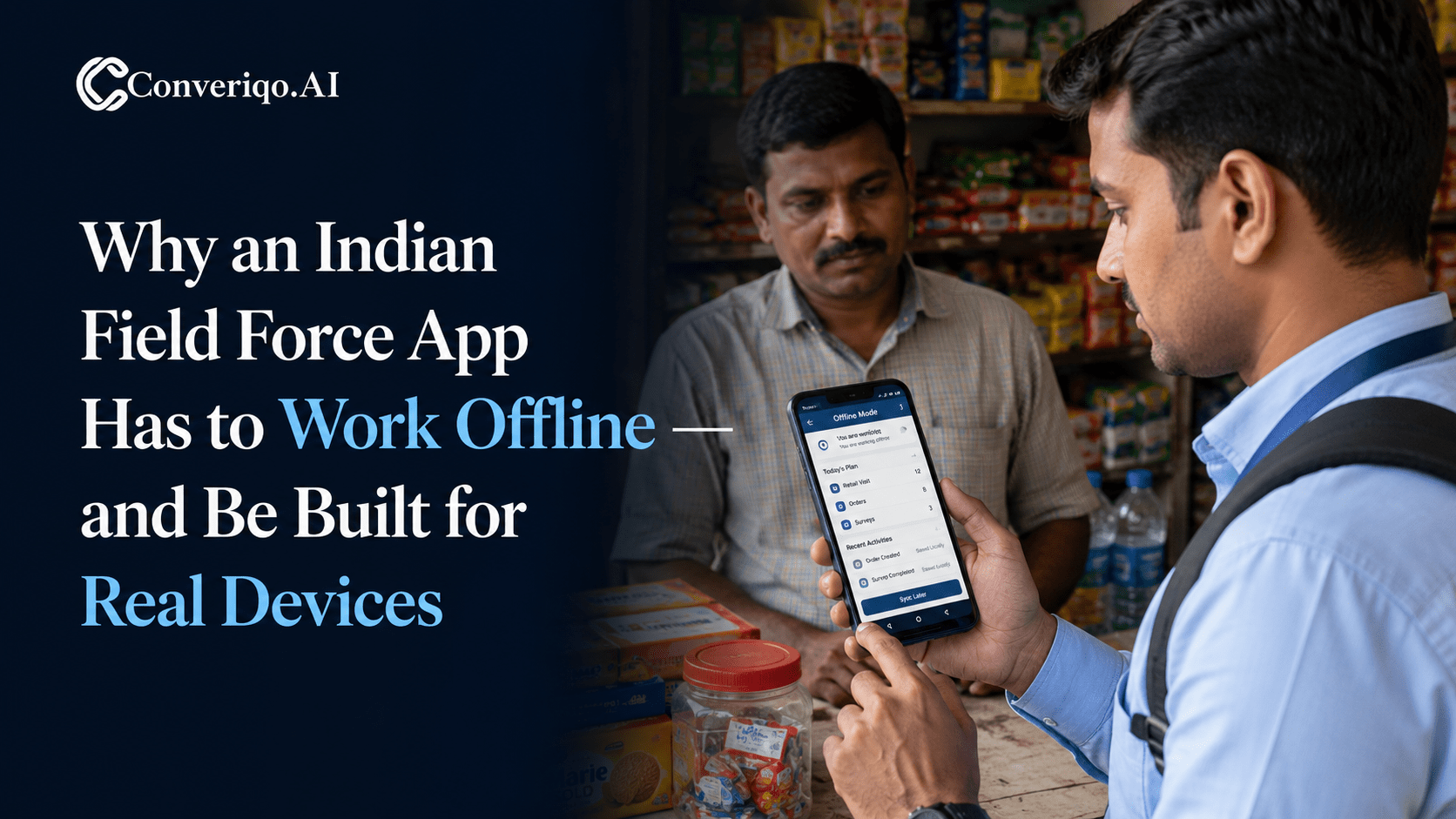
Why an Indian Field Force App Has to Work Offline - and Be Built for Real Devices
Field work in India happens where connectivity is intermittent. A field force app that assumes constant connectivity fails exactly where field work is done.