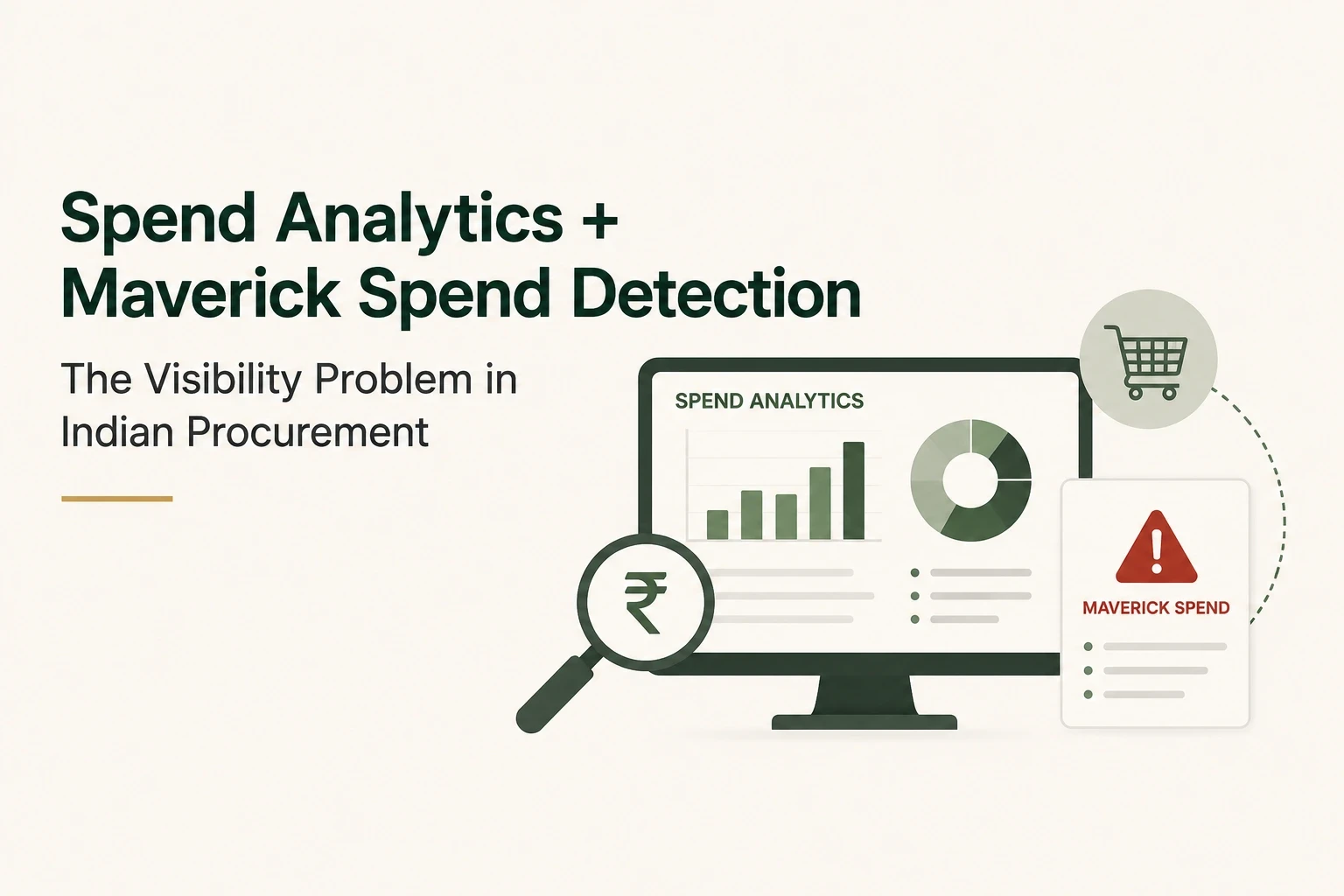
A CFO at an Indian mid-market company at INR 400 crore in revenue runs a quarterly procurement review. The procurement team presents top vendors by spend, top categories, total purchase order value, and contract negotiation savings achieved during the quarter. The numbers look reasonable. The CFO signs off. The review concludes.
What the review does not show - what the CFO has no way to see from the available data - is that 24% of the company's total spend in the quarter went to vendors outside negotiated contracts and approved procurement processes. The maverick spend. The purchases made by business units directly with vendors, often at rates 12% to 20% higher than the negotiated contract rates for the same category, often through processes that bypassed the formal procurement approval. The maverick spend is not in the procurement team's report because the procurement team does not always see it - it shows up in the ERP as line items in cost centres without consistent metadata, scattered across category codes that obscure the pattern.
What maverick spend is and why it persists
Maverick spend is procurement that occurs outside the negotiated contracts and approved processes the procurement function has put in place. It typically takes one of three forms in Indian companies.
Off-contract purchases. The marketing team buys event services from a new vendor without consulting procurement, even though a contract exists with a preferred event vendor at negotiated rates. The new vendor charges 15% more for similar service. The purchase is legitimate from a business perspective but is paying above contracted rates.
Process-bypass purchases. A business head with delegation authority approves a purchase directly with a vendor without going through the procurement intake process. The purchase is approved according to delegation rules but did not benefit from procurement's vendor evaluation, contract intelligence, or pricing leverage.
Category-misclassified purchases. Purchases classified into general expense categories that hide their true category nature. A capital equipment purchase classified as 'operational supplies' because the line item description does not clearly identify it. The misclassification keeps the spend out of category-specific contract leverage and out of category-level analytics.
Why maverick spend persists in most Indian companies - three reasons.
Visibility gap. The procurement team cannot see the maverick spend because the procurement systems do not capture it. The ERP shows the transaction; it does not flag the transaction as off-contract or process-bypass. Without analytics that compare actual spend against contract coverage, the maverick spend stays invisible.
Business unit incentives. Business heads optimise for speed and convenience. Going through procurement adds days or weeks to a purchase cycle. Going direct to a vendor takes hours. The business head choosing to go direct is making a rational local decision; the organisation-level cost of the maverick spend is not on their P&L.
Procurement function authority. In many Indian companies, the procurement function does not have hard authority to prevent off-contract purchases. The CFO controls payment but not all purchasing decisions. Without analytics-driven enforcement, procurement operates on persuasion rather than control.
What spend analytics actually does
Spend analytics runs across the full spend population - every PO, every invoice, every payment - and surfaces patterns that single-transaction review cannot reveal. Four categories of patterns worth surfacing.
Maverick spend by category, vendor, and requester. Which categories have the most maverick spend (often professional services, marketing services, IT services, facilities). Which business units are the largest sources. Which vendors are receiving the maverick spend - sometimes the same vendor relationship is generating both contracted and off-contract activity.
Contract savings realisation. The negotiated savings from procurement contracts versus the actual savings reflected in paid prices. Realisation typically runs 60% to 80% in companies without contract intelligence at invoice processing. Mature automation lifts this to 90%+ by catching deviations at matching time and pushing back to vendors.
Category trend analysis. Emerging spend categories where contract coverage may be inadequate. A category showing 40% growth quarter-over-quarter without a corresponding contract may be the next candidate for procurement negotiation. The trend signal surfaces categories that historical review based on top-vendor-by-spend would miss.
Vendor consolidation opportunities. Categories where the company is paying multiple vendors for the same service at different rates. The same staffing category might have five vendors with rates ranging from INR 800 to INR 1,400 per hour - consolidation to two or three preferred vendors at the lower end of the rate band typically saves 15% to 25% on that category.
What changes when spend analytics becomes part of the operation
Four shifts.
Maverick spend reduces 40% to 70% from baseline. The visibility itself reduces the maverick spend - when the CFO can see maverick spend by business unit, business heads adjust their purchasing behaviour. Adding analytics-driven enforcement (the system blocks off-contract purchases above a threshold) drives the reduction further. The maverick spend never goes to zero (some genuinely needs to happen outside contracts), but the persistent 15-35% baseline drops to 5-15%.
Contract savings move from theoretical to realised. The negotiation team gets feedback on whether the savings they negotiated actually showed up in paid prices. The feedback drives more rigorous contract negotiations because the team can see what worked and what got eroded by maverick spend or contract deviation.
Procurement strategy gets data-driven. Category-level analytics inform where procurement should focus negotiation effort. Vendor consolidation opportunities surface with quantified savings potential. Category trends drive proactive contract initiation rather than reactive contract handling. The procurement function shifts from execution-focused to strategy-focused - which is what the CFO and CPO have wanted all along.
CFO board reporting improves. The procurement section of the CFO's board reporting moves from activity metrics (vendor count, PO value, contract count) to outcome metrics (maverick spend trend, savings realisation, category trends, working capital impact). The board sees a procurement function that is managing the procurement engine rather than just operating it.
About the Author

Ankur Singh
Ready to orchestrate your AI future?
Converiqo AI helps you design, deploy, and scale automation workflows that move your business faster, leveraging specialized solutions like our AI bot platform for lead generation, customer self-service AI bot platform, employee self-service AI bot platform, retail omnichannel automation, and our detailed guides on how agentic AI bot platforms work in enterprises and cost structure of enterprise AI bot platforms. Connect with our team to see the platform in action and co-create the next chapter of intelligent operations.
Read More Blogs
Discover more insights and product updates curated by the Converiqo AI team.

Real ROI of Field Force Automation - Beyond the Activity Dashboard
Four metrics that show real field force automation ROI in India - productivity, data reliability, throughput, and field attrition - not just the activity dashboard.

Beat Planning Is the Highest-Leverage Field Force Capability - Here Is Why
Beat planning decides coverage, call frequency, and whether field time is productive. Why it is the single highest-leverage field force automation capability.
Why an Indian Field Force App Has to Work Offline - and Be Built for Real Devices
Field work in India happens where connectivity is intermittent. A field force app that assumes constant connectivity fails exactly where field work is done.