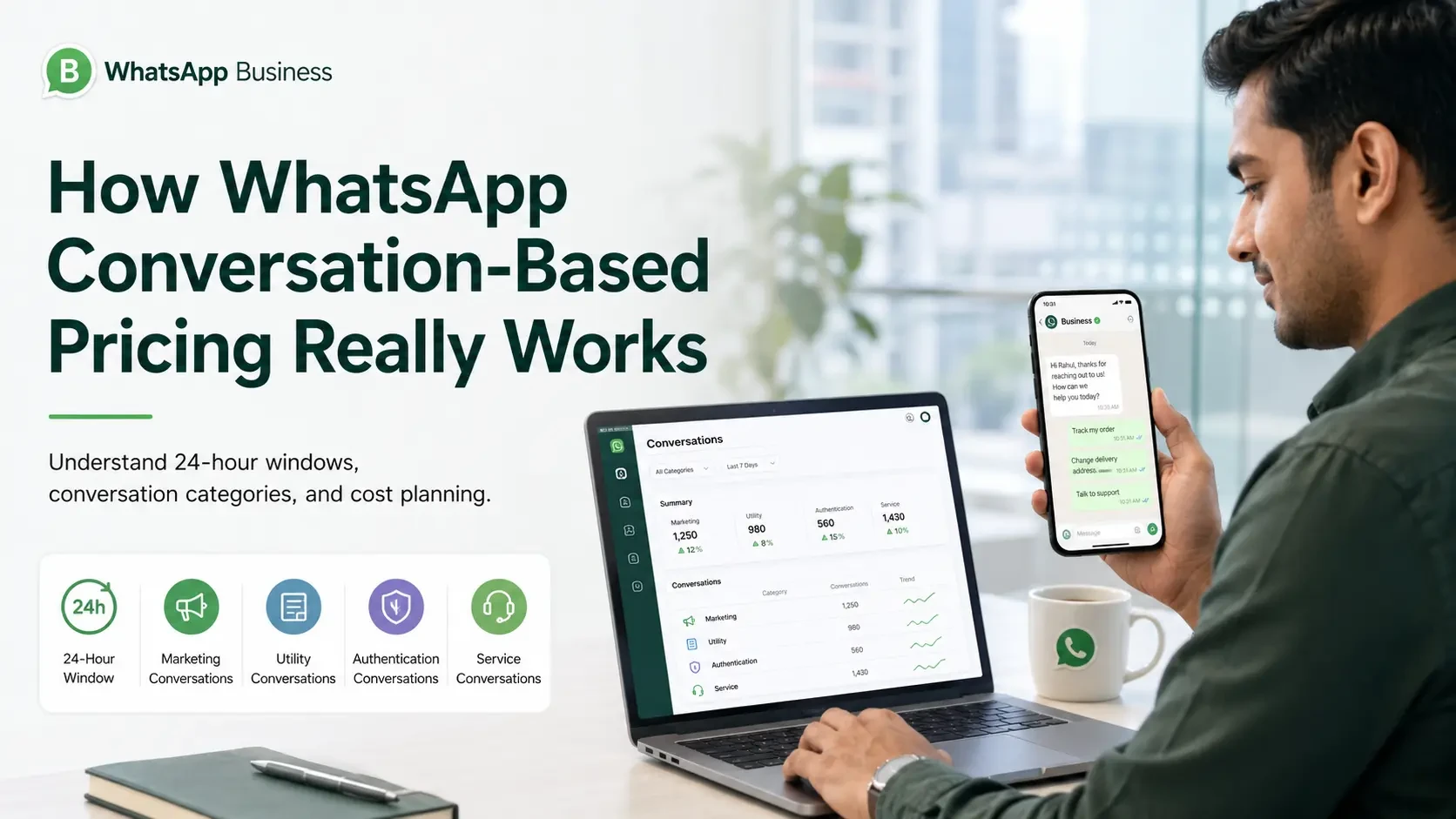
WhatsApp API pricing is conversation-based, not message-based.
This single fact confuses more Indian business owners than any other part of WhatsApp Business setup.
You do not pay per message sent. You pay per 24-hour conversation window opened - and within that window, you can send as many messages as you want at no extra Meta charge.
The four conversation categories
Meta defines four categories, each priced differently. Understanding which category your messages fall into is the difference between a predictable bill and an expensive surprise.
Marketing
Promotional content. Offers, campaigns, product launches, sale notifications, re-engagement.
Highest priced category. Designed to discourage spam.
Must use pre-approved Marketing template. Requires explicit user opt-in.
Utility
Transactional updates the customer expects after an action - order confirmation, shipping status, payment receipt, appointment reminders, account updates, delivery alerts.
Lower priced than Marketing.
Must use Utility template. Triggered by a user action or a documented business relationship.
Authentication
OTPs, two-factor codes, password resets, login verification.
Lowest priced outbound category.
Must use Authentication template. Strict format rules - no marketing content sneaked in.
Service
User-initiated conversations - when a customer messages you first.
Cheapest category. A wide free-entry window applies for service conversations (currently a generous monthly allowance applies to most BSP plans - verify your specific plan).
When you respond within the 24-hour window after a user message, you do not need a template - you can send any content.
The 24-hour window
When a user messages your business, a 24-hour service conversation window opens.
Within this window - you can reply with any content (text, images, documents, voice, lists, buttons) without a template, often at low or zero cost depending on your plan.
After 24 hours - you must use a pre-approved template to message the user again. The template's category determines the new conversation cost.
How to estimate your monthly cost
Three numbers matter.
Estimated monthly conversations by category - marketing, utility, authentication, service. Be honest about what falls where.
Your BSP's rate card per category. Indian BSPs publish these; Meta's official rates are also public. Confirm current rates with your BSP - they change.
Your BSP's platform fees. Monthly platform fee. Sometimes a per-message markup. Sometimes bundled. Look at the full picture.
Rough monthly cost calculation - (conversations × rate per category) + platform fee. Simple in principle. Plan for 20 to 30 percent buffer for actual usage variance.
The BSP fee structure to watch
Indian BSPs commonly use one of three structures.
Per-message markup - adds a fixed amount on top of Meta's conversation rate. Simple to understand. Pricing scales linearly with volume.
Monthly platform fee + Meta passthrough - fixed monthly cost for the platform, Meta rates passed through at cost. Better for high-volume; worse for low-volume.
Bundled plans - fixed monthly fee includes a certain conversation volume; overage charged per conversation. Mid-range option.
Watch for - additional charges for AI conversations, dedicated number rental fees, team-seat fees, integration fees. The headline pricing is rarely the actual cost.
Real-world cost examples for Indian businesses
Approximate cost ranges to set expectations. Always confirm current rates with your BSP.
Small business - 2,000 conversations/month, mostly utility and service. Indicative cost typically falls in the lower thousands of rupees per month range, depending on BSP.
Mid-size business - 10,000 conversations/month, mix of marketing, utility, and service. Indicative cost typically in the mid-five-figure rupee range per month.
High-volume business - 50,000+ conversations/month with heavy marketing. Six-figure monthly cost, often negotiated with custom enterprise pricing.
Always run your specific numbers through current rate cards. Pricing changes - both Meta's and BSPs'.
Where money gets wasted
Three patterns waste WhatsApp spend consistently.
Sending marketing template messages to users who did not opt in - high block rate, quality rating drops, and the conversations were paid for.
Mislabelling marketing as utility - Meta catches this and reclassifies. Eventually leads to template rejections and reduced send limits.
Not using the 24-hour service window - businesses paying for fresh marketing conversations when they could have nudged within an existing service window.
The shift to make
Stop calculating WhatsApp cost like SMS - per message.
Start thinking in conversations - categorized correctly, opted-in properly, and timed within the 24-hour windows that minimize cost.
The Indian businesses with the lowest WhatsApp cost per outcome are not the ones with the cheapest BSP. They are the ones who designed their conversation flows to use the right category at the right time.
About the Author

Avni Chadha
Ready to orchestrate your AI future?
Converiqo AI helps you design, deploy, and scale automation workflows that move your business faster, leveraging specialized solutions like our AI bot platform for lead generation, customer self-service AI bot platform, employee self-service AI bot platform, retail omnichannel automation, and our detailed guides on how agentic AI bot platforms work in enterprises and cost structure of enterprise AI bot platforms. Connect with our team to see the platform in action and co-create the next chapter of intelligent operations.
Read More Blogs
Discover more insights and product updates curated by the Converiqo AI team.

Real ROI of Field Force Automation - Beyond the Activity Dashboard
Four metrics that show real field force automation ROI in India - productivity, data reliability, throughput, and field attrition - not just the activity dashboard.

Beat Planning Is the Highest-Leverage Field Force Capability - Here Is Why
Beat planning decides coverage, call frequency, and whether field time is productive. Why it is the single highest-leverage field force automation capability.
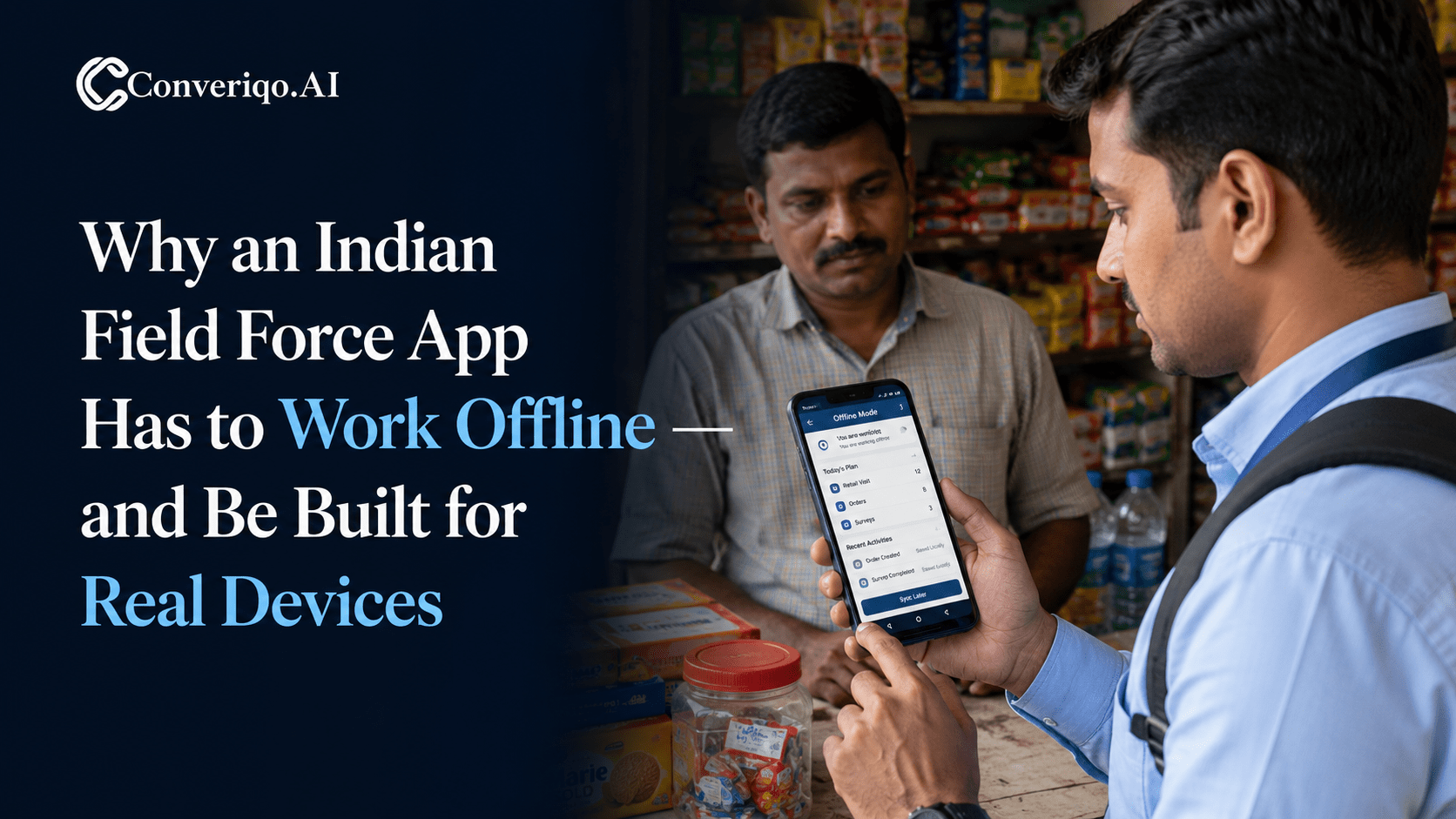
Why an Indian Field Force App Has to Work Offline - and Be Built for Real Devices
Field work in India happens where connectivity is intermittent. A field force app that assumes constant connectivity fails exactly where field work is done.