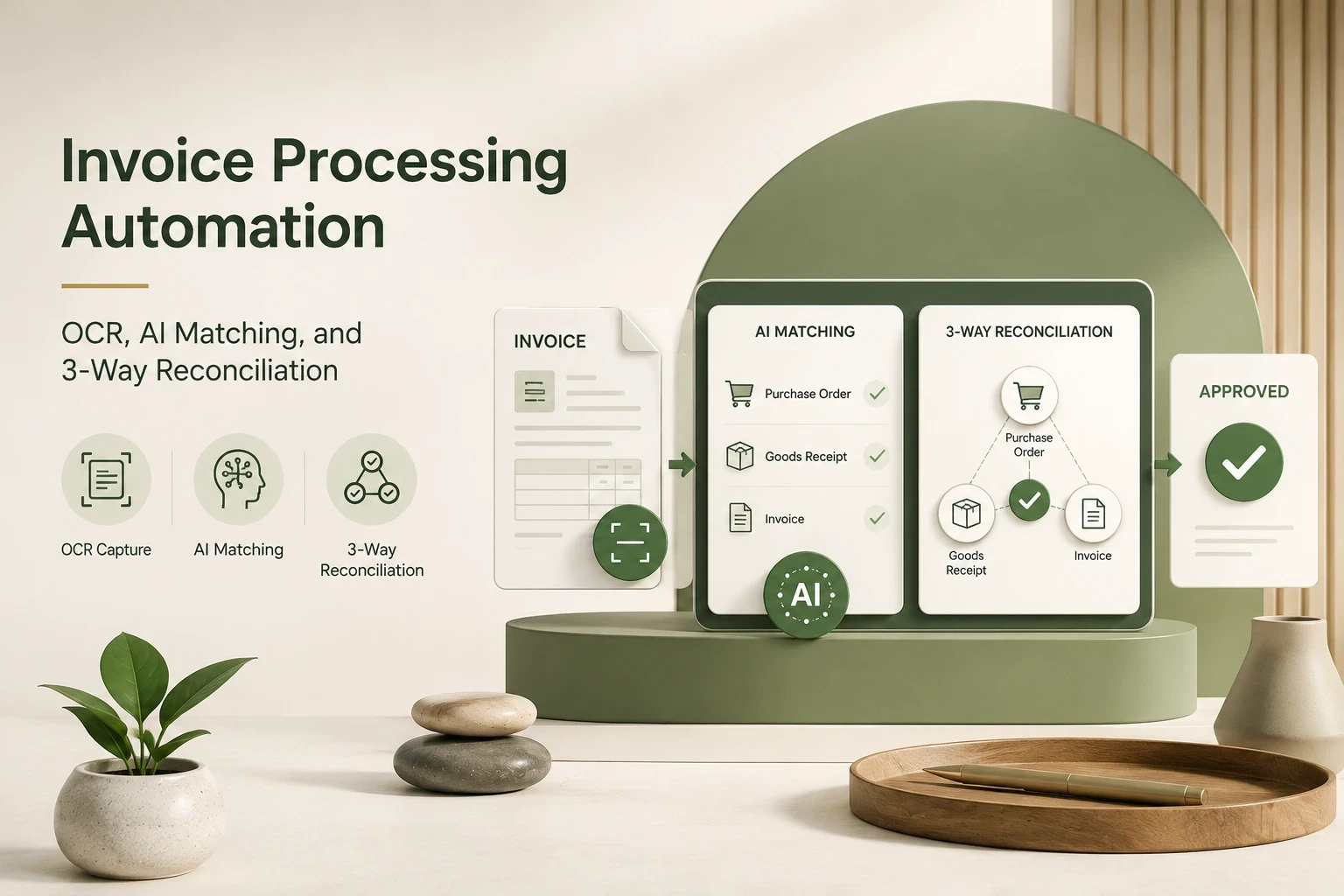
Invoice processing is the workflow stage where procurement automation visibly pays back the fastest. The accounts payable team in most Indian companies spends the majority of its time on three-way matching - checking that the PO, the GRN (Goods Receipt Note), and the invoice align on quantity, price, line items, GST amounts, and TDS applicability. The work is necessary, the work is high-volume, and the work is almost entirely amenable to automation in 2026.
Most Indian AP teams do this work manually. Each invoice gets opened, the corresponding PO pulled up in the ERP, the GRN pulled up from goods receipt records, the three documents compared side by side, the GST reconciliation done against the vendor's GSTR-2A or GSTR-2B for the period, the TDS section determined, the TDS amount calculated and deducted, the invoice posted into the ERP, and the payment scheduled. For a company processing 500 invoices a month, this is 200 to 400 hours of AP team time monthly - roughly two to three full-time equivalents working on a workflow that has known rules and known data sources.
What invoice processing automation actually covers
Five stages that automation handles end-to-end for the bulk of invoices, with human review only for exceptions.
Invoice ingestion. Invoices arrive through email (most commonly in India), the GST e-invoicing portal (mandatory for vendors above turnover threshold), vendor self-service portals (the parallel capability covered in the next pillar), or paper. The automation accepts all input formats. Email invoices get monitored on a shared inbox. E-invoices flow in as structured data from the IRP. Paper invoices get scanned and OCR-converted. The ingestion layer normalises these into one structured invoice format for downstream processing.
OCR and field extraction. For non-electronic invoices (PDF emails, paper scans), OCR extracts the structured data - vendor name and GSTIN, invoice number and date, line items with quantity and price, GST amounts by HSN code, TDS section if applicable, payment terms. Mature OCR engines for Indian invoices handle the variety of invoice templates that Indian vendors produce — there is no single 'invoice format' and the automation needs to handle this variety. Production-grade OCR accuracy on Indian invoices in 2026 runs 92% to 98% on standard fields.
Three-way matching. The extracted invoice data gets matched against the corresponding PO and GRN. Line items match on quantity, price, and description. Totals match. GST amounts match the HSN-applicable rates. Matches that pass all checks go straight through to posting. Mismatches get flagged as exceptions for AP review. Production three-way matching handles 70% to 85% of invoices straight-through in mature deployments, depending on the cleanliness of the PO data, the vendor invoice quality, and the matching rules tuning.
GST input credit reconciliation. Each purchase invoice gets matched against the vendor's GSTR-2A and GSTR-2B filings to verify that the input credit can actually be claimed. Mismatches - vendor has not filed yet, vendor filed with different invoice number, vendor filed with different GSTIN of buyer, etc. - get flagged for vendor pushback. Manual reconciliation produces 3% to 8% input credit leakage; automated reconciliation captures most of this and converts the leakage into actual claimed credit.
TDS determination and deduction. Each invoice gets evaluated for TDS applicability - Section 194C (contractor payments), Section 194I (rent), Section 194J (professional services), Section 194Q (goods purchase above threshold), Section 195 (non-resident payments), etc. The applicable rate gets calculated, the deduction applied, the TDS certificate prepared, and the data fed into the TDS return filing workflow. Manual TDS produces errors that surface in tax audits months later.
What makes Indian invoice processing automation distinctive
Three India-specific considerations that generic global invoice processing platforms often miss.
GST framework integration as first-class. GST is not an optional compliance add-on for Indian invoice processing - it is integral to the workflow. Input credit reconciliation against GSTR-2A/2B, HSN code validation, place-of-supply determination (intra-state vs inter-state, affecting IGST vs CGST+SGST), reverse charge mechanism handling for applicable categories. Generic global platforms that treat GST as 'tax handling' miss the depth of integration the Indian framework requires.
TDS as embedded workflow. TDS deduction and reporting is a workflow that runs inside invoice processing in India, not a separate accounting function. The procurement automation needs to determine applicability per invoice, deduct, generate the Form 16A or 16B certificate, and feed into Form 26Q/27Q return filing. Treating TDS as 'post-processing' produces errors and timing issues that automated handling avoids.
MSME 45-day clock. MSME-registered vendor invoices need to be paid within 45 days of acceptance. The procurement automation needs to identify MSME status at invoice processing (some platforms still treat MSME as a vendor-master-only flag and miss the per-invoice implication), start the 45-day clock at acceptance, alert before breach, and enforce payment scheduling. Most generic invoice processing platforms either miss this or treat it as a manual policy check.
What changes when invoice processing automation works
Five measurable shifts.
Invoice processing cost. Manual processing in Indian companies runs INR 250 to 1,200 per invoice. Automated processing with straight-through matching for 70-85% of invoices runs INR 50 to 150 per invoice. For a company processing 500 invoices monthly, the annual saving is INR 12 lakh to INR 60 lakh - visible cost reduction.
AP team capacity. The two to three FTEs currently consumed by manual three-way matching get redeployed to higher-value work - vendor relationship management, payment optimisation, treasury alignment, supplier rationalisation. The capacity does not disappear; it shifts to work the AP function should be doing but currently cannot.
GST input credit captured. The 3% to 8% input credit leakage from manual reconciliation reduces to under 1%. For a company with INR 80 crore monthly purchase volume at 18% GST, this is INR 1.4 to 3.7 crore additional input credit captured monthly - typically a larger number than the direct processing cost saving.
MSME compliance. The 18% MSME 45-day breach rate (a typical Indian baseline in companies without automation) drops to near-zero as the system enforces payment timing. Compound interest exposure and reputational risk go away. Companies in regulated sectors where MSME compliance is being audited (BFSI especially) see the compliance gap close fully.
Audit readiness. The audit trail for every invoice - the OCR extraction, the matching decision, the GST reconciliation, the TDS calculation, the payment scheduling - is queryable and exportable. Tax audits, internal audits, and sector-specific audits get satisfied with structured data rather than spreadsheets and email archives.
What invoice processing automation does not handle (and shouldn't)
Three categories worth naming explicitly.
Exception handling for genuinely complex cases. When invoice line items genuinely do not match the PO, when the GRN disputes the quantity received, when the vendor has billed for items outside the contract scope - these are judgement cases that need AP team review. Automation that tries to force-resolve genuine exceptions produces worse outcomes than automation that surfaces them for human judgement. The 15-30% exception queue is appropriate and not a sign of automation failure.
Vendor dispute negotiation. Disagreements with vendors over price, quality, delivery, or contract interpretation are commercial negotiations that humans handle. The automation should surface the dispute (the matching failure that triggered it) and provide context (PO terms, GRN data, contract clauses) but should not attempt automated negotiation. Vendor relationships need human stewardship at decision points.
Fraud detection beyond rule-based checks. Automation can catch obvious anomalies - duplicate invoices, invoices to non-existent vendors, line items priced significantly above contract or market. Sophisticated procurement fraud - collusion between buyer and vendor, structured invoice splitting to evade approval thresholds, kickback schemes - requires investigative work beyond rule-based detection. Treat automation as a control layer that surfaces signals; treat investigative response as a separate function with proper governance.
About the Author

Yash Soni
Ready to orchestrate your AI future?
Converiqo AI helps you design, deploy, and scale automation workflows that move your business faster, leveraging specialized solutions like our AI bot platform for lead generation, customer self-service AI bot platform, employee self-service AI bot platform, retail omnichannel automation, and our detailed guides on how agentic AI bot platforms work in enterprises and cost structure of enterprise AI bot platforms. Connect with our team to see the platform in action and co-create the next chapter of intelligent operations.
Read More Blogs
Discover more insights and product updates curated by the Converiqo AI team.

Real ROI of Field Force Automation - Beyond the Activity Dashboard
Four metrics that show real field force automation ROI in India - productivity, data reliability, throughput, and field attrition - not just the activity dashboard.

Beat Planning Is the Highest-Leverage Field Force Capability - Here Is Why
Beat planning decides coverage, call frequency, and whether field time is productive. Why it is the single highest-leverage field force automation capability.
Why an Indian Field Force App Has to Work Offline - and Be Built for Real Devices
Field work in India happens where connectivity is intermittent. A field force app that assumes constant connectivity fails exactly where field work is done.