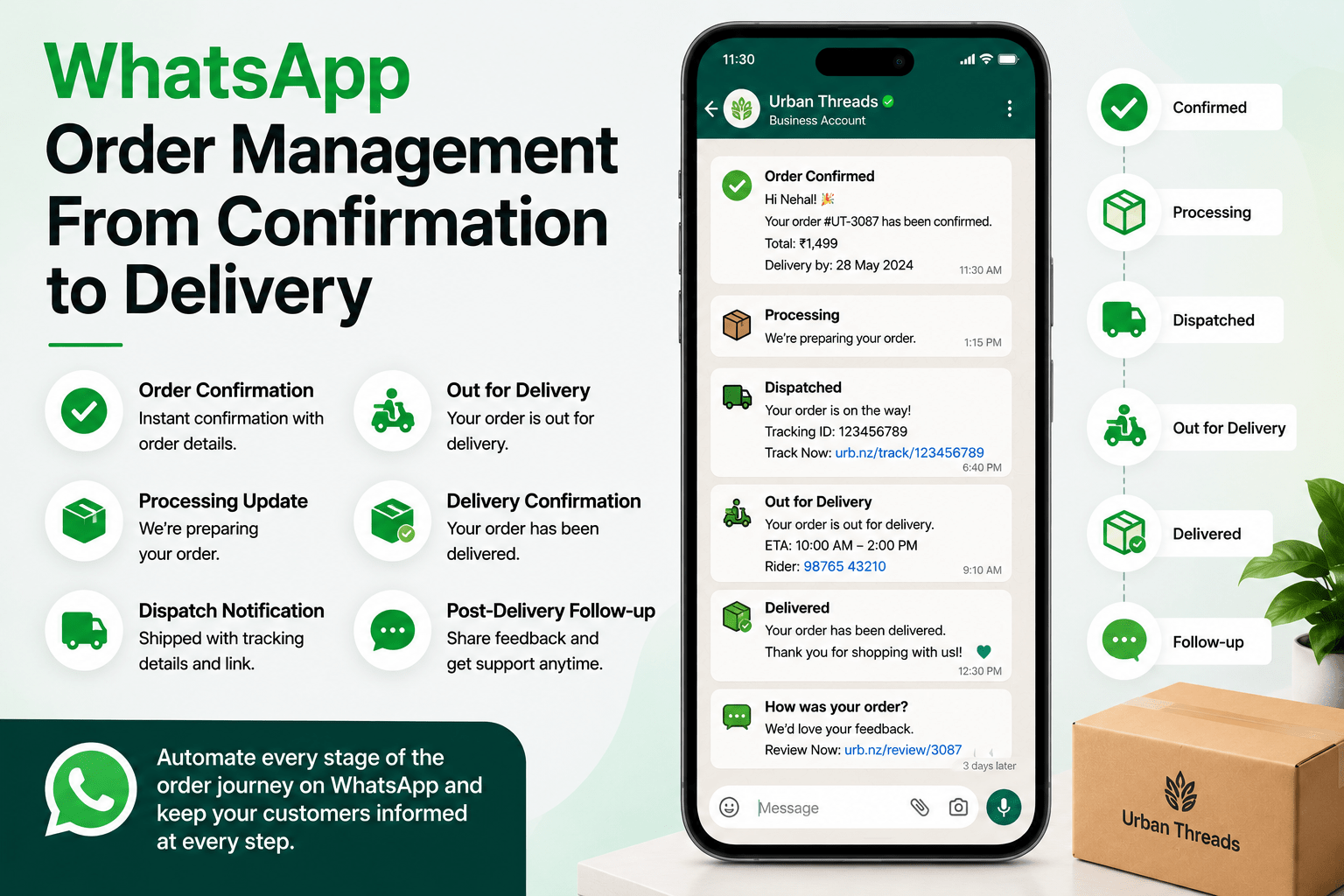
An order on WhatsApp is the start of a workflow, not the end of one.
The customer expects acknowledgement within seconds, updates through dispatch and delivery, and clear visibility into where their order is at every stage.
Done well, the post-order experience on WhatsApp is smoother than what most Indian e-commerce websites deliver - because the customer does not have to log in, hunt for their order, or check email for status updates. The updates come to them, in the conversation that already exists.
Done badly, the post-order experience is silence - until the customer messages asking where their order is, and a staff member has to look it up manually.
The stages and what each one needs to do
Stage 1 - Order confirmation (within 30 seconds of payment)
An automated message that confirms - order number, items, total amount, delivery address, expected delivery date.
What works - clear, structured, scannable. Customer can verify everything is correct without typing back.
What does not - silence. Or a confirmation that takes minutes because a staff member has to send it manually. The customer's anxiety window starts at payment and ends at confirmation. Keep it short.
Stage 2 - Processing update (within a few hours, optional)
Order is in the warehouse, being prepared. Brief reassurance message.
Most retailers skip this stage. For high-value orders or for first-time customers, it adds confidence.
Stage 3 - Dispatch notification
Order has been handed to logistics. Includes - tracking number, logistics partner name, expected delivery date, tracking link.
What works - the tracking link should be one tap, no login required, mobile-friendly. Some logistics partners' tracking pages are not - in which case, a re-skinned tracking view inside WhatsApp (through a Flow or a hosted tracking page) is the better path.
Stage 4 - Out for delivery
The day-of-delivery notification. Approximate delivery window if available. Phone number of the delivery agent if the logistics partner provides it.
What works - proactive. The customer should know the delivery is happening before the delivery agent calls them.
Stage 5 - Delivery confirmation
Automated message confirming delivery, with - order details one more time, what to do if there is an issue, and a hook for feedback or review.
Stage 6 - Post-delivery follow-up (3 to 7 days later)
Check-in. How was the product. Any issues. Request for review or feedback. Sometimes a cross-sell or replenishment offer where relevant.
What automation makes possible
Every message in this sequence can be automated. The triggers come from - payment gateway webhook (for confirmation), order management system (for processing), logistics partner webhook (for dispatch, out-for-delivery, delivery), and a scheduled workflow (for post-delivery follow-up).
No staff intervention needed for the standard happy path. Staff get involved only when something deviates - failed delivery, returns request, customer asks a question the bot cannot answer.
Handling exceptions
Failed delivery
Logistics tried to deliver, customer was not available. Automated message with options - reschedule, change address, return to sender. Each option is a structured response, not free text.
Wrong product or damage
Returns flow triggered. Photos of the issue uploaded inside the chat. Return shipping label generated. Refund timeline communicated.
Customer query during transit
Customer asks where their order is. The bot looks up the latest tracking status and replies with current location, expected delivery, and tracking link.
Integration is everything here
Order management on WhatsApp without integration is just chat. Order management on WhatsApp with proper integration is operational software.
Required integrations - order management system or ERP, payment gateway, logistics aggregator, inventory system, and CRM. Most automation platforms support these integrations out of the box. If yours does not, the setup quickly becomes manual and error-prone.
The shift to make
Stop treating WhatsApp orders as conversations you handle in batches.
Start treating them as transactions that flow through an automated, integrated, end-to-end workflow - from payment confirmation to delivery to post-delivery follow-up.
When this works, customers stop messaging to ask where their order is. The information reaches them before they need to ask. That alone reduces customer service load measurably.
About the Author

Ankur Singh
Ready to orchestrate your AI future?
Converiqo AI helps you design, deploy, and scale automation workflows that move your business faster, leveraging specialized solutions like our AI bot platform for lead generation, customer self-service AI bot platform, employee self-service AI bot platform, retail omnichannel automation, and our detailed guides on how agentic AI bot platforms work in enterprises and cost structure of enterprise AI bot platforms. Connect with our team to see the platform in action and co-create the next chapter of intelligent operations.
Read More Blogs
Discover more insights and product updates curated by the Converiqo AI team.

Real ROI of Field Force Automation - Beyond the Activity Dashboard
Four metrics that show real field force automation ROI in India - productivity, data reliability, throughput, and field attrition - not just the activity dashboard.

Beat Planning Is the Highest-Leverage Field Force Capability - Here Is Why
Beat planning decides coverage, call frequency, and whether field time is productive. Why it is the single highest-leverage field force automation capability.
Why an Indian Field Force App Has to Work Offline - and Be Built for Real Devices
Field work in India happens where connectivity is intermittent. A field force app that assumes constant connectivity fails exactly where field work is done.