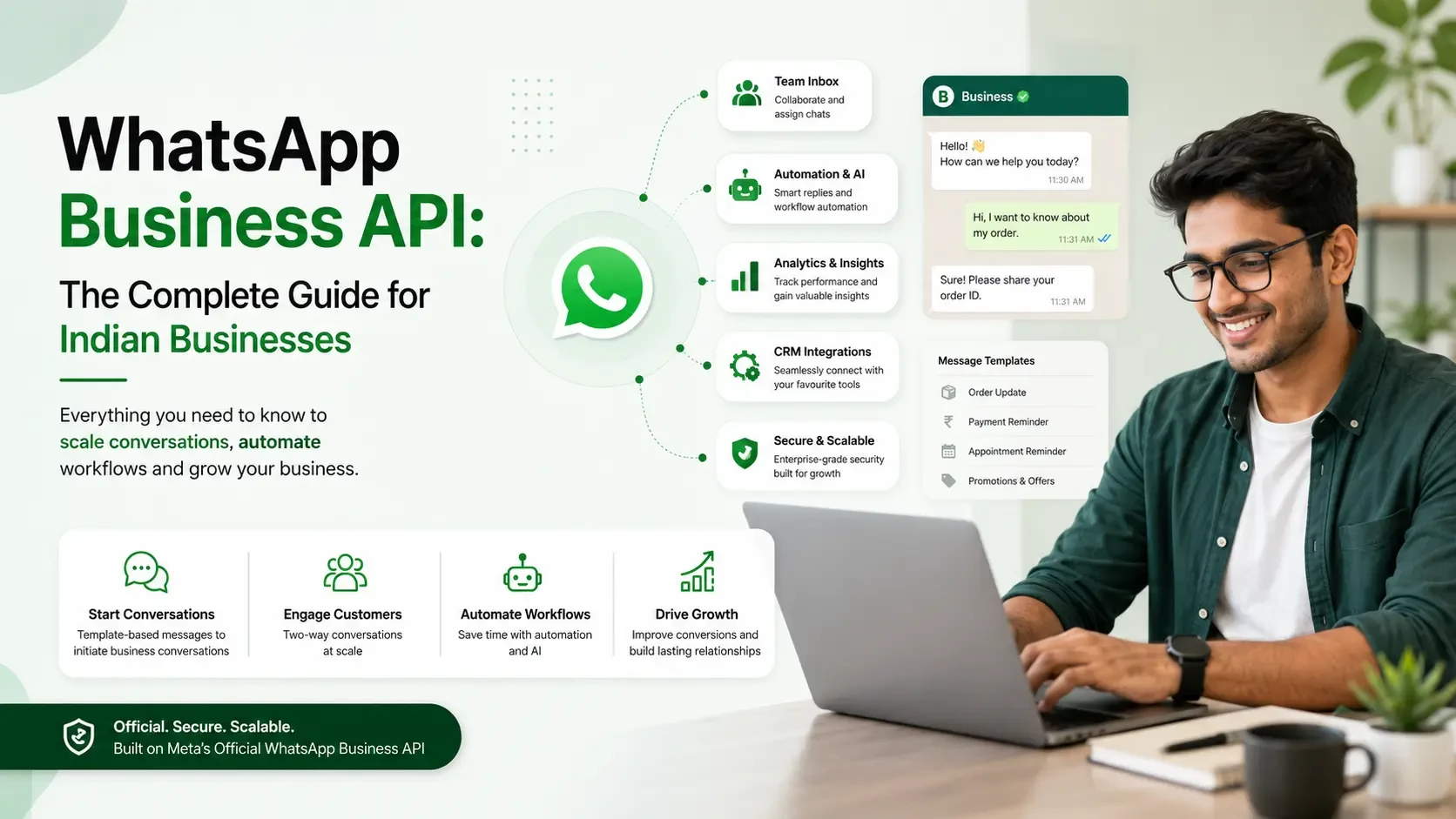
WhatsApp is not a channel for Indian businesses.
It is the customer-facing surface.
Customers do not email you. They do not always call. They WhatsApp.
Leads come through WhatsApp. Orders get confirmed on WhatsApp. Payments get followed up on WhatsApp. Complaints land on WhatsApp. Reminders go out on WhatsApp. Renewals close on WhatsApp.
India runs on it. Over 500 million WhatsApp users. Almost every adult with a phone. Tier 1, Tier 2, Tier 3, rural - same platform.
Yet most Indian businesses are using WhatsApp at a fraction of what it can actually do - because the difference between WhatsApp Business app and WhatsApp Business API is invisible until someone explains it.
This guide is that explanation. What the API actually is. What it can and cannot do. What it costs. What compliance you need. And what changes when you switch from the consumer app or the Business app to the API layer underneath.
The three layers of WhatsApp for business
Most business owners think there is one WhatsApp. There are three.
Layer 1 - WhatsApp (consumer app)
The personal app. Free. Designed for individuals.
Many small businesses still run on this - the owner's personal WhatsApp, used for customer chats. Works at very low volume. Falls apart fast as soon as the business scales.
Risks - using a personal number for business means the number cannot be reassigned, message history is locked to one phone, and Meta's policies allow account suspension for high-volume business use on personal accounts.
Layer 2 - WhatsApp Business app
The free app for small businesses. A step up from the consumer app - business profile, catalogue, quick replies, labels, simple automations.
Works for businesses with one or two people handling chats. Breaks at scale because - only one device active at a time, no real automation logic, no integration with CRM or other systems, no team-routing, no AI.
Most Indian businesses outgrow the Business app within their first 500 to 1,000 monthly customer conversations.
Layer 3 - WhatsApp Business API
Not an app. A backend integration layer that lets your systems - CRM, support tool, e-commerce platform, custom-built workflow - send and receive WhatsApp messages programmatically.
What this unlocks - multiple agents handling the same number simultaneously, full automation logic, CRM integration, broadcast at scale (with consent), template messages for marketing and utility flows, agentic AI handling conversations end-to-end without human handoff for routine queries.
The API is what every serious business eventually needs. The question is when to switch and how.
When to switch from Business app to API
Three signals consistently point to the switch being overdue.
1. More than one person handles WhatsApp
The Business app allows one device active at a time (companion devices exist but limited). The moment two people need to handle chats simultaneously, you have outgrown the app.
Most Indian businesses hit this around 500 to 1,000 monthly conversations or 5 to 10 active chats at once.
2. You want automation beyond auto-reply
The Business app supports basic auto-replies and quick replies. It does not support - qualification flows, routing logic, conditional follow-ups, integration with your CRM or booking system, AI-handled conversations, cart abandonment recovery.
If you want any of these, the API is the only path.
3. You want to do outbound messaging at scale
Broadcasting on the Business app is heavily restricted - capped at 256 contacts per broadcast, only contacts who saved your number. Designed to prevent spam.
The API allows broadcast to opted-in customers using template messages, with compliance. This is necessary the moment you want to send order updates, booking reminders, payment links, or marketing campaigns at scale.
How WhatsApp Business API pricing actually works
WhatsApp API pricing is conversation-based, not message-based - and this confuses most Indian business owners.
Conversation categories
Meta defines four conversation categories - each priced differently.
Marketing - promotional messages, offers, campaigns. Highest priced.
Utility - transactional updates customers expect (order confirmation, shipping, payment receipts). Lower priced.
Authentication - OTPs and login codes. Lowest priced.
Service - user-initiated conversations (customer messages you first). Lowest cost - and a wide free entry-point window applies.
Indian rates as of 2026
Rates change. Always verify current pricing in your BSP dashboard or Meta's official rate card. But the general shape - Marketing conversations cost the most, Utility costs less, Authentication and Service are cheapest. All priced per 24-hour conversation window, not per message.
The hidden cost - your BSP
You access the API through a Business Solution Provider (BSP) like Gupshup, Wati, AiSensy, Interakt, or platform partners like Converiqo. BSPs add their own platform fees on top of Meta's conversation rates.
Indian BSPs typically charge - a platform fee (monthly or per-message markup) plus Meta's conversation rate. Some bundle. Some don't. Comparison shopping is necessary.
What you can send - and what gets you banned
Template messages (outbound)
When you message a customer first (outside the 24-hour service window), you must use a pre-approved template message. Meta reviews and approves each template before you can use it.
Template categories - marketing, utility, authentication. Each has rules about what content is allowed.
Templates can include variables (customer name, order ID, amount), buttons (Call, URL, Quick Reply), media (images, documents, video), and quick reply options.
Session messages (inbound and response)
When a customer messages you first, you have a 24-hour window to respond with any content - no template needed. This is the service conversation window.
Almost any content works here - text, images, documents, voice notes, location, contact cards, interactive lists, buttons.
What gets you banned
Messaging users without consent. Marketing templates sent to users who haven't opted in. High block-rate from recipients. Spam-like patterns. Misleading template content. Sending utility-style messages that are actually marketing.
Meta tracks quality ratings on every business number. Numbers with low quality ratings get throttled - you can still send, but to fewer recipients per day. Repeated violations lead to permanent ban.
The Indian compliance layer - DPDP, opt-in, and consent
India's Digital Personal Data Protection Act (DPDP) makes consent explicit for processing personal data - including WhatsApp numbers used for marketing or non-essential business communication.
Practical requirements for WhatsApp marketing in India in 2026 -
-
explicit opt-in for marketing messages, separately from terms of service
-
documented opt-in record (timestamp, source, what user agreed to)
-
easy opt-out mechanism in every marketing message
-
honoured opt-outs immediately - repeat marketing after opt-out is a clear violation
-
purpose limitation - collected for X, used for X, not repurposed
-
data retention discipline - don't keep WhatsApp data indefinitely without legal basis
Indian regulators are starting to enforce. Penalties under DPDP can reach significant amounts. Compliance is no longer optional even for small businesses.
What WhatsApp API + agentic AI actually unlocks
The API by itself is plumbing. It lets messages flow. It does not handle conversations.
Agentic AI sits on top of the API. The combination is where the operational change happens.
Without AI - humans handle every WhatsApp conversation. Even with the API, you need a team to respond.
With agentic AI - the AI handles routine conversations end-to-end. Lead qualification. Booking confirmation. Order status. FAQs. Payment reminders. The human team handles only what the AI escalates - typically 20 to 40 percent of total volume, depending on the business.
What this changes for an Indian business - response time drops from hours to seconds, 24x7 coverage without night-shift staffing, handling of regional language queries (Hindi, Tamil, Bengali, Telugu, Marathi, Kannada), conversation history persists across team members, and integration with your CRM means the AI knows context the human would have to look up.
Use cases that work consistently on WhatsApp
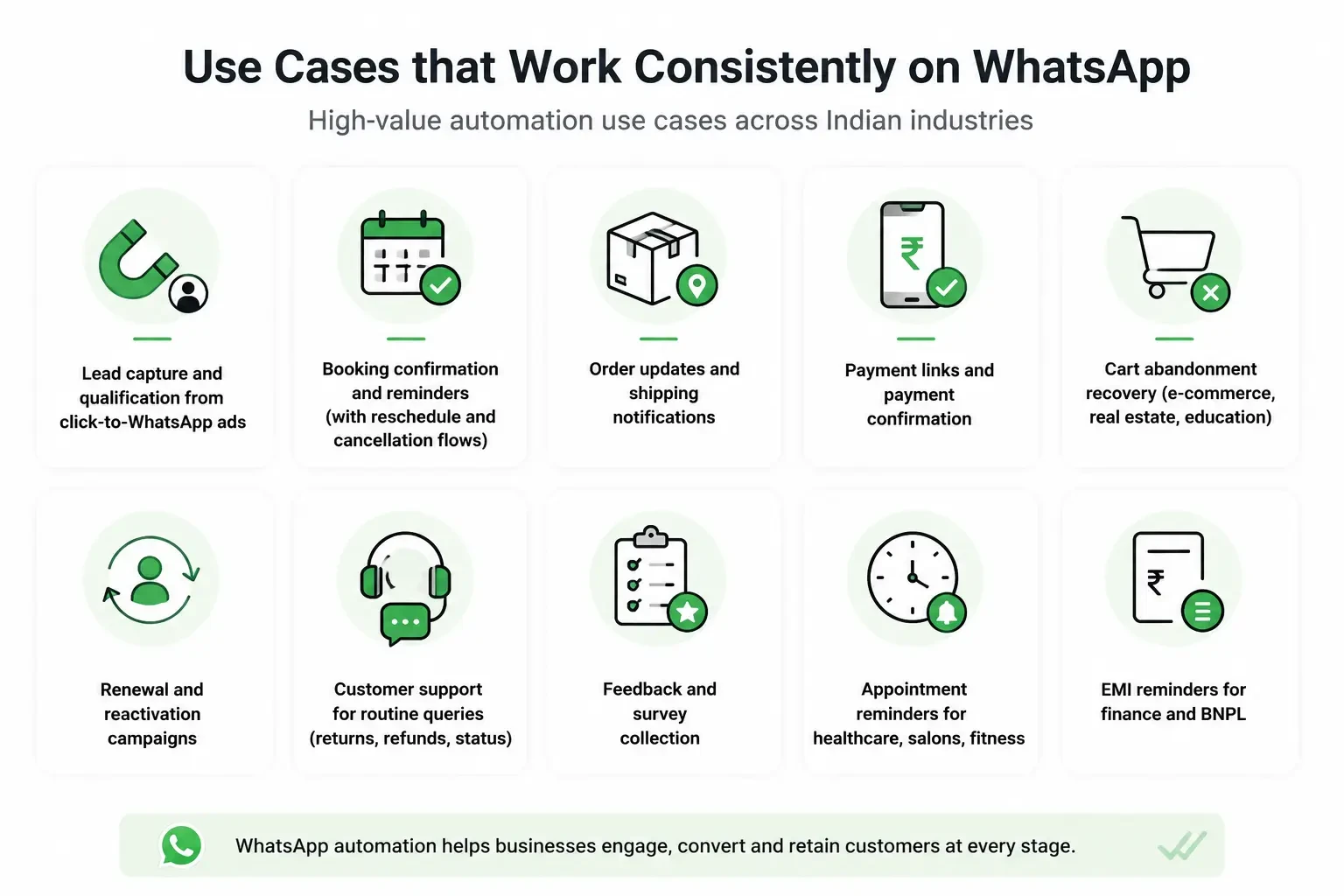
Across Indian industries, the highest-ROI WhatsApp automation use cases are remarkably consistent.
-
lead capture and qualification from click-to-WhatsApp ads
-
booking confirmation and reminders (with reschedule and cancellation flows)
-
order updates and shipping notifications
-
payment links and payment confirmation
-
cart abandonment recovery (e-commerce, real estate, education)
-
renewal and reactivation campaigns
-
customer support for routine queries (returns, refunds, status)
-
feedback and survey collection
-
appointment reminders for healthcare, salons, fitness
-
EMI reminders for finance and BNPL
Use cases that do not work on WhatsApp
Equally important to know what fails.
-
long-form content delivery (people skim WhatsApp, they do not read)
-
complex multi-step forms (better as web forms with WhatsApp follow-up)
-
decision-heavy purchases needing extensive research (use website + WhatsApp for clarification)
-
high-emotion complaints requiring human empathy from the first message
-
audio-heavy content for users who do not have data to download voice messages
Channel-fit matters. The decision is rarely 'WhatsApp or nothing' - it is 'WhatsApp for which parts of the journey.'
Common mistakes Indian businesses make
Treating WhatsApp like SMS
WhatsApp is a conversation channel, not a broadcast channel. Businesses that treat it like SMS - bulk promotional messages, no conversation backbone - see high opt-out rates and quality rating drops.
Not investing in template approval discipline
Each template gets reviewed. Bad templates get rejected. Businesses that don't take template writing seriously waste weeks on approval cycles.
Hoping the personal WhatsApp will scale
Personal numbers running business chats eventually break - either through suspension or through chaos as the volume grows. Switch to API earlier than you think.
Underestimating quality rating
Quality rating affects how many messages per day you can send. A drop from High to Medium to Low quality cuts your daily send limit substantially. Recovery is slow.
Forgetting language
Indian customers respond differently to English-only WhatsApp messages versus Hindi or regional language. Most automation platforms still default to English. Multi-language matters more for India than for Western markets.
The shift to make
Stop treating WhatsApp as a side channel handled by whoever has time.
Start treating it as the primary customer-facing surface it actually is for Indian businesses - with the API underneath, agentic AI on top, compliance handled deliberately, and a strategy for which parts of your funnel run on it.
The Indian businesses growing fastest right now are the ones who got this right two to three years ago. The window to catch up is still open. It is not getting wider.
Frequently asked questions
Can I use my existing WhatsApp Business number for the API?
Yes, but the number gets migrated - it leaves the Business app and lives on the API after migration. You cannot use it on both simultaneously. Plan the switch with continuity in mind.
Do I need to be a large business to use the API?
No. Small businesses with 500 to 1,000 monthly conversations often get more value from the API than larger ones. The pricing scales - you pay for what you use.
How long does API onboarding take?
Through a good BSP - 2 to 7 working days for number verification, business verification, and template approvals. Through a poorly-set-up provider, it can take weeks.
Will customers see my chats as 'Business' or 'verified'?
Numbers on the API are marked as Business by default. The green verified tick (official business account) is a separate, more selective process - granted by Meta based on brand prominence, not automatically.
Can I migrate from one BSP to another later?
Yes. WhatsApp allows BSP migration. Data portability varies - templates usually port; conversation history sometimes does not. Plan ahead if migration is likely.
What is the minimum monthly cost?
Through Indian BSPs, basic plans typically start in the low thousands of rupees per month, plus conversation costs. Above that, pricing scales with conversation volume and add-on features. AI-handled conversation pricing is sometimes bundled, sometimes separate.
About the Author

Md Ashik Alam
Ready to orchestrate your AI future?
Converiqo AI helps you design, deploy, and scale automation workflows that move your business faster, leveraging specialized solutions like our AI bot platform for lead generation, customer self-service AI bot platform, employee self-service AI bot platform, retail omnichannel automation, and our detailed guides on how agentic AI bot platforms work in enterprises and cost structure of enterprise AI bot platforms. Connect with our team to see the platform in action and co-create the next chapter of intelligent operations.
Read More Blogs
Discover more insights and product updates curated by the Converiqo AI team.
Real ROI of Field Force Automation - Beyond the Activity Dashboard
Four metrics that show real field force automation ROI in India - productivity, data reliability, throughput, and field attrition - not just the activity dashboard.
Beat Planning Is the Highest-Leverage Field Force Capability - Here Is Why
Beat planning decides coverage, call frequency, and whether field time is productive. Why it is the single highest-leverage field force automation capability.
Why an Indian Field Force App Has to Work Offline - and Be Built for Real Devices
Field work in India happens where connectivity is intermittent. A field force app that assumes constant connectivity fails exactly where field work is done.