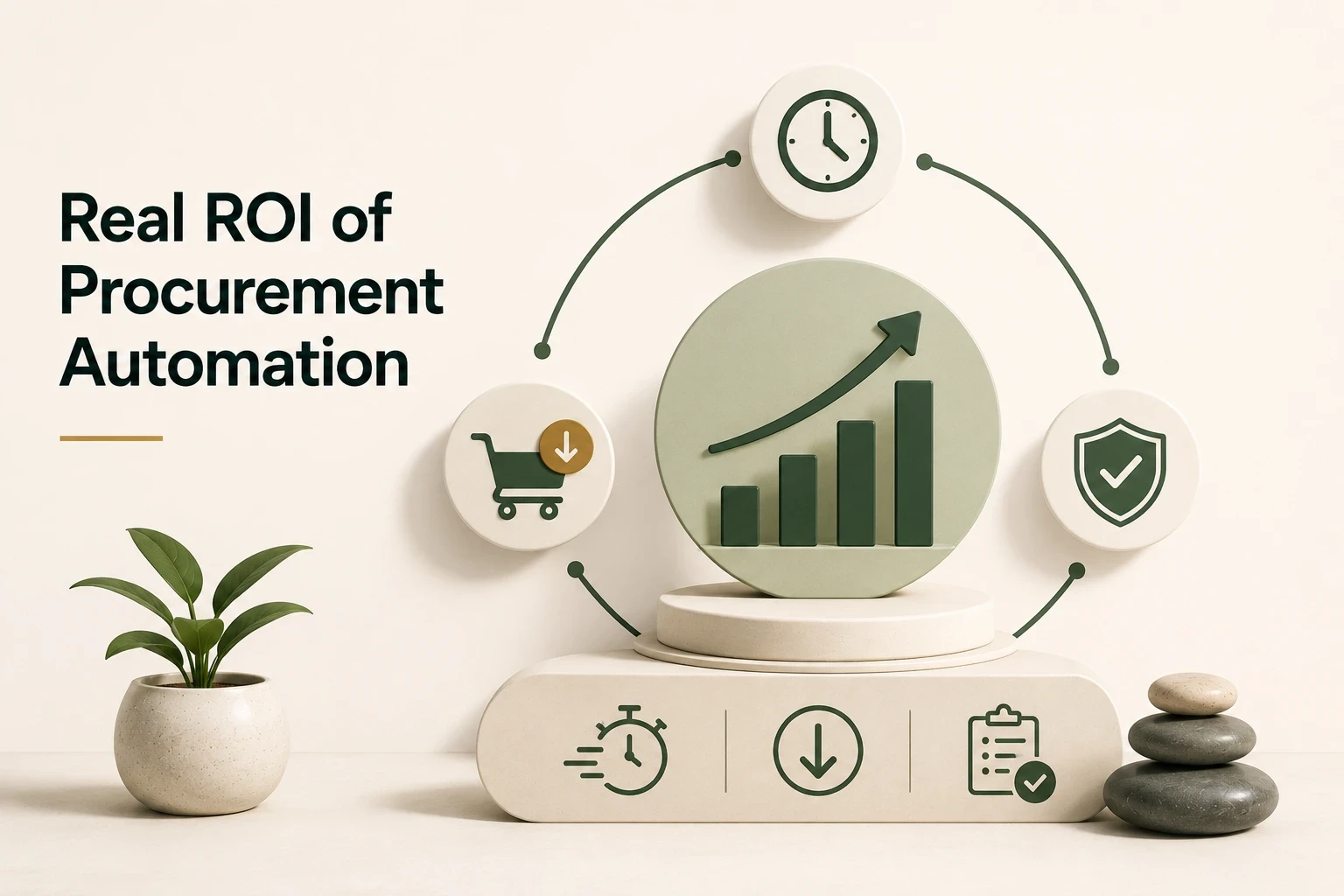
Most ROI calculations for procurement automation that Indian companies see during vendor evaluations focus on a single metric - accounts payable team headcount reduction through invoice processing automation. The vendor projects that automation handles X% of invoices straight-through, removes Y AP positions, and saves Z lakh per month. Show that, declare ROI.
This framing is incomplete in a specific way. It treats automation as a transactional cost-reduction exercise - fewer people processing the same invoices - and misses the larger ROI dimensions that often matter more over 12 to 24 months. The full ROI picture requires five metrics, used together.
Metric 1 - Procure-to-pay cycle time
Time from purchase request raised to vendor payment released. The end-to-end cycle metric that captures whether the orchestration is actually working.
Indian baselines. Companies with only PO approval automated typically run 6 to 10 weeks. Companies with full procurement automation deployed and tuned run 2 to 4 weeks. The compression of 3 to 6 weeks per cycle has a working capital impact that often exceeds the visible cost savings - for an INR 100 crore procurement budget with quarterly average payable balance, the working capital release from cycle time compression can be INR 8 to 20 crore.
Tracking discipline. Measure end-to-end (request raised to payment released), not just the visible stages. Many companies track only PO-creation-to-payment and miss the upstream intake stage where significant cycle time accumulates. The full cycle is what affects working capital and vendor relationships.
Metric 2 - Maverick spend rate
Share of total spend that occurs outside negotiated contracts and approved procurement processes. The metric that captures procurement effectiveness most directly.
Indian baselines: 15% to 35% in companies without spend analytics visibility. Mature automation reduces this to 5% to 15%. The maverick spend is typically paid at rates 8% to 25% above contracted rates, so a 20-point reduction in maverick spend rate translates to roughly 2% to 5% reduction in total procurement spend cost. For an INR 100 crore procurement budget, this is INR 2 to 5 crore annually.
Beyond the direct cost. The maverick spend reduction also restores procurement's negotiation leverage. Vendors who knew they could get incremental off-contract business at premium rates now have to compete on the contracted rate. The next contract negotiation cycle starts from a stronger position.
Metric 3 - Contract savings realisation
Share of negotiated contract savings that actually shows up in paid prices. The metric that closes the loop between procurement strategy and procurement execution.
Indian baselines: 60% to 80% in companies without contract intelligence at invoice processing. Mature automation lifts this to 90%+. The 10-30 point lift translates directly to procurement spend reduction at the rate the negotiated savings were originally projected.
Why most companies under-track. Contract savings realisation requires comparing actual paid prices against negotiated contract rates at invoice processing. Manual reconciliation does not catch the deviations consistently. The negotiation team often does not get feedback on what stuck and what eroded. The metric tells the team what worked, which informs the next negotiation cycle.
Metric 4 - Cost per invoice processed
Total accounts payable cost (salaries, infrastructure, processing platform fees, automation platform fees) divided by invoices processed. The unit economics number.
Indian baselines: INR 250 to INR 1,200 per invoice depending on volume, current automation depth, and AP team operating model. Mature automation reduces this to INR 50 to INR 150 per invoice as straight-through processing handles 70% to 85% of invoices and the AP team handles only exceptions. For a company processing 500 invoices monthly, the annual saving is INR 12 lakh to INR 60 lakh.
This is the metric vendors emphasise because it is the most visible direct saving. It is real and important, but it is typically a smaller number than the cycle time impact or the maverick spend reduction or the GST input credit capture.
Metric 5 - Compliance violation rate
Share of transactions that breach GST, TDS, MSME 45-day, or sector-specific procurement requirements. The metric that captures risk-adjusted ROI.
Most Indian companies do not track this systematically until an audit surfaces violations. The exposure is real but invisible in routine reporting. Mature automation drives the violation rate to near-zero by enforcing compliance at workflow points rather than relying on post-transaction review.
Quantifying the risk-adjusted value. GST input credit leakage averages 3% to 8% of input credit value in manual environments. For a company with INR 100 crore annual GST input credit, this is INR 3 to 8 crore annually that automated reconciliation captures. MSME compound interest exposure on 18% breach rate (a common Indian baseline) for INR 50 crore MSME spend is INR 50 lakh to INR 1.5 crore annually. Sector regulator violations carry varying penalties but increasingly include reputational and licensing consequences. The risk-adjusted compliance value often exceeds all direct cost savings combined.
Hidden costs the vendors do not mention
Three.
Implementation effort. Quoted license fees exclude integration cost. Real implementation includes ERP integration (SAP, Oracle, Tally, Zoho Books, Microsoft Dynamics, etc., each with their own integration realities), contract repository ingestion and clause extraction tuning, vendor master cleanup, category taxonomy alignment, GST reconciliation setup, TDS rule configuration, sector-specific compliance setup, AP team training, business unit communication. For Indian mid-sized operations, this is typically 300 to 600 hours of internal effort plus INR 8 to 25 lakh of consulting in the first 90 to 120 days.
Ongoing tuning. Procurement rules and contract terms change. New categories emerge. New compliance requirements appear (GST framework updates, MSME rules, sector regulator changes). Plan for 20 to 30 hours per month of internal effort on platform tuning, typically the procurement operations lead with vendor support.
Vendor onboarding and training. Bringing the SMB vendor base - particularly Tier 2 and Tier 3 vendors - onto the automation framework (electronic invoicing, vendor self-service, MSME status submission) takes time and effort. Some vendors are initially resistant or unable to engage with electronic processes. The vendor onboarding effort is real and should be planned for over 6 to 12 months.
Payback period
For Indian companies with 500+ monthly invoices or INR 50 crore+ annual addressable spend, typical payback is 5 to 11 months. Variance comes from current baseline metrics (worse baselines means bigger improvements), ERP integration complexity (Indian-built platforms typically integrate faster than global), and spend mix (high MSME content increases the compliance and working capital value).
Below INR 10 to 15 crore annual addressable spend, the orchestration overhead typically exceeds the value. ERP-based PO approval with strong process discipline often delivers better unit economics at small scale. Between INR 15 to 50 crore, automation pays off if MSME content or GST complexity makes the compliance dimension material. Above INR 50 crore, automation becomes essential for any kind of consistent procurement effectiveness and audit-clean operations.
About the Author

Avni Chadha
Ready to orchestrate your AI future?
Converiqo AI helps you design, deploy, and scale automation workflows that move your business faster, leveraging specialized solutions like our AI bot platform for lead generation, customer self-service AI bot platform, employee self-service AI bot platform, retail omnichannel automation, and our detailed guides on how agentic AI bot platforms work in enterprises and cost structure of enterprise AI bot platforms. Connect with our team to see the platform in action and co-create the next chapter of intelligent operations.
Read More Blogs
Discover more insights and product updates curated by the Converiqo AI team.

Real ROI of Field Force Automation - Beyond the Activity Dashboard
Four metrics that show real field force automation ROI in India - productivity, data reliability, throughput, and field attrition - not just the activity dashboard.

Beat Planning Is the Highest-Leverage Field Force Capability - Here Is Why
Beat planning decides coverage, call frequency, and whether field time is productive. Why it is the single highest-leverage field force automation capability.
Why an Indian Field Force App Has to Work Offline - and Be Built for Real Devices
Field work in India happens where connectivity is intermittent. A field force app that assumes constant connectivity fails exactly where field work is done.