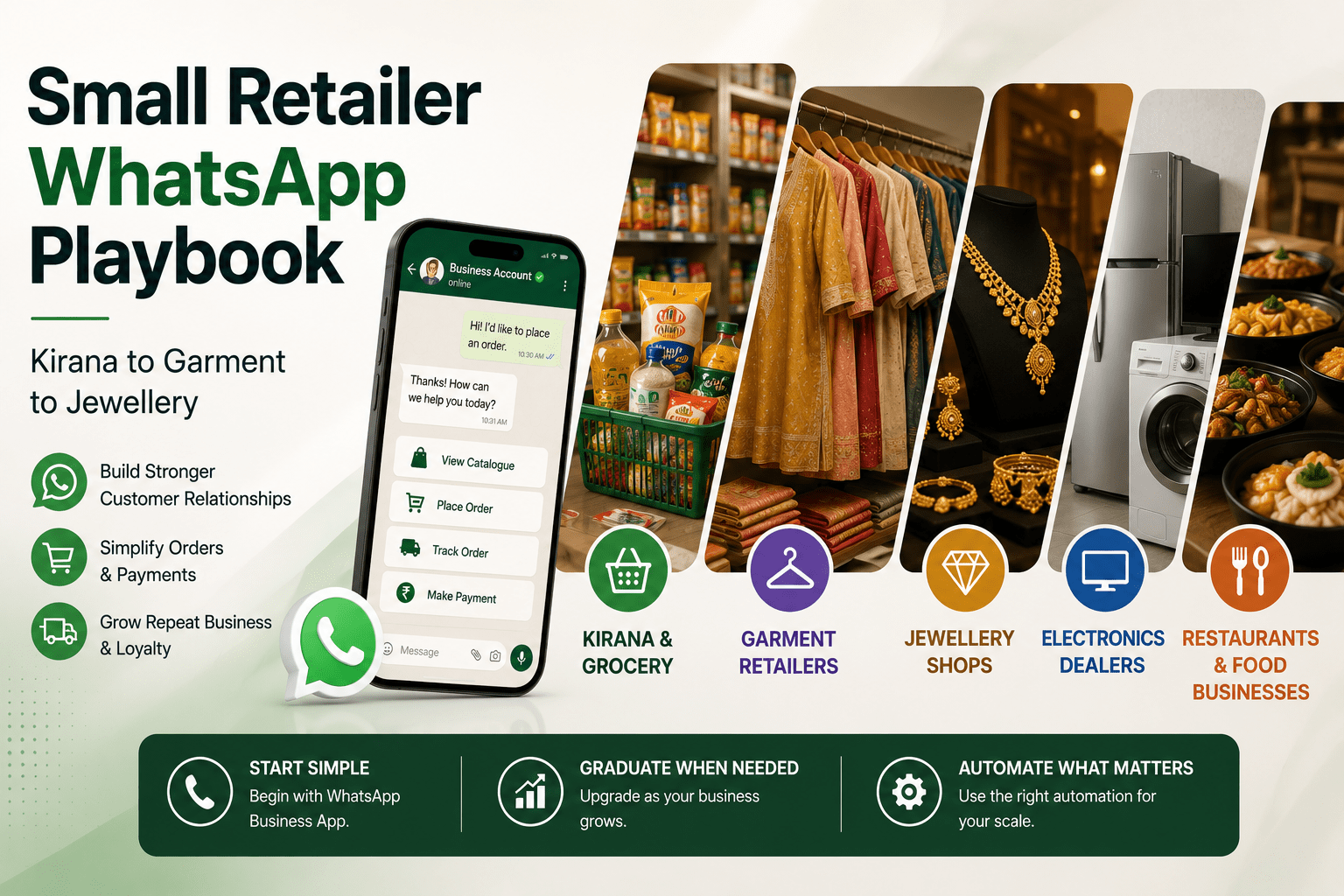
Most WhatsApp commerce content is written for D2C brands and mid-market retailers.
Small Indian retailers - the kirana shop, the standalone garment store, the family jewellery shop, the local electronics dealer - operate differently. Different customer relationships, different volumes, different teams, different economics.
Here is the practical WhatsApp playbook for small retailers in India, by category.
Kirana and grocery shops
Many kirana stores already take orders over WhatsApp. Customer messages a list. Owner replies with availability. Delivery boy is sent. Payment is collected on delivery or via UPI.
What upgrading looks like - a structured order flow instead of free-text lists. A simple product catalogue for top SKUs (oils, atta, sugar, daily essentials). Inventory awareness so out-of-stock items are not promised. Automated order confirmation. UPI link instead of asking customers to send proof of payment.
What does not need upgrading at small kirana scale - heavy automation, integration with ERP, complex cart flows. The economics of small kirana do not justify the platform cost for those layers yet.
Right tools - WhatsApp Business app is often sufficient up to a few hundred orders per month. Beyond that, a basic automation layer pays off.
Standalone garment retailers
Indian garment retail on WhatsApp is one of the strongest fits. Customers want to see products, ask questions, get advice on combinations and sizing - all before buying.
Strong garment retailer playbook -
-
WhatsApp catalogue with curated bestsellers, organised by category (sarees, kurtis, men's wear, formal, casual)
-
high-quality product photos with both flat-lay and on-model views
-
fabric descriptions and size guides that handle the most common questions
-
Flow-based size selection that captures size, colour, quantity in one structured step
-
human salesperson handover for high-ticket items (bridal, occasion wear) - the AI handles browsing, human handles closing
-
WhatsApp-only offers timed around festivals and seasons
Jewellery shops
Jewellery on WhatsApp combines high trust requirements with high consideration - customers research extensively before buying.
Strong jewellery playbook -
-
catalogue limited to a curated set - not the full inventory, but the pieces the shop wants to lead with
-
detailed descriptions covering metal purity (gold karat), weight, certification (BIS, hallmark), design source
-
video calls scheduled through WhatsApp for high-value pieces - customer sees the piece on video before deciding
-
appointment booking for in-store visits, with reminder workflow
-
post-purchase service workflow - repair, polishing, exchange, valuation reminders for insurance
-
festive and wedding-season campaigns that are timed precisely
The customer relationship in jewellery is multi-decade. The WhatsApp setup should reflect that - not a hard-sell channel, but a relationship-management channel.
Local electronics and appliance dealers
Electronics customers want to compare specifications, get clear pricing, and understand warranty and after-sales support before committing.
Strong electronics dealer playbook -
-
catalogue of current stock with full specifications, MRP, and selling price
-
comparison capability - customer can ask 'which TV under X budget' and get a structured response
-
EMI options surfaced clearly (most electronics customers want EMI information up front)
-
warranty and after-sales support information available in the conversation
-
post-installation follow-up workflow
-
festive offer campaigns - Diwali, Republic Day, end-of-financial-year
Restaurants and food businesses
Restaurants on WhatsApp run differently from product retailers. The catalogue is a menu. The order is time-sensitive. Customisation matters.
Strong restaurant playbook -
-
menu catalogue updated daily for items in/out of stock
-
structured order flow - pick items, customise, confirm address, pay
-
reasonable response time on order confirmation given kitchen capacity
-
delivery tracking, even if simple (your order is being prepared, your order is on the way)
-
post-meal feedback request
-
promotions timed for lunch, dinner, weekends, festivals
What is common across all small retailer categories
Three principles that apply regardless of category.
First - start with WhatsApp Business app, not the API. The free app is enough for the first few hundred conversations per month. Spending money on API and automation before the volume justifies it is wasted capital.
Second - graduate when volume forces it. The graduation triggers - staff spending more than 2 hours daily replying manually, conversations being missed, customers complaining about delays, or volume above a few hundred orders monthly.
Third - the automation layer should match the business's actual complexity. Most small retailers do not need everything a large D2C brand needs. They need the basics done well - catalogue, order capture, payment, confirmation, basic tracking.
The shift to make
Stop assuming WhatsApp commerce is only for D2C brands with millions in revenue.
Start treating it as the operating system for any small Indian retailer who is already taking orders over chat — with the right amount of structure, automation, and integration for the scale of the business.
The retailers who do this well in 2026 will quietly outcompete the ones who keep running WhatsApp on a single phone with no structure. The technology is mature. The economics work. The customer is already on the channel.
About the Author

Md Ashik Alam
Ready to orchestrate your AI future?
Converiqo AI helps you design, deploy, and scale automation workflows that move your business faster, leveraging specialized solutions like our AI bot platform for lead generation, customer self-service AI bot platform, employee self-service AI bot platform, retail omnichannel automation, and our detailed guides on how agentic AI bot platforms work in enterprises and cost structure of enterprise AI bot platforms. Connect with our team to see the platform in action and co-create the next chapter of intelligent operations.
Read More Blogs
Discover more insights and product updates curated by the Converiqo AI team.

Real ROI of Field Force Automation - Beyond the Activity Dashboard
Four metrics that show real field force automation ROI in India - productivity, data reliability, throughput, and field attrition - not just the activity dashboard.

Beat Planning Is the Highest-Leverage Field Force Capability - Here Is Why
Beat planning decides coverage, call frequency, and whether field time is productive. Why it is the single highest-leverage field force automation capability.
Why an Indian Field Force App Has to Work Offline - and Be Built for Real Devices
Field work in India happens where connectivity is intermittent. A field force app that assumes constant connectivity fails exactly where field work is done.