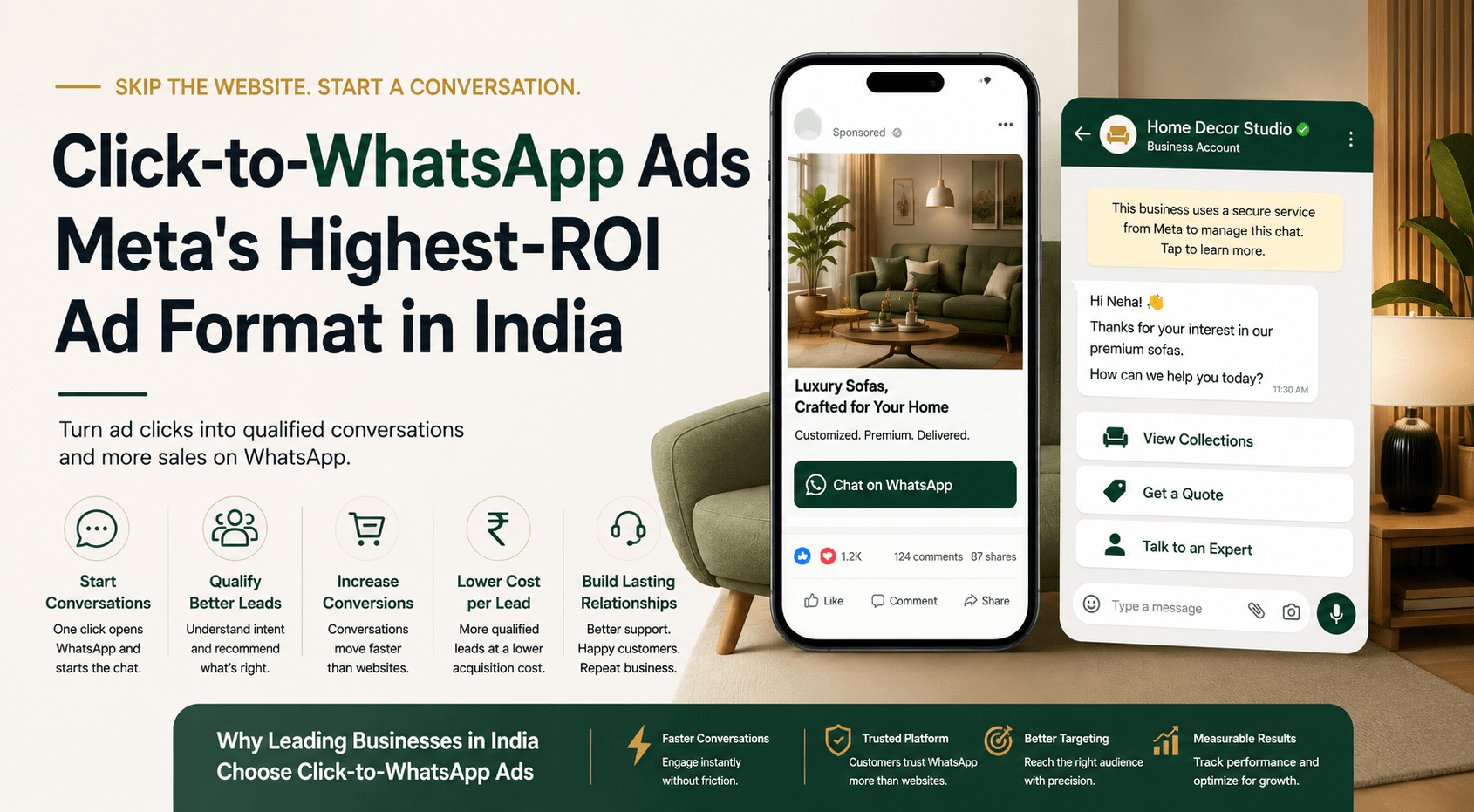
Click-to-WhatsApp ads - also called click-to-message ads or CTWA - have become Meta's highest-ROI ad format for many Indian businesses.
They appear on Facebook and Instagram. When a user clicks the ad, instead of going to a website, WhatsApp opens with a conversation already started with the business.
For Indian businesses, this is often the single most efficient customer acquisition channel available. Here is why they work and how to actually run them well.
Why CTWA ads outperform website-link ads in India
Three reasons specific to the Indian market.
Reason 1 - funnel collapse. A website-link ad asks the user to land on a page, find the relevant product, fill in details, possibly create an account, navigate to checkout, and complete payment. Each step loses a meaningful share of users. A CTWA ad collapses the funnel to two steps - click and converse. The conversation can carry the user from question to purchase in minutes.
Reason 2 - trust transfer. Most Indian users have a higher baseline trust in WhatsApp conversations than in unfamiliar checkout pages. The ad takes them from advertising context to a more trusted context immediately.
Reason 3 - mobile-first reality. For most Indian internet users, the primary surface is the mobile phone. WhatsApp is already running. A website might load slowly on patchy 4G. The conversation surface is faster, more familiar, and lower-friction.
Where CTWA ads work best
Specific use cases where CTWA consistently outperforms alternatives -
-
high-consideration purchases that benefit from conversation (jewellery, real estate, education, insurance, B2B services)
-
products where size, fit, or configuration matters (apparel, footwear, eyewear, customised items)
-
businesses where customer service touch is part of the value (D2C brands, premium retailers)
-
categories where COD is the dominant payment method and trust matters (Tier 2 and Tier 3 markets)
-
businesses with a strong sales team that can convert warm leads (auto dealers, real estate brokers, education counsellors)
Where CTWA ads work less well
-
very low-ticket impulse purchases where conversation friction outweighs convenience
-
products where the customer wants to compare extensively before buying (consumer electronics with many specs)
-
businesses without a strong response capability - if CTWA leads land in WhatsApp and no one responds for 6 hours, the ROI collapses
-
categories where Meta has stricter ad policies (alcohol, tobacco, financial products without proper licensing)
What separates a good CTWA campaign from a bad one
1. The ad creative sets the conversation up
The creative should make the post-click conversation obvious. If the ad shows a specific product, the conversation should start with that product. If the ad offers a quote, the first message should ask the qualifying questions.
Mismatched creative and conversation kills conversion.
2. Response time matters
The first response from your side should be within seconds - ideally automated and contextual. Customers who arrive from an ad expect immediate engagement. A response that takes 2 hours converts substantially worse.
3. The first message has to qualify
Not interrogate. Qualify. A good first message acknowledges the interest, asks one or two specific questions that help you understand fit, and moves the conversation forward.
Bad first message - "Welcome to ABC Retailers. How can we help you today?" Generic, requires the customer to do all the work.
Better first message - "Thanks for your interest in our wedding collection. Quick question to help me show you the most relevant pieces - are you shopping for a bride or a guest?"
4. The handover from bot to human happens cleanly
Most CTWA conversations have a hybrid handling - automation for early qualification, human for final close. The handover should be invisible to the customer. The human picks up with full context of the conversation, not from scratch.
5. Re-engagement of dormant leads
Many CTWA leads do not convert immediately. They go quiet. A 24-hour re-engagement message - within Meta's rules and the customer's opt-in scope - recovers a meaningful share.
Costs and economics
Cost per CTWA conversation in India depends heavily on targeting, creative quality, and competition in the category. For well-targeted campaigns in active categories, the cost per qualified conversation is often dramatically lower than the equivalent cost per qualified lead through website-link campaigns.
Where it goes wrong - broad targeting, weak creative, no automation to handle scale, slow human response. These compound and turn CTWA from a high-ROI channel into a wasted budget.
The shift to make
Stop running website-link ads as the default and CTWA ads as a 'let's try this' experiment.
Start treating CTWA as the primary ad format for any business where conversation is part of the sale - which, in India, is most businesses.
The Indian businesses that have moved heavily into CTWA in the last two years are quietly outcompeting the ones that have not. The cost of customer acquisition is lower. The qualification is better. The conversion is higher. The only reason most businesses have not made this shift fully is because the operational capability behind the conversation - automation, integration, fast response - needs to be in place.
About the Author

Md Ashik Alam
Ready to orchestrate your AI future?
Converiqo AI helps you design, deploy, and scale automation workflows that move your business faster, leveraging specialized solutions like our AI bot platform for lead generation, customer self-service AI bot platform, employee self-service AI bot platform, retail omnichannel automation, and our detailed guides on how agentic AI bot platforms work in enterprises and cost structure of enterprise AI bot platforms. Connect with our team to see the platform in action and co-create the next chapter of intelligent operations.
Read More Blogs
Discover more insights and product updates curated by the Converiqo AI team.
Real ROI of Field Force Automation - Beyond the Activity Dashboard
Four metrics that show real field force automation ROI in India - productivity, data reliability, throughput, and field attrition - not just the activity dashboard.
Beat Planning Is the Highest-Leverage Field Force Capability - Here Is Why
Beat planning decides coverage, call frequency, and whether field time is productive. Why it is the single highest-leverage field force automation capability.
Why an Indian Field Force App Has to Work Offline - and Be Built for Real Devices
Field work in India happens where connectivity is intermittent. A field force app that assumes constant connectivity fails exactly where field work is done.