
When procurement slows down, teams often blame volume.
But volume is usually not the real root cause.
The bigger problem is workflow friction.
Here are nine common procurement bottlenecks that slow teams down:
1. Unstructured purchase requests
Requests come in with missing fields, unclear justification, or inconsistent formats.
2. Manual approval chasing
Approvals depend on inbox follow-ups instead of system-driven routing.
3. Policy checks happen too late
Compliance is reviewed after work has already moved instead of inside the workflow.
4. Preferred supplier usage is inconsistent
Requesters bypass compliant buying routes because guidance is weak.
5. Sourcing coordination is fragmented
RFQ and RFP processes take longer because communication and comparison are not centralized.
6. PO visibility is poor
Teams cannot easily see where a purchase order is delayed or what stage it is in.
7. Contract obligations and renewals are missed
Key terms, timelines, and renewal events are not monitored closely enough.
8. Invoice mismatch handling is reactive
Teams only discover problems when invoices are already causing payment issues.
9. Reporting arrives too late
Spend, approval delays, and exception patterns are visible after the problem, not during it.
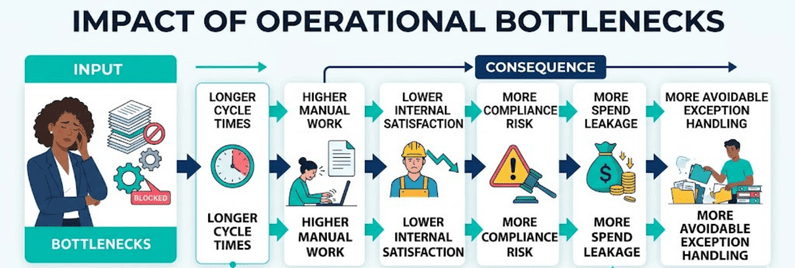 What these bottlenecks cost
These issues drive:
- longer cycle times
- higher manual work
- lower internal satisfaction
- more compliance risk
- more spend leakage
- more avoidable exception handling
How automation helps
Automation improves bottlenecks by:
- standardizing request intake
- routing approvals automatically
- enforcing policy earlier
- guiding compliant buying
- making workflow status visible
- flagging exceptions earlier
- improving analytics and accountability
Conclusion
Procurement does not become faster just because teams work harder.
It becomes faster when the workflow gets redesigned.
Review My Procurement Workflow
FAQ
What are the most common procurement bottlenecks?
Common bottlenecks include unstructured requests manual approvals delayed policy checks poor visibility and fragmented sourcing workflows.
Why do procurement processes slow down as volume increases?
Processes slow down because manual workflows do not scale leading to delays inconsistencies and higher follow up effort.
How does automation reduce procurement bottlenecks?
Automation standardizes workflows improves visibility routes approvals automatically and reduces manual coordination.
Which procurement stage should be optimized first?
Organizations should start with request intake approval workflows and visibility into purchase order status.
How can procurement teams improve workflow visibility?
By using centralized systems that track request status approvals and exceptions in real time instead of relying on email or spreadsheets.
About the Author
Ankur Singh
Ready to orchestrate your AI future?
Converiqo AI helps you design, deploy, and scale automation workflows that move your business faster, leveraging specialized solutions like our AI bot platform for lead generation, customer self-service AI bot platform, employee self-service AI bot platform, retail omnichannel automation, and our detailed guides on how agentic AI bot platforms work in enterprises and cost structure of enterprise AI bot platforms. Connect with our team to see the platform in action and co-create the next chapter of intelligent operations.
Read More Blogs
Discover more insights and product updates curated by the Converiqo AI team.

Real ROI of Field Force Automation - Beyond the Activity Dashboard
Four metrics that show real field force automation ROI in India - productivity, data reliability, throughput, and field attrition - not just the activity dashboard.

Beat Planning Is the Highest-Leverage Field Force Capability - Here Is Why
Beat planning decides coverage, call frequency, and whether field time is productive. Why it is the single highest-leverage field force automation capability.

Why an Indian Field Force App Has to Work Offline - and Be Built for Real Devices
Field work in India happens where connectivity is intermittent. A field force app that assumes constant connectivity fails exactly where field work is done.