One of the most common mistakes businesses make in conversational AI is asking the wrong first question.
They ask:
“Which bot should we buy?”
Website chatbot?
WhatsApp bot?
AI voicebot?
That sounds reasonable, but it skips the real issue.
The right question is:
“Which channel best fits the buyer behavior, urgency, and next step we need to convert?”
Because no single channel wins every time.
A website chatbot is not automatically better than WhatsApp.
WhatsApp is not automatically better than voice.
And voice is not automatically the answer just because it feels high-touch.
What actually converts better is channel-to-workflow fit.
If your business wants more qualified leads, better booking rates, and lower response leakage, you need to understand what each channel does well, where it underperforms, and how to combine them without creating fragmented conversations.
The short answer
If you want a quick answer:
-
Website chatbot is usually strongest for converting active website traffic while intent is hottest.
-
WhatsApp bot is usually strongest for ongoing follow-up, low-friction re-engagement, and high-response conversational nurture.
-
AI voicebot is usually strongest when urgency is high, the interaction is time-sensitive, or the next step depends on spoken confirmation or assisted booking.
The best-performing setup for many businesses is not single-channel.
It is an omnichannel workflow where channels play different roles in the same conversion journey.
What a website chatbot does best
A website chatbot works best when the buyer is already on your site and needs help taking the next step now.
That may include:
-
understanding your service
-
asking about pricing or scope
-
checking availability
-
clarifying fit
-
choosing the right option
-
sharing enquiry details
-
requesting a callback or demo
Why website chat performs well:
-
the visitor is already in your environment
-
the bot can respond based on page context
-
conversion can happen before the visitor leaves
-
the handoff to form, booking, or sales can be immediate
Website chatbot usually wins for:
-
B2B SaaS demo capture
-
IT services inquiry capture
-
product discovery
-
service qualification
-
real estate project pages
-
high-intent landing pages
-
first-touch FAQ plus lead capture
Where it often underperforms:
-
when the visitor leaves and no follow-up channel is connected
-
when the chatbot is too generic
-
when it asks too many questions too early
-
when it does not connect to booking or routing
-
when mobile visitors prefer messaging over website forms
A website chatbot is strongest at the moment of active browsing. Its biggest weakness is what happens after the visitor exits unless another workflow takes over.
What a WhatsApp bot does best
WhatsApp is usually the strongest channel for response continuity.
Why?
Because the conversation does not disappear when the website session ends.
The buyer can reply later.
The business can follow up later.
Documents, location pins, reminders, and quick confirmations can happen in the same thread.
WhatsApp often performs well for:
-
admissions enquiries
-
clinic appointment requests
-
event and hospitality enquiries
-
local service businesses
-
real estate follow-up
-
automotive sales follow-up
-
retail assisted buying
-
quote-based services
-
appointment reminders and re-engagement
Why it converts well:
-
buyers are already comfortable using it
-
response friction is low
-
follow-up feels more natural than email
-
booking reminders and nudges are easier
-
conversation history stays accessible
Where it underperforms:
-
when the business uses it like an unstructured support inbox
-
when routing logic is weak
-
when every lead gets the same message
-
when qualification is too shallow
-
when teams do not distinguish hot leads from casual enquiries
WhatsApp is not powerful because it is trendy.
It is powerful because it reduces the friction between first inquiry and ongoing engagement.
What an AI voicebot does best
Voice works best where immediacy matters.
A voicebot can be especially effective when:
-
the buyer wants a fast answer without typing
-
the interaction is urgent
-
the business depends on call-based inbound demand
-
appointments or confirmations need faster handling
-
operating hours and call volumes create response gaps
-
customers are more comfortable speaking than writing
Voicebot usually wins for:
-
call center environments
-
clinics and healthcare scheduling
-
service center bookings
-
field service dispatch
-
high-volume phone enquiries
-
after-hours call capture
-
callback automation
-
multilingual phone support
Why voice can outperform chat in some journeys:
-
spoken interactions can feel faster
-
urgency is easier to handle
-
buyers can complete actions without navigating screens
-
high-intent prospects often call when they want immediate movement
Where it underperforms:
-
when the use case needs visual content or documents
-
when buyers prefer to review details in text
-
when the business has not designed good handoff logic
-
when voice is deployed as a rigid IVR replacement instead of conversational workflow
A voicebot should not be treated like a fancier IVR.
Its real value is handling intent, qualification, routing, and booking in moments where delay is expensive.
Which channel converts better by business type?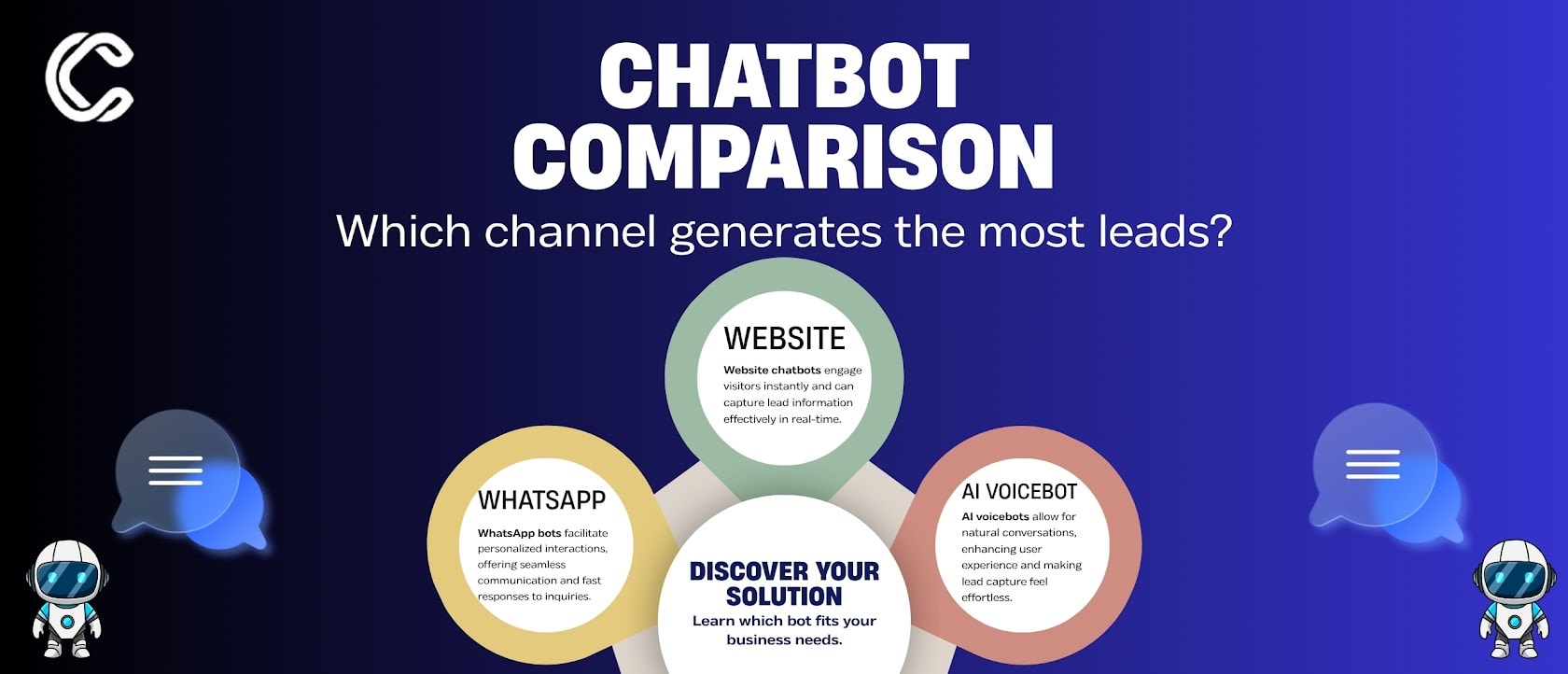
The best answer depends on the business motion.
For B2B SaaS and enterprise services
Website chatbot often wins first-touch conversion because buyers usually discover the product on the website first. WhatsApp can support follow-up later if the market expects it. Voice is less often the first conversion channel unless callback speed is central.
For education and admissions
WhatsApp usually becomes the operational workhorse. Students and parents ask repeated questions, need reminders, and often respond better to messaging continuity. Website chat is useful for capture. Voice can support callbacks and counseling confirmation.
For healthcare and clinics
Voice and WhatsApp often outperform website-only flows because appointment urgency is higher. Website chat can still qualify and guide specialty selection, but booking confirmation and reminders usually benefit from messaging or voice.
For real estate and site visits
Website chat helps convert project traffic. WhatsApp helps continue the conversation, share brochures, and confirm visits. Voice becomes useful when speed or personal reassurance matters.
For local services, auto, and field operations
WhatsApp and voice usually matter more than website-only chat because the next step often involves quick coordination, scheduling, directions, or service confirmation.
For customer support deflection and service
The answer changes. Website and in-app chat may dominate self-service, while voice matters for escalations and urgent issues.
The biggest mistake: treating channels like separate products
This is where many automation rollouts fail.
The business buys:
-
one website chatbot
-
one WhatsApp tool
-
one call automation tool
Each works separately.
Each team sees only part of the conversation.
Each handoff loses context.
That creates:
-
duplicated questions
-
slower follow-up
-
inconsistent tone
-
poor lead visibility
-
weak reporting
The real goal should be one unified workflow across channels.
That means:
-
shared context
-
common qualification logic
-
common routing rules
-
booking continuity
-
CRM sync
-
channel-specific messaging, not disconnected systems
In other words, channel choice should sit inside workflow design.
How to decide which one to deploy first
Use this decision framework.
Start with website chatbot first if:
-
most of your qualified traffic lands on the website
-
you run landing page campaigns
-
buyers compare options before raising a hand
-
demo capture is the main conversion action
-
your site currently leaks visitors without conversation support
Start with WhatsApp first if:
-
your market already uses WhatsApp heavily
-
follow-up is the biggest problem
-
your sales process requires back-and-forth
-
leads need reminders, documents, or scheduling support
-
your business depends on conversational nurture
Start with AI voicebot first if:
-
your business receives heavy call volume
-
urgency is high
-
after-hours enquiries are being missed
-
appointment or service coordination happens by phone
-
agents are overloaded by repetitive call handling
Start with omnichannel if:
-
demand enters from multiple channels already
-
buyers switch channels during the journey
-
you need one conversation history and one routing logic
-
you want to reduce fragmented tools and inconsistent handoffs
What actually converts better: the commercial answer
The highest-converting setup is usually the one that:
-
matches buyer preference
-
reduces response delay
-
captures the right qualification signals
-
moves the buyer to booking quickly
-
keeps the conversation continuous across channels
-
hands off with context when a human is needed
That is why the better question is not:
“Which bot is best?”
The better question is:
“Which workflow should each channel support?”
Conclusion
If you want a simple rule:
-
Use website chat to convert active traffic before it leaves.
-
Use WhatsApp to continue, nurture, and re-engage.
-
Use voice when urgency, speed, or spoken completion matters.
-
Use workflow orchestration to connect all three.
The businesses that convert best do not pick one channel based on hype.
They design one revenue journey and let each channel play the role it is best suited for.
Compare My Channel Mix
FAQ
Is WhatsApp better than a website chatbot for lead generation?
Not always. WhatsApp is often better for follow-up and re-engagement. Website chat is often better for converting active website visitors before they leave.
When should businesses use AI voicebots for lead generation?
Voicebots work best when urgency is high, inbound calls matter, or the next step depends on fast spoken handling such as appointments, callbacks, or confirmations.
Should businesses deploy all three channels at once?
Only if the workflow is already clear. Otherwise, start with the channel where current demand is strongest, then expand with shared context and routing logic.
Can one lead move across channels?
Yes. In many businesses, the best-performing journeys start on one channel and continue on another. The key is maintaining context across the journey.
What is the biggest mistake in channel selection?
Choosing channels as isolated tools instead of designing one connected lead workflow.
About the Author
Nikita Srivastava
Ready to orchestrate your AI future?
Converiqo AI helps you design, deploy, and scale automation workflows that move your business faster, leveraging specialized solutions like our AI bot platform for lead generation, customer self-service AI bot platform, employee self-service AI bot platform, retail omnichannel automation, and our detailed guides on how agentic AI bot platforms work in enterprises and cost structure of enterprise AI bot platforms. Connect with our team to see the platform in action and co-create the next chapter of intelligent operations.
Read More Blogs
Discover more insights and product updates curated by the Converiqo AI team.

Real ROI of Field Force Automation - Beyond the Activity Dashboard
Four metrics that show real field force automation ROI in India - productivity, data reliability, throughput, and field attrition - not just the activity dashboard.

Beat Planning Is the Highest-Leverage Field Force Capability - Here Is Why
Beat planning decides coverage, call frequency, and whether field time is productive. Why it is the single highest-leverage field force automation capability.
Why an Indian Field Force App Has to Work Offline - and Be Built for Real Devices
Field work in India happens where connectivity is intermittent. A field force app that assumes constant connectivity fails exactly where field work is done.