
Procurement teams are under pressure from both sides.
The business wants faster purchasing, better vendor responsiveness, and less friction for internal requesters.
Finance wants stronger control, tighter compliance, lower leakage, and better spend visibility.
But in many companies, procurement still runs through a patchwork of emails, spreadsheets, approval follow-ups, policy checks, vendor coordination, purchase-order tracking, contract reminders, and invoice exception handling.
That is why procurement slows down even in businesses that already have ERP systems.
The system of record may exist, but the workflow layer is still too manual.
This is where procurement automation matters.
Procurement automation helps teams reduce manual work across requisitions, approvals, sourcing, purchase orders, contracts, invoice matching, supplier coordination, and spend governance. Instead of relying on fragmented handoffs and constant chasing, teams can move work through structured, policy-aware workflows with better visibility and control.
And when AI is added to that workflow layer, procurement can go beyond simple rule automation. It can support guided buying, anomaly detection, supplier risk monitoring, contract intelligence, predictive sourcing, and procurement copilots that help teams make faster and better decisions.
In this guide, you will learn:
-
what procurement automation actually means
-
which workflows are best suited for automation
-
where AI adds real operational value
-
what changes when teams move beyond manual procurement
-
how to evaluate procurement automation in practical business terms
Why procurement still feels slow in many organizations
A lot of procurement teams are not struggling because they lack effort.
They are struggling because the workflow is fragmented.
Common issues include:
-
purchase requests arriving in inconsistent formats
-
approvals delayed in email chains
-
policy checks happening manually
-
sourcing events taking too long to coordinate
-
purchase orders being tracked across multiple systems
-
contract milestones and renewals being missed
-
invoice mismatches requiring repeated follow-up
-
supplier onboarding, compliance, and risk reviews happening too late
-
spend visibility arriving after the fact instead of during the buying process
This creates several business problems at once:
-
slower procurement cycle time
-
higher manual workload
-
more approval bottlenecks
-
more exception handling
-
weaker compliance enforcement
-
lower purchasing visibility
-
delayed vendor coordination
-
more leakage and avoidable spend
In simple terms, the problem is not just that procurement is busy.
The problem is that too much procurement work is still dependent on manual coordination.
What procurement automation actually means
Procurement automation means using software and workflow logic to reduce manual work across the procurement lifecycle.
That can include:
-
structured purchase requisitions
-
policy-based approval routing
-
catalog-based buying with budget checks
-
RFQ and RFP workflows
-
purchase-order creation and tracking
-
contract workflow automation
-
three-way matching across PO, GRN, and invoice
-
discrepancy handling and fraud flags
-
spend analytics and policy monitoring
-
supplier communication and risk monitoring
The goal is not just to digitize forms.
The goal is to move procurement work faster, with fewer delays, stronger compliance, clearer accountability, and better decision support.
A modern procurement automation layer should help teams answer questions like:
-
Is this purchase compliant with policy?
-
Who should approve this request and in what sequence?
-
Is budget available?
-
Which suppliers are preferred or approved?
-
Is the invoice aligned with the PO and goods receipt?
-
Are there risk, fraud, or contract issues to flag?
-
Where is procurement getting delayed today?
That is the difference between simple digitization and actual procurement workflow automation.
What workflows are most commonly automated
1. Purchase requisitions
A requester submits a purchase need through a structured workflow instead of email or informal messages.
The system can capture category, amount, business need, vendor preference, delivery details, and supporting documents.
2. Approval workflows
Approvals are routed automatically based on policy, spend threshold, department, category, budget owner, or exception logic.
This reduces manual follow-up and helps teams enforce governance without slowing everything down unnecessarily.
3. Catalog and guided buying
Employees buy through approved catalogs, preferred suppliers, and compliant recommendations rather than uncontrolled off-process spending.
4. Sourcing workflows
RFQ and RFP processes can be standardized so procurement teams manage bidding, supplier responses, and comparisons more efficiently.
5. Purchase order generation and tracking
Once approved, purchase orders can be created, routed, tracked, and monitored through a defined lifecycle instead of spreadsheet-led coordination.
6. Contract workflows
Procurement automation can support drafting, e-signature routing, clause library usage, obligation tracking, and renewal alerts.
7. Three-way matching and invoice validation
Invoices can be checked against the purchase order and goods receipt to detect mismatches, missing records, duplicate billing, and exception scenarios earlier.
8. Spend visibility and analytics
Teams can monitor spend, approval delays, preferred vendor usage, savings attribution, and policy compliance instead of waiting for fragmented reporting cycles.
9. Supplier risk and compliance workflows
Supplier onboarding, document validation, certification tracking, sanctions exposure checks, and ESG-related monitoring can be systematized instead of handled reactively.
What AI changes in procurement automation
Basic procurement automation uses rules.
AI-enhanced procurement automation adds judgment support, prediction, anomaly detection, and conversational workflow assistance.
This is where Converiqo positioning becomes stronger than standard workflow software.
It is not just digitizing procurement steps. It is helping teams operate procurement workflows more intelligently.
AI can improve procurement in several ways:
AI-led guided buying
Instead of leaving requesters to guess which path to follow, AI can recommend compliant buying routes, preferred suppliers, and next-best workflow actions.
Predictive sourcing suggestions
AI can help identify likely supplier options, suggest sourcing routes, and support faster initial procurement evaluation.
Fraud and anomaly monitoring
Invoice and approval patterns can be monitored for unusual behavior, duplicate risk, mismatch patterns, and suspicious exceptions.
Contract intelligence
AI can help surface risky clauses, key obligations, renewal timing, milestone reminders, and contract change concerns.
Supplier risk intelligence
Procurement teams can monitor supplier risk, compliance issues, certification risk, and broader supplier health more proactively.
Conversational procurement requests
Instead of requiring every user to navigate rigid forms first, conversational procurement intake can help requesters submit structured needs more easily while still maintaining policy enforcement.
Procurement copilots
Procurement leaders and operators can use AI copilots for spend intelligence, workflow guidance, exception analysis, and process support.
Autonomous reorder triggers
For repeatable inventory-linked procurement needs, stock-level signals can trigger reorder workflows faster and more consistently.
The value here is not “AI for the sake of AI.”
The value is faster execution, fewer misses, better compliance, and better operational visibility.
Procurement automation vs manual procurement
Manual procurement often depends on people remembering the process.
Automated procurement depends on the process being built into the workflow.
That difference affects speed, control, and scale.
With manual procurement, teams often face:
-
inconsistent request quality
-
hidden approval delays
-
limited policy enforcement
-
poor auditability
-
reactive supplier management
-
invoice exception backlogs
-
fragmented data across email, spreadsheets, ERP, and shared drives
With procurement automation, teams can move toward:
-
standardized intake
-
approval routing based on policy
-
stronger compliance controls
-
clearer tracking across workflow stages
-
more reliable supplier and contract administration
-
earlier detection of mismatches and anomalies
-
better analytics for spend and performance
Manual procurement can work at low volume.
It usually breaks under growth, complexity, multi-entity operations, and higher control requirements.
Where procurement automation delivers business value
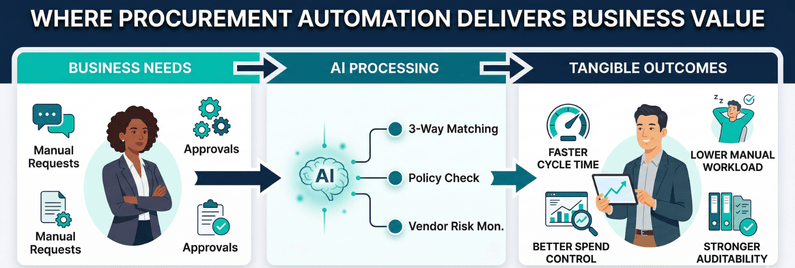
The strongest procurement automation story is not “we automated a workflow.”
The stronger story is what commercial or operational outcome improved.
1. Faster cycle time
Requests, approvals, PO creation, and issue handling move faster.
That helps procurement serve the business better and reduces internal frustration.
2. Lower manual workload
Procurement teams spend less time chasing approvals, checking policy manually, and following up on routine exceptions.
3. Better policy compliance
Approvals, budgets, preferred suppliers, and exception rules are enforced more consistently.
4. Better spend control
Teams gain visibility into what is being requested, approved, purchased, and paid.
That improves leakage control and savings opportunities.
5. Fewer invoice and matching errors
Three-way matching automation helps catch discrepancies earlier and reduce downstream finance and vendor disputes.
6. Stronger supplier management
Approved vendor paths, risk monitoring, performance context, and document tracking become easier to manage at scale.
7. Better auditability and governance
A structured workflow creates clearer records for policy, approvals, contracts, exceptions, and compliance checks.
8. Better decision support
Analytics, risk signals, predictive suggestions, and procurement copilots improve operational visibility and decision speed.
Signs your procurement workflow needs automation
You likely need procurement automation if:
-
approvals are stuck in email and follow-up loops
-
request quality is inconsistent across teams
-
policy compliance depends too much on manual checks
-
sourcing events take too long to coordinate
-
PO tracking is fragmented
-
contract renewals or obligations are missed
-
invoice mismatch resolution consumes too much time
-
supplier compliance reviews are reactive
-
reporting arrives too late to change decisions
-
business teams complain that procurement is slow and opaque
What to look for in procurement automation software
When evaluating procurement automation, look beyond generic “source-to-pay” claims.
The right questions are operational.
A strong platform should support:
-
configurable requisition workflows
-
policy-based approval routing
-
budget checks and catalog controls
-
sourcing workflow support
-
PO lifecycle tracking
-
contract workflow and renewal intelligence
-
three-way matching and exception handling
-
fraud and anomaly monitoring
-
spend dashboards and savings visibility
-
supplier risk and compliance intelligence
-
conversational intake and workflow assistance
-
role-based analytics and governance
If AI is part of the platform, ask where it improves execution materially.
The right answer should be tied to workflow speed, compliance, visibility, risk reduction, or decision quality.
Why procurement automation is becoming a strategic priority
Procurement is no longer just an administrative function.
It influences cost control, supplier resilience, operational speed, working-capital discipline, and governance.
As companies grow, procurement complexity increases faster than manual coordination can handle.
That is why modern teams are investing in workflow automation, intelligent controls, and AI-assisted process improvement.
The real shift is this:
procurement is moving from reactive processing to workflow-led control and intelligence.
Conclusion
Procurement automation is not just about doing the same work digitally.
It is about redesigning how procurement moves.
When teams automate requisitions, approvals, sourcing, PO workflows, contracts, invoice matching, supplier risk, and spend visibility, procurement becomes faster, more reliable, and easier to govern.
And when AI is added thoughtfully, teams can go further — with guided buying, anomaly detection, predictive sourcing, contract intelligence, and procurement copilots that reduce operational friction and improve decision quality.
That is the real opportunity.
Not just fewer manual steps.
Better procurement execution.
Book a Procurement Automation Demo
FAQ
What is procurement automation?
Procurement automation is the use of software and workflow logic to reduce manual work across requisitions, approvals, sourcing, purchase orders, contracts, invoice matching, supplier management, and spend controls.
What processes can procurement automation improve?
It can improve purchase requisitions, approval routing, catalog buying, sourcing workflows, PO generation, contract workflows, invoice matching, supplier compliance, and spend visibility.
How does AI help in procurement automation?
AI can support guided buying, anomaly detection, predictive sourcing, supplier risk intelligence, contract analysis, conversational procurement requests, and procurement copilots for faster decision support.
What is three-way matching in procurement?
Three-way matching compares the purchase order, goods receipt, and supplier invoice to detect mismatches and reduce payment errors or fraud risk.
How do I know if my company needs procurement automation?
If approvals are delayed, requests are inconsistent, invoice exceptions are frequent, supplier compliance is reactive, or spend visibility is weak, procurement automation is likely worth evaluating.
About the Author
Priya Maurya
Ready to orchestrate your AI future?
Converiqo AI helps you design, deploy, and scale automation workflows that move your business faster, leveraging specialized solutions like our AI bot platform for lead generation, customer self-service AI bot platform, employee self-service AI bot platform, retail omnichannel automation, and our detailed guides on how agentic AI bot platforms work in enterprises and cost structure of enterprise AI bot platforms. Connect with our team to see the platform in action and co-create the next chapter of intelligent operations.
Read More Blogs
Discover more insights and product updates curated by the Converiqo AI team.

Real ROI of Field Force Automation - Beyond the Activity Dashboard
Four metrics that show real field force automation ROI in India - productivity, data reliability, throughput, and field attrition - not just the activity dashboard.

Beat Planning Is the Highest-Leverage Field Force Capability - Here Is Why
Beat planning decides coverage, call frequency, and whether field time is productive. Why it is the single highest-leverage field force automation capability.
Why an Indian Field Force App Has to Work Offline - and Be Built for Real Devices
Field work in India happens where connectivity is intermittent. A field force app that assumes constant connectivity fails exactly where field work is done.