For many procurement teams, the biggest slowdown happens before sourcing even starts.
It begins at request intake and approval routing.
If purchase requisitions arrive incomplete, approvals move slowly, and policy checks happen manually, procurement loses time before the buying process is even properly underway.
This is why purchase requisition and approval workflows are often the best place to start procurement automation.
And when AI is added, these workflows can become faster and more intelligent — not just digitized.
Why requisition and approval workflows break
Common issues include:
- requesters submitting incomplete information
- no standard intake path
- approvers unclear on urgency or context
- budget checks happening too late
- preferred vendor rules not being followed
- approvals routed manually through email
- exception handling being inconsistent
What automation improves first
A strong workflow layer helps teams:
- collect structured purchase request data
- enforce required fields and supporting documents
- route approvals by spend threshold, category, department, or budget owner
- make approval status visible
- reduce manual chasing
Where AI adds value
AI improves these workflows when it helps users make better and faster decisions.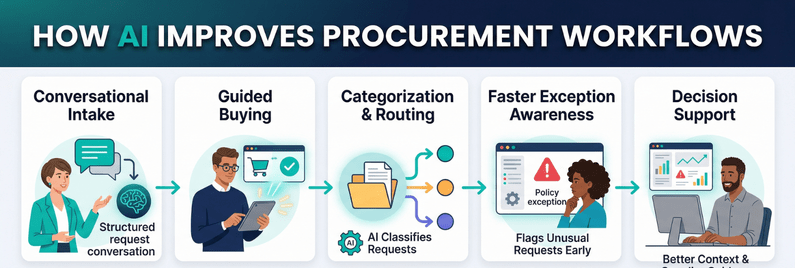
1. Conversational procurement intake
Instead of forcing every requester through a rigid form first, AI can guide users through a structured request conversation while still capturing policy-relevant details.
2. Guided buying
AI can suggest compliant routes, approved suppliers, or the right procurement path based on request context.
3. Better categorization and routing
AI can help classify requests, identify likely categories, and improve routing logic for approvals.
4. Faster exception awareness
AI can flag unusual requests, likely policy exceptions, or missing information earlier.
5. Decision support for approvers
Approvers can get clearer context, budget implications, supplier guidance, or risk signals before they approve.
What changes operationally
When purchase requisitions and approvals improve, procurement benefits downstream too:
- faster request-to-approval time
- fewer incomplete requests
- stronger compliance
- lower approval follow-up burden
- better requester experience
- better workflow predictability
What to automate first
Start with:
- structured requisition templates
- policy-based approval routing
- budget and threshold rules
- preferred supplier logic
- approval visibility and escalation rules
- exception monitoring
Conclusion
A slow procurement process often starts with a weak intake and approval layer.
Fix that layer, and procurement moves faster everywhere else.
Book an Approval Workflow Demo
FAQ
What is a purchase requisition workflow in procurement?
A purchase requisition workflow is the process of submitting reviewing and approving internal purchase requests before sourcing or purchasing begins.
Why do procurement approvals get delayed?
Approvals get delayed due to incomplete requests manual routing unclear ownership and lack of visibility into approval status.
How does automation improve requisition and approval workflows?
Automation standardizes request intake routes approvals automatically enforces policies earlier and reduces manual follow up.
What role does AI play in procurement approvals?
AI helps by guiding request submission improving routing accuracy flagging exceptions and providing decision support to approvers.
What should be automated first in procurement workflows?
Organizations should start with structured requisition templates approval routing rules budget checks supplier logic and visibility into workflow status.
About the Author
Akanksha
Ready to orchestrate your AI future?
Converiqo AI helps you design, deploy, and scale automation workflows that move your business faster, leveraging specialized solutions like our AI bot platform for lead generation, customer self-service AI bot platform, employee self-service AI bot platform, retail omnichannel automation, and our detailed guides on how agentic AI bot platforms work in enterprises and cost structure of enterprise AI bot platforms. Connect with our team to see the platform in action and co-create the next chapter of intelligent operations.
Read More Blogs
Discover more insights and product updates curated by the Converiqo AI team.

Real ROI of Field Force Automation - Beyond the Activity Dashboard
Four metrics that show real field force automation ROI in India - productivity, data reliability, throughput, and field attrition - not just the activity dashboard.

Beat Planning Is the Highest-Leverage Field Force Capability - Here Is Why
Beat planning decides coverage, call frequency, and whether field time is productive. Why it is the single highest-leverage field force automation capability.

Why an Indian Field Force App Has to Work Offline - and Be Built for Real Devices
Field work in India happens where connectivity is intermittent. A field force app that assumes constant connectivity fails exactly where field work is done.