
A lot of teams think their follow-up process is “basically fine.”
Usually, it is not.
In many cases, the process is fragmented. Sales reps reply when they can, WhatsApp chats are scattered across devices, callbacks are remembered mentally or noted casually, CRM updates happen later, and leads often sit between marketing and sales without clear ownership. There is also no defined rule for when and how re-engagement should happen.
The result is predictable.
Pipeline leakage.
Not because the market is weak. Not because every lead is bad.
Because follow-up is inconsistent, late, generic, or invisible.
If your business depends on enquiries becoming demos, appointments, consultations, or sales conversations, follow-up is not a side task.
It is a revenue workflow.
1. Responding fast once, then disappearing
Some businesses reply quickly to the first message, then slow down immediately after. This creates a false sense of responsiveness. The lead feels attended to initially, but momentum drops in the next step.
Why it hurts:
- trust drops after the first interaction
- buyer momentum breaks
- serious leads move elsewhere
Follow-up should be designed across the entire early journey, not just the first reply.
2. Treating every lead exactly the same
A hot lead asking for availability should not be treated the same as someone casually exploring information.
When businesses fail to differentiate, urgency signals are ignored and high-intent leads get lost in generic workflows.
The right approach is to segment follow-up based on intent, urgency, fit, and the next expected action.
3. Depending on humans to remember every callback
This is one of the most common and silent revenue leaks.
A callback is planned, the day gets busy, the reminder is missed, and the lead slowly goes cold. The issue is not effort, it is the absence of a system.
Manual memory is never reliable at scale.
Instead, follow-up should be supported by automated reminders, task triggers, and structured workflows that ensure consistency regardless of workload.
4. Asking leads to restart the conversation
Leads often find themselves repeating the same information across multiple touchpoints.
They explain their requirement once, then another team asks again, and sometimes support repeats it again. This creates friction and reduces confidence in the business.
A strong follow-up system should preserve context across channels and teams so that every interaction feels continuous and informed.
5. Using generic follow-up messages
A large portion of follow-up communication fails because it lacks relevance. Messages like “just checking” or “any update” do not add value and are easy to ignore.
Effective follow-up should:
- refer to the specific request or conversation
- provide a clear next step
- reduce the effort needed to respond
The goal is not just to follow up, but to move the conversation forward.
6. Not following up after incomplete booking
When a lead starts a booking but does not complete it, many businesses assume a loss of interest.
In reality, the lead may have been distracted, needed clarification, or intended to return later.
Incomplete actions often signal strong intent.
Instead of ignoring them, businesses should trigger timely nudges, offer rescheduling options, or provide assisted booking to recover these opportunities.
7. Ignoring off-hours and weekend gaps
A significant number of leads arrive outside business hours. If follow-up only happens when teams are active, these leads are forced to wait, and their intent window weakens.
Automation plays a critical role here by ensuring that leads receive immediate acknowledgment, basic qualification, and the ability to take action even when teams are offline.
8. Measuring activity instead of progression
Many teams focus on surface-level metrics such as number of replies, calls, or messages handled. While these indicate activity, they do not reflect progress.
This leads to optimizing effort instead of outcomes.
What actually matters is:
- follow-up response rate
- booking rate after follow-up
- lead reactivation rate
- inquiry-to-meeting conversion
Tracking progression ensures that follow-up contributes directly to revenue.
9. Following up without a clear next step
Follow-up without direction creates fatigue.
Leads do not need reminders. They need clarity on what to do next.
A strong follow-up should guide the lead toward action, such as selecting a time slot, confirming details, reviewing options, or speaking to a specialist.
Every message should reduce friction and make the next step obvious.
10. Not knowing when automation should stop and humans should step in
Both over-automation and under-automation create problems.
- weak leads consume valuable human time
- high-intent leads stay stuck in automation
- complex cases lack human judgment
The solution lies in defining clear escalation rules where automation handles repetitive tasks, while high-value or complex interactions are quickly routed to human teams.
The 3 mistakes that matter most
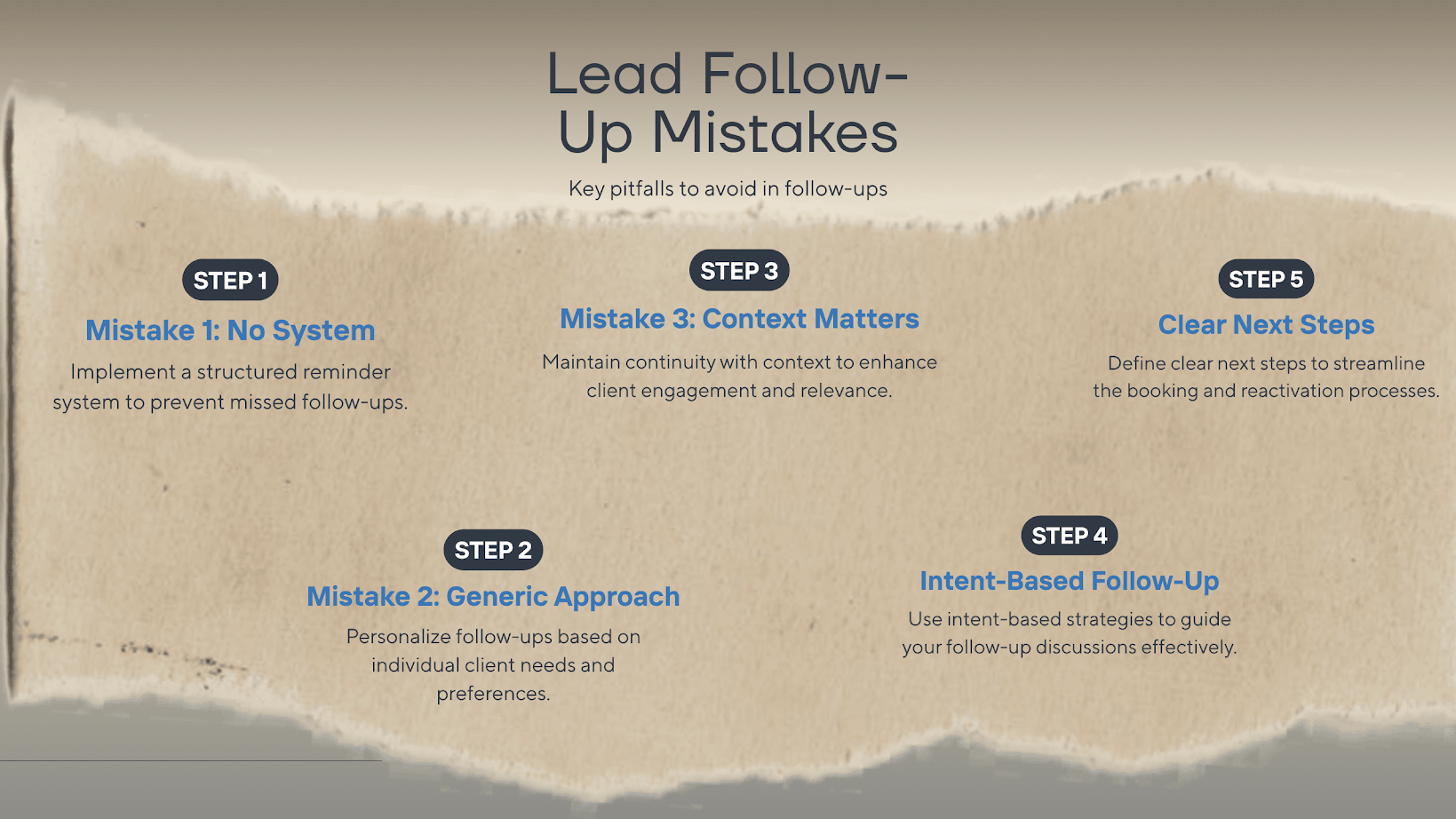
While all mistakes matter, three typically create the biggest impact:
- lack of a structured reminder system leads to silent lead loss
- generic follow-up reduces response and booking rates
- absence of context continuity damages trust
Fixing these areas alone can significantly improve performance.
A quick follow-up review checklist
Before blaming lead quality, businesses should evaluate their follow-up system.
Do you follow up based on intent or just volume? Does your system automatically trigger reminders? Can leads easily move from conversation to booking? Do teams have full context before responding? Are after-hours leads handled properly? And most importantly, are you tracking outcomes instead of just activity?
If the answer to several of these is no, the follow-up workflow is likely the real bottleneck.
Conclusion
Most businesses do not lose leads because they failed to respond.
They lose leads because their follow-up is:
- late
- generic
- inconsistent
- fragmented
- difficult to act on
Follow-up is not just communication.
It is momentum management.
And momentum is what turns interest into pipeline.
FAQ
What is the biggest lead follow-up mistake?
Depending on humans to remember every follow-up is one of the biggest and most expensive mistakes.
Should every lead receive the same follow-up sequence?
No. Follow-up should reflect intent, urgency, fit, and the next best action.
Can automation improve lead follow-up without sounding robotic?
Yes. Good automation uses context, timing, and action-driven messaging.
Why do generic follow-up messages perform badly?
Because they add no value and do not help the lead move forward.
What should businesses track in follow-up performance?
Track response rate, booking rate, reactivation rate, and conversion to meetings.
About the Author
Akanksha
Ready to orchestrate your AI future?
Converiqo AI helps you design, deploy, and scale automation workflows that move your business faster, leveraging specialized solutions like our AI bot platform for lead generation, customer self-service AI bot platform, employee self-service AI bot platform, retail omnichannel automation, and our detailed guides on how agentic AI bot platforms work in enterprises and cost structure of enterprise AI bot platforms. Connect with our team to see the platform in action and co-create the next chapter of intelligent operations.
Read More Blogs
Discover more insights and product updates curated by the Converiqo AI team.

Real ROI of Field Force Automation - Beyond the Activity Dashboard
Four metrics that show real field force automation ROI in India - productivity, data reliability, throughput, and field attrition - not just the activity dashboard.

Beat Planning Is the Highest-Leverage Field Force Capability - Here Is Why
Beat planning decides coverage, call frequency, and whether field time is productive. Why it is the single highest-leverage field force automation capability.
Why an Indian Field Force App Has to Work Offline - and Be Built for Real Devices
Field work in India happens where connectivity is intermittent. A field force app that assumes constant connectivity fails exactly where field work is done.