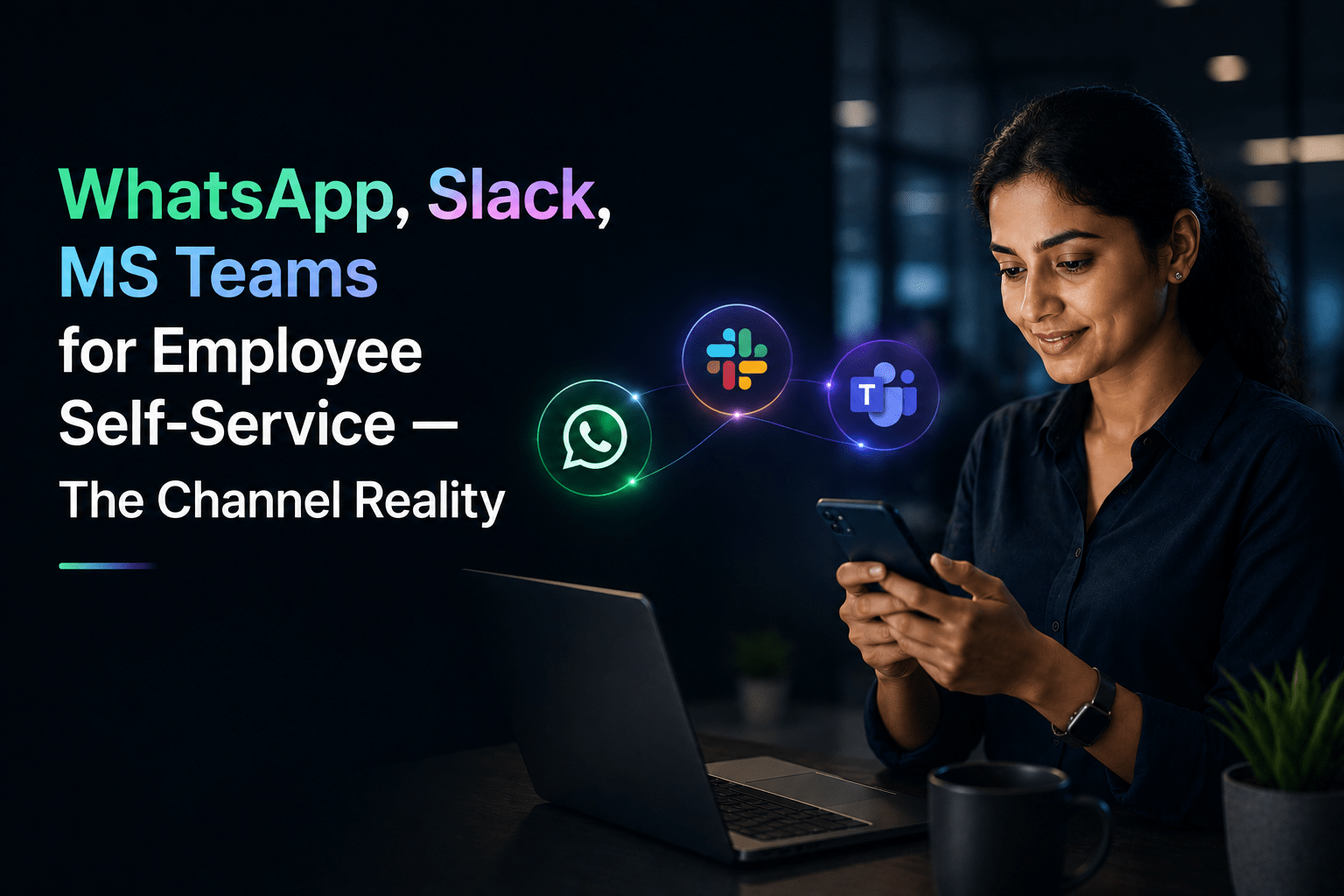
Channel-native employee self-service sounds like one decision - pick the channel, deploy on it. The Indian workforce reality is that channels split by workforce segment, and most companies have multiple segments. Tech and product teams live in Slack. Corporate functions in larger enterprises live in MS Teams. Sales and field teams live in WhatsApp. Blue-collar and operations teams live entirely in WhatsApp, often without email or company laptops. Deploying ESS on just one channel covers a subset of the workforce and leaves the rest still pinging HR.
The four channel segments
Slack-native segment. Tech companies, product organisations, startups, design teams, consulting firms. Slack is the working channel. Employees check Slack throughout the day. HR app in Slack with conversational AI handles employee queries inside the channel where work already happens.
MS Teams segment. Large enterprises, banking and financial services, regulated industries, organisations with Microsoft enterprise licensing. MS Teams is the working channel for corporate and knowledge work segments. Same approach as Slack - HR bot inside Teams handles queries where employees already are.
WhatsApp-only segment. Sales teams in the field, drivers, factory workers, retail staff, security personnel, contractors and gig workers, blue-collar workforce. They have phones. They use WhatsApp. They often do not have company email or laptops. ESS that requires app installation or portal logins excludes them entirely. WhatsApp-based ESS reaches them.
Email-preferring segment. Senior leadership, some corporate functions, employees who prefer formal communication. Email is the working channel. ESS responses via email work for this segment alongside the other channels for the rest of the workforce.
Channel-by-channel design considerations
Slack ESS. Inline messaging within DMs to the HR app. Slash commands for common actions. Rich message formatting for policy responses and document downloads. Modal forms for transactions that benefit from structured input. Threading for approval workflows. Integration with Slack identity for employee authentication. Adoption typically reaches 70-90% within months because employees encounter HR self-service in the channel they use all day.
MS Teams ESS. Inline messaging in 1-on-1 chats with the HR bot or in a dedicated HR channel. Adaptive cards for rich response formatting. Teams app integration for transactional flows. Manager approvals delivered as Teams cards with inline approve / reject buttons. Authentication via Microsoft identity. Adoption mirrors Slack in MS-Teams-native enterprises.
WhatsApp ESS. Critical for reaching blue-collar and field workforce. Inbound queries handled in WhatsApp Business API conversations. Template messages for outbound and reminders (utility templates for HR notifications, with explicit consent). The 24-hour window discipline applies - free-form responses within the window, pre-approved templates outside. Vernacular handling is essential; the WhatsApp segment is the segment that most needs Hindi, Tamil, Telugu, Marathi, Bengali, Gujarati, Kannada, and code-switching.
Email ESS. Inbound queries triaged by the AI agent, with responses delivered as structured email. Useful for transactional confirmations even for employees primarily on Slack or Teams. Approval workflows can use email for managers who prefer it, with one-click action links.
The multi-channel reality
Most Indian companies need at least two channels. A tech-heavy SMB might run Slack plus WhatsApp - Slack for the engineering and product team, WhatsApp for the sales team in the field. A mid-market enterprise might run MS Teams plus WhatsApp - Teams for corporate, WhatsApp for manufacturing and field operations. A BPO might run primarily WhatsApp for the agent workforce plus email for management. Single-channel ESS deployments leave parts of the workforce un-served.
The right approach is one AI agent serving multiple channels - the employee chooses the channel, the agent meets them there, the HRMS update happens identically regardless of which channel the request came from. Multi-channel ESS shares the underlying conversational understanding, policy knowledge, transactional capability, and approval workflow across all channels. The channels are interfaces to the same agent, not separate systems.
What WhatsApp specifically requires
WhatsApp ESS for blue-collar workforce involves specific discipline that Slack and MS Teams do not require.
Consent capture matters more. Blue-collar employees may not have signed digital consent forms when their employment was set up. Onboarding the workforce to WhatsApp-based ESS requires explicit opt-in, captured cleanly, with the ability to opt out per category - HR notifications, payroll alerts, attendance reminders, broader broadcasts.
Vernacular is structural. Blue-collar workforce often has limited English. ESS responses in English get ignored, misunderstood, or escalated. Hindi at minimum, regional language for the relevant geography, code-switching handled gracefully. The conversation needs to work in the employee's actual language, not a corporate-language version that the employee then has to translate mentally.
Voice notes and informal language. Many WhatsApp-segment employees communicate via voice notes rather than typed messages. Production-grade WhatsApp ESS handles voice input, transcribes it accurately in the relevant language, and processes the request. Typed messages from this segment are often informal - abbreviations, mixed languages, partial grammar. The AI agent needs to understand the intent regardless.
The 24-hour window and template categories. WhatsApp Business API's 24-hour customer service window distinguishes free-form messaging (inside) from pre-approved templates (outside). Most ESS interactions happen inside the window because the employee initiates. Outbound HR communications - leave approval notifications, payslip availability alerts, policy update notifications - use utility templates that comply with WhatsApp's category requirements.
What changes when multi-channel ESS works
Three measurable shifts.
ESS adoption across the entire workforce, not just the corporate-laptop segment. Blue-collar and field workforce stop being structurally excluded from self-service. The HR team's helpdesk load drops across all segments, not just the digital-native ones.
Vernacular usage data surfaces what was previously hidden. The factory workforce in Tamil Nadu actually asks 40% of their questions in Tamil. The sales team in Bihar uses Hindi. The Mumbai corporate office uses English with occasional Hindi. The data informs both ESS tuning and broader HR communications strategy.
Employee experience scores improve across segments rather than just for the workforce segment that was already digitally well-served. The eNPS lift in blue-collar workforce when WhatsApp ESS becomes available is often the largest segment-specific improvement in the deployment, because the baseline was lowest.
About the Author

Himani Chaudhary
Ready to orchestrate your AI future?
Converiqo AI helps you design, deploy, and scale automation workflows that move your business faster, leveraging specialized solutions like our AI bot platform for lead generation, customer self-service AI bot platform, employee self-service AI bot platform, retail omnichannel automation, and our detailed guides on how agentic AI bot platforms work in enterprises and cost structure of enterprise AI bot platforms. Connect with our team to see the platform in action and co-create the next chapter of intelligent operations.
Read More Blogs
Discover more insights and product updates curated by the Converiqo AI team.
Real ROI of Field Force Automation - Beyond the Activity Dashboard
Four metrics that show real field force automation ROI in India - productivity, data reliability, throughput, and field attrition - not just the activity dashboard.
Beat Planning Is the Highest-Leverage Field Force Capability - Here Is Why
Beat planning decides coverage, call frequency, and whether field time is productive. Why it is the single highest-leverage field force automation capability.
Why an Indian Field Force App Has to Work Offline - and Be Built for Real Devices
Field work in India happens where connectivity is intermittent. A field force app that assumes constant connectivity fails exactly where field work is done.