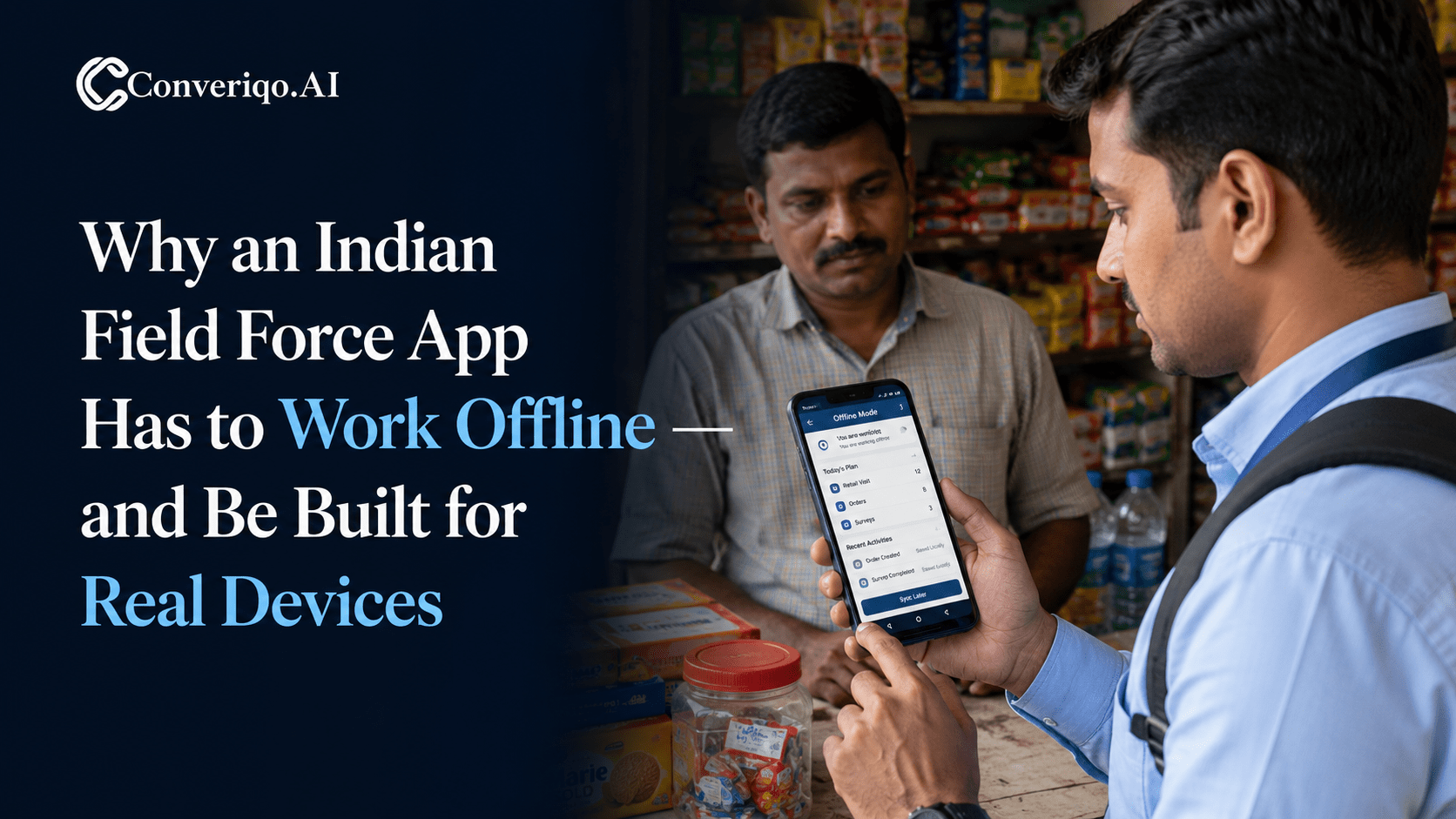
A field force app demo runs beautifully. It runs in a conference room, on a fast wifi network, on a recent phone. Every screen loads instantly, every sync completes, every map renders. The company sees the demo and buys the app.
Then the app meets the actual field. A rural beat with one bar of signal. A basement retail outlet with no signal at all. The interior of a large building. A semi-urban market in a network dead zone. A five-year-old Android phone on a modest data plan with the battery already low by mid-afternoon. The app that was flawless in the conference room becomes a daily struggle in the conditions field work actually happens in.
Connectivity in the field is intermittent - everywhere
It is tempting to think of the connectivity problem as a rural problem. It is not only rural. Field connectivity is intermittent across rural beats, semi-urban markets, and dense urban areas alike - the basement shop, the building interior, the crowded-cell dead zone. A field employee's day passes through a constantly changing connectivity environment, and significant parts of it have no usable signal.
An app that assumes constant connectivity fails in exactly those parts. The order will not save. The check-in will not register. The screen spins. And the field employee, standing at a counter with a customer waiting, learns a lesson the company did not intend to teach: the app cannot be relied on, so do the real work first and deal with the app later, from memory, when there is signal. That single learned behaviour is how a connectivity gap becomes a data-quality collapse.
Offline-tolerant is a structural requirement
The fix is not better network coverage - the field employee cannot control that. The fix is an app that is offline-tolerant by design. The field employee captures everything locally, on the device, immediately - the order at the counter, the check-in at the door, the competitor note while standing in the shop. The app stores it and syncs when a connection returns, without the employee having to think about it.
Done properly, the field employee never experiences the connectivity gap at all. The app is fast and responsive whether there is signal or not, because the capture is local and the sync is deferred and automatic. Offline tolerance is not an advanced feature to add later. For an Indian field force app it is a structural requirement, because without it the app fails in the median field condition, not the edge case.
Built for the device the field force actually carries
Connectivity is half the field-reality problem. The device is the other half. The Indian field workforce runs on phones - and not flagship phones. Mid-range and older Android devices, modest storage, modest RAM, modest data plans, batteries that have to last a long field day.
A field force app has to be built for that device: light to install, fast on modest hardware, frugal with data, gentle on the battery. An app designed and tested on a high-end phone will be sluggish, storage-hungry, and battery-draining on the device the field employee actually holds - and an app that drains the battery by mid-afternoon is an app the field employee will close to get through the rest of the day.
The test that matters
The conference-room demo is the wrong test. The right test for an Indian field force app is the field test: a real field employee, on a real mid-range phone, on a real beat that passes through real dead zones, for a real full day. An app that holds up under that test will hold up everywhere. An app that was only ever tested on office wifi and good phones will keep failing in the field no matter how good the demo looked - and every failure teaches the field workforce to trust it a little less.
About the Author

Himani Chaudhary
Ready to orchestrate your AI future?
Converiqo AI helps you design, deploy, and scale automation workflows that move your business faster. Connect with our team to see the platform in action and co-create the next chapter of intelligent operations.
Read More Blogs
Discover more insights and product updates curated by the Converiqo AI team.

Real ROI of Field Force Automation - Beyond the Activity Dashboard
Four metrics that show real field force automation ROI in India - productivity, data reliability, throughput, and field attrition - not just the activity dashboard.

Beat Planning Is the Highest-Leverage Field Force Capability - Here Is Why
Beat planning decides coverage, call frequency, and whether field time is productive. Why it is the single highest-leverage field force automation capability.
The 7 Capabilities of Real Field Force Automation - and What Each One Fixes
What a complete field force automation system covers - seven capabilities, and what breaks in the field employee's day when each one is missing.