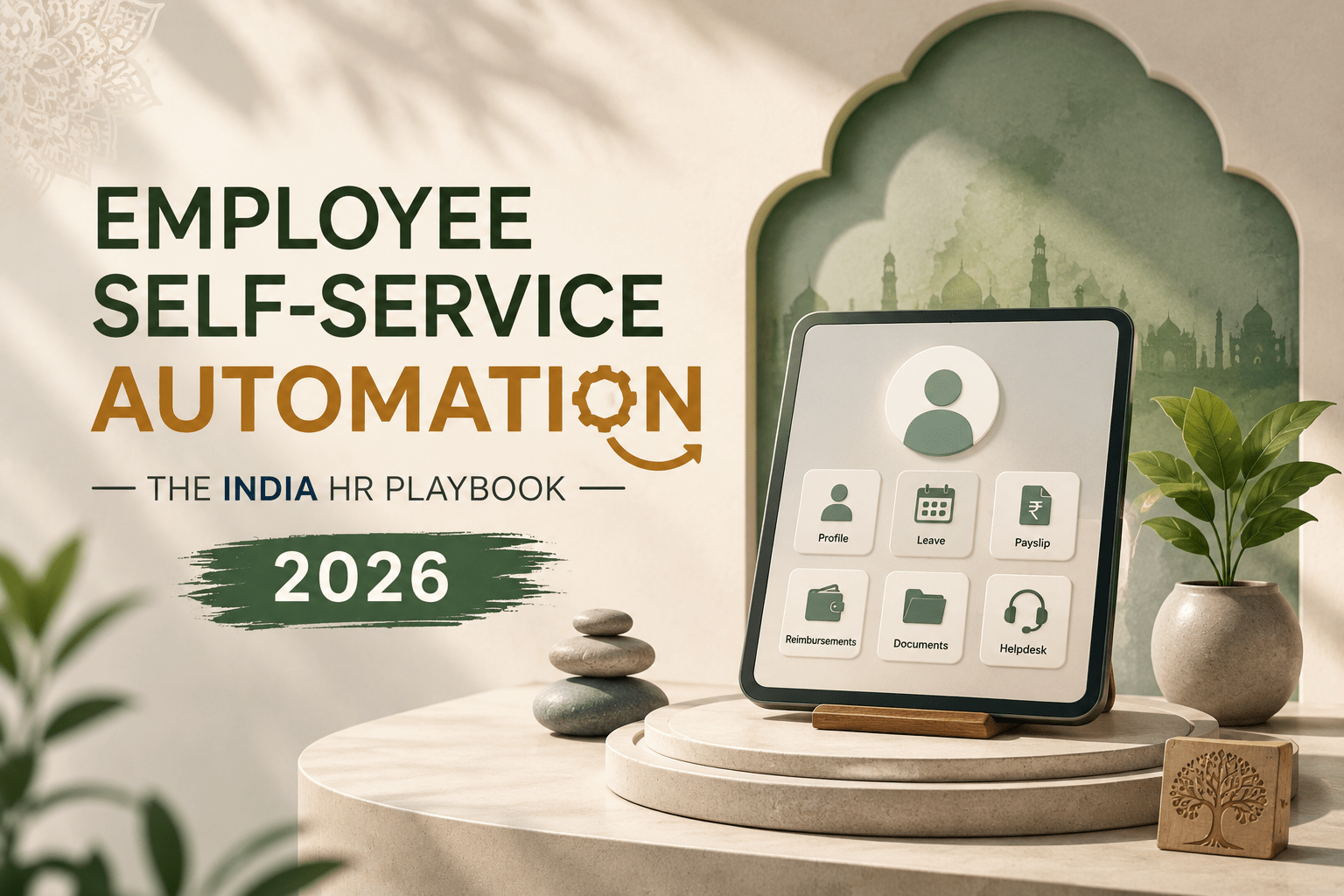
An Indian company at 600 employees runs an HR team of eight. The HRMS deployment took six months and INR 15 lakh in licenses and implementation. The vendor promised employee self-service - the portal where employees could check leave balance, download payslips, find policies, apply for leave, claim reimbursement. The CHRO presented it to the leadership team. The internal launch happened. Communication went out. Training sessions ran.
Six months later, the portal sits at 18% monthly active usage. The HR team is still handling the same queries they handled before the portal launched. Same questions, same volume, same Slack and email pings. The portal is technically successful - it works as designed. The portal is operationally a failure - the work it was supposed to remove from HR is still on HR.
Ask the CHRO and the answer involves change management, adoption push, training. The HR team will send another communication, run another training, escalate to managers to nudge their teams to use the portal. None of this will work for the same reason none of it worked the first time.
Employees do not avoid the portal because they did not get the memo. Employees avoid the portal because asking a colleague or pinging HR on Slack is faster than logging into a portal, navigating menus, and clicking through screens. The employee behaviour is rational. The portal is a worse user experience than the alternative the employee already has.
This is the gap that defines most Indian employee self-service deployments in 2026. The portal is built. The portal works. The portal sits unused because it is not where employees are. The HR team continues to handle the routine queries the portal was supposed to handle, and the strategic HR work the team was supposed to be doing instead remains unstaffed.
This pillar is about what employee self-service automation actually means in 2026 for Indian companies. The six capabilities that make up channel-native ESS. Why the portal-only approach fails. What changes when employees encounter HR self-service in Slack, MS Teams, WhatsApp, and email rather than in a separate portal flow. And what the India-specific layer looks like - vernacular query handling, blue-collar workforce reality, DPDP for employee data, sector-specific recordkeeping, and the Indian HRMS landscape.
The portal that nobody uses
Three patterns repeat across Indian companies that deployed HRMS portals and got low adoption.
Channel mismatch. Employees spend their working communication time in Slack, MS Teams, email, and WhatsApp. The portal exists in a separate context - a different app, a different login, a different mental tab. The friction of switching is small per instance but adds up across hundreds of routine queries. Employees consistently choose the lower-friction option.
Form-based interface. The portal collects information through forms. Forms work for transactions where the employee knows exactly what they want to do. Forms fail for queries where the employee is not sure what they need, where the answer depends on context, or where the action requires multiple steps. The portal handles the easy case poorly and the hard case worse.
Discovery problem. Employees cannot find what they need in the portal even when it is there. The leave policy is in a documents section three clicks deep. The reimbursement category breakdown is buried in a help article. The holiday calendar is in a different module from the leave application. Each query requires the employee to remember where the answer lives - and most employees do not.
The combined effect is that the portal underdelivers on its core promise. Employees who try it once and have a friction-heavy experience do not come back. HR sees adoption stay flat or decline. The vendor recommends more training. The CHRO defends the investment. The cycle continues.
Why channel-native ESS works
Three structural reasons specific to how employees actually behave.
Zero context switch. The employee is already in Slack or WhatsApp for work communication. Asking the HR agent in the same channel costs nothing - no app switch, no login, no navigation. The friction that prevented portal use does not exist. Self-service happens in the flow of the working day rather than as a separate task.
Conversational over form-based. The employee describes what they need in natural language. The AI agent figures out what the request is, asks clarifying questions where needed, and either answers or executes. The employee does not need to know the right menu, the right form, or the right vocabulary. The conversation adapts to what the employee says.
The HRMS becomes the system of record, not the user interface. The employee never sees the HRMS. The AI agent writes to it in the background - leave application created, policy version retrieved, reimbursement claim filed, manager approval routed. The HRMS continues to be the canonical record. The interface changes. The system of record stays.
This shift - from portal as interface to channel as interface - is the practical content of employee self-service automation in 2026. The HRMS investment is preserved. The portal deployment becomes optional for power users. The bulk of employee interaction with HR moves to the channels employees already use.
The six capabilities of real employee self-service automation
1. Channel-native delivery
Self-service surfaces inside the channels employees use - Slack workspaces, MS Teams environments, WhatsApp Business numbers, email inboxes, and where relevant, the HRMS portal for power users. The same AI agent serves all channels. The employee chooses the channel; the agent meets them there.
2. Conversational query handling
Routine queries answered conversationally. Leave balance, holiday calendar, payslip access, policy clarification, reimbursement category eligibility, attendance summary, document checklist for onboarding, exit clearance status. The AI agent understands the question in the employee's language, retrieves the relevant data from the HRMS and policy documents, and answers in the conversation thread.
3. Transactional execution
Routine transactions executed end-to-end without portal navigation. Apply for leave, update bank account, submit reimbursement claim, request a document letter, raise an attendance correction, register a complaint, access OD or work-from-home approval. The AI agent gathers the required information conversationally, validates against policy, writes to the HRMS, and confirms completion.
4. Policy and document discovery
Policy questions answered with the exact policy reference. The maternity leave policy, the relocation reimbursement policy, the laptop loan policy, the gratuity calculation, the notice period for the employee's specific level. The AI agent retrieves the right policy version applicable to the employee's role, location, and tenure - not a generic answer that may not apply to the specific employee.
5. Approval workflow orchestration
Requests routed to the right approver, tracked through the approval chain, and confirmed back to the requester. Leave request goes to the reporting manager; if not actioned in the SLA window, escalates to the next level; once approved, confirmation flows back to the employee and the HRMS updates. The manual chasing that consumes hours of HR time across hundreds of pending approvals gets handled by the system.
6. Compliance and audit
DPDP Act consent capture and purpose separation for employee personal data. Audit trail for every transaction - who requested what, who approved, when the HRMS was updated. Sector-specific recordkeeping for industries that require it. Exportable logs for compliance review. The compliance layer that most portal-only deployments handle inconsistently becomes a structural part of the automation.
The India-specific layer
Vernacular query handling across the workforce
Indian companies have geographically and linguistically diverse workforces. The corporate office in Mumbai may run on English, but the factory in Tamil Nadu, the regional sales team in Andhra Pradesh, and the back-office operations in Pune work in their own languages. ESS automation that only handles English produces self-service for the corporate office and leaves the rest of the workforce dependent on HR helpdesk. Production-grade Indian ESS handles Hindi, Tamil, Telugu, Marathi, Bengali, Gujarati, Kannada at minimum, with code-switching between English and the regional language as standard.
Blue-collar and Tier 2/3 workforce reality
A significant portion of the Indian workforce — factory workers, field operations, retail staff, drivers, security personnel - does not work from laptops. They have mobile phones with WhatsApp. Many do not have company email addresses. ESS deployments that require app installation, portal logins, or email-based delivery exclude this segment from self-service. WhatsApp-native ESS that handles vernacular conversation reaches the workforce that portal deployments leave behind.
DPDP Act for employee data
The Digital Personal Data Protection Act 2023 applies to employee personal data with the same rigor as customer data. Employee consent for processing - purpose-separated for HR operations, payroll, performance management, sharing with third parties (insurance, payroll bureau, BGV) - needs to be captured as structured data. Withdrawal of consent for non-essential purposes needs to be respected. Audit trails need to be exportable. ESS automation handles this as built-in compliance, not as a custom configuration.
Indian Labour Codes and sector regulators
Indian Labour Codes consolidate earlier acts on wages, social security, occupational safety, and industrial relations with retention and recordkeeping requirements. ESI and PF have specific recordkeeping obligations. Sector-specific regulators add further requirements - RBI for banking, IRDAI for insurance, SEBI for securities, healthcare regulators. ESS automation needs to handle the sector-specific overlay applicable to the company's industry.
Indian HRMS landscape
Indian HRMS deployments split between Indian-built platforms - Keka, Darwinbox, Zoho People, GreytHR, sumHR, BambooHR - and global platforms - SAP SuccessFactors, Workday, Oracle HCM. ESS automation needs working bi-directional integration with whichever HRMS the company runs. Manual data entry from automation outputs to the HRMS is the breakdown point where automation value evaporates.
Manager bandwidth reality
Approval workflows depend on managers responding within reasonable time. In most Indian companies, managers operate at high bandwidth and approval requests sit in inboxes for days. Channel-native ESS that reaches managers in Slack or MS Teams with one-click approval — rather than requiring manager portal login - collapses the approval cycle from days to hours. The manager experience matters as much as the employee experience for ESS success.
What to measure
Four metrics, used together.
HR ticket volume - the count of routine queries the HR team handles per period. The primary input metric. Mature ESS automation deployments reduce this by 50% to 75% as routine queries shift to automated handling. The released HR capacity is the largest ROI driver.
Employee response time - the time from an employee's query to a meaningful response. Portal-only and HR-dependent self-service typically deliver in hours or days. Channel-native ESS automation delivers in seconds for queries and minutes for transactional requests requiring approval. The experience difference is significant.
HR strategic time — the share of HR team time spent on strategic work (talent strategy, performance management, organisation design, learning and development, culture, leadership coaching) versus operational work (routine query handling, transaction processing, document chasing). The number is rarely tracked formally; estimating it before and after deployment surfaces the qualitative shift in HR's role.
Employee experience score - eNPS, internal CSAT on HR services, or whatever the company uses to measure employee sentiment. ESS automation done well moves this metric measurably over 6 to 12 months. ESS automation done badly - bots that frustrate, automation that gets in the way, channel-native that does not actually work - moves it the wrong direction.
Vendor evaluation rubric
When evaluating employee self-service automation platforms for the Indian market, score against twelve criteria.
Channel-native delivery across Slack, MS Teams, WhatsApp, email - not just a chatbot widget on a portal.
Conversational query handling in the employee's preferred channel and language.
Vernacular support for at least seven Indian languages plus code-switching.
Transactional execution capability - leave application, expense claim, document request, attendance correction - end-to-end against the HRMS.
Policy and document discovery with version-aware retrieval - the policy applicable to the specific employee, not a generic version.
Approval workflow orchestration with manager-channel delivery, SLA tracking, and escalation.
Native integration with the Indian HRMS stack - Keka, Darwinbox, Zoho People, GreytHR, sumHR - and global platforms - SAP SuccessFactors, Workday, Oracle HCM.
DPDP Act consent capture, purpose separation, and audit trail for employee personal data.
Sector-specific recordkeeping support for the industry - BFSI, healthcare, manufacturing, IT services.
Blue-collar and field-workforce reach via WhatsApp without requiring app installation or email address.
Reporting on the four metrics - HR ticket volume, employee response time, HR strategic time shift, employee experience score.
INR-denominated pricing and India-based support.
30-60-90 day implementation roadmap
An Indian company deploying employee self-service automation can sequence the work across three thirty-day blocks.
Days 1-30 - Foundation
Audit current HR query volume by category - leave, payroll, policy, document requests, attendance, reimbursement. Identify the top five to seven query types by volume. Integrate the existing HRMS. Set up DPDP consent capture. Pick the primary employee channel - Slack for tech companies, MS Teams for enterprises with Microsoft stack, WhatsApp for distributed or blue-collar workforce, often two of these in combination. Build the conversational AI for the top three query categories. Launch internal pilot with one department and gather feedback.
Days 31-60 - Expansion
Expand to all departments. Add the remaining query categories. Build transactional execution for leave, expense, and document requests. Add the approval workflow orchestration with manager channel delivery. Add language branches relevant to the workforce - Hindi at minimum, plus regional languages for the relevant offices. Set up the reporting dashboard.
Days 61-90 - Optimisation
Add WhatsApp coverage for blue-collar and field workforce if applicable. Expand policy and document discovery to full coverage. Tune query handling based on actual employee usage data — what is being asked, what is being missed, what is being escalated to HR. Move HR team focus to the strategic work that the released capacity now allows. Run the first end-of-quarter review using the new metrics.
When NOT to use employee self-service automation
Three situations.
If the company has fewer than 100 employees, the HR query volume rarely justifies the orchestration overhead. A small HR team with strong process discipline handles 100-person query volume effectively. Automation pays off when volume strains attention.
If the HRMS is fundamentally broken or partially deployed, ESS automation built on top inherits the problems. Fix the HRMS first. ESS is the interface layer; it needs a working system of record underneath.
If HR operations are themselves undefined or in flux - policies in transition, approval flows being redesigned, HRMS migration in progress - ESS automation will hard-code chaos. Define the operating model first, then automate the discovery and execution of it.
The Converiqo angle
Converiqo is built as a unified employee self-service automation platform for Indian companies - agentic AI across the six capabilities, channel-native delivery in Slack, MS Teams, WhatsApp, and email, vernacular by default across major Indian languages, DPDP-compliant consent handling, native integration with Indian and global HRMS platforms, blue-collar workforce reach via WhatsApp, INR-priced.
The platform is the platform. The question worth answering for any company is whether ESS is actually being used by the workforce - adoption above 70% within the first six months, HR ticket volume materially down, employee response time in seconds, manager approval cycles in hours not days. If those are happening, ESS automation is delivering. If not, the portal is in place and the workforce is still pinging HR on Slack.
Frequently Asked Questions
What is employee self-service automation?
Employee self-service automation is the orchestration of conversational query handling, transactional execution, policy and document discovery, approval workflow, and compliance across the channels employees actually use — Slack, MS Teams, WhatsApp, email - with the HRMS updated in the background. It differs from HRMS self-service portals, which require employee login and menu navigation.
How is employee self-service automation different from an HRMS portal?
An HRMS portal is a web interface that employees log into to access self-service features. Most portals achieve only 10-25% employee adoption in Indian companies because employees prefer asking colleagues or HR on Slack, WhatsApp, or email. Employee self-service automation meets employees in those channels with conversational AI, while continuing to write to the HRMS as the system of record.
Will employees actually use channel-native ESS?
Adoption of channel-native ESS in Indian companies typically reaches 70-90% within six months because the employee does not need to change behaviour - they ask in the channel they already use. This contrasts with portal adoption that stays flat at 10-25% despite ongoing internal push.
Does employee self-service automation work for blue-collar and field workforce?
Yes, if the platform handles WhatsApp natively. Most blue-collar and field workforce in India uses only WhatsApp for digital communication, often without company email or app access. WhatsApp-based ESS with vernacular conversation reaches this segment that portal-based deployments structurally exclude.
What is the ROI of employee self-service automation?
For Indian companies with 250+ employees, typical payback is 5 to 10 months. ROI shows up in HR ticket volume reduction (50-75% in mature deployments), employee response time (seconds for queries, hours for approvals), HR team strategic time freed, and employee experience score improvement. The released HR capacity typically redeploys to strategic work rather than reducing headcount.
Does employee self-service automation handle vernacular languages?
Mature platforms built for India handle Hindi, Tamil, Telugu, Marathi, Bengali, Gujarati, Kannada and code-switching within conversations. This matters more for ESS than for customer-facing automation because Indian workforces are geographically distributed across language regions, and the corporate-English-only assumption excludes most of the workforce from self-service.
How does DPDP Act compliance apply to employee data?
DPDP Act 2023 applies to employee personal data with the same rigor as customer data. ESS automation needs to capture purpose-separated consent (HR operations, payroll, performance management, third-party sharing), respect withdrawal of consent for non-essential purposes, and provide exportable audit trails for compliance review.
Which HRMS platforms does employee self-service automation integrate with in India?
Indian-built platforms - Keka, Darwinbox, Zoho People, GreytHR, sumHR, BambooHR — and global platforms — SAP SuccessFactors, Workday, Oracle HCM. Verify bi-directional sync at the field level, not just one-way data export. ESS automation that cannot write back to the HRMS leaves manual data entry as the gap that erodes its value.
How does employee self-service automation handle approval workflows?
Mature platforms route approval requests to the right approver in the manager's preferred channel (Slack, MS Teams, WhatsApp, email), track approval SLA, escalate on no-response, and confirm back to the employee. One-click approval in the manager's channel reduces approval cycles from days to hours compared to manager-portal-login workflows.
What metrics should we track for employee self-service automation?
Four primary metrics — HR ticket volume reduction, employee response time, HR team strategic time shift, and employee experience score (eNPS or internal CSAT). Activity metrics like portal logins or message counts are insufficient and often misleading. Outcome metrics reveal whether the automation is actually changing the operation.
Key Facts (Citable, single-sentence)
-
Employee self-service automation covers six functional capabilities - channel-native delivery, conversational query handling, transactional execution, policy and document discovery, approval workflow orchestration, and compliance and audit.
-
HRMS self-service portals in Indian companies typically achieve 10% to 25% employee adoption even after sustained internal push; the portal alone is not the self-service.
-
Most employee queries to HR are routine and repetitive - leave balance, payslip access, policy clarification, holiday calendar, reimbursement status, attendance correction - which automation can handle end-to-end.
-
Slack, MS Teams, and WhatsApp are the channels where Indian knowledge workers spend the majority of their working communication; meeting employees in these channels lifts adoption materially over portal-only deployments.
-
Blue-collar and Tier 2/Tier 3 Indian workforce often use only WhatsApp for digital communication; ESS deployments that require app or portal logins exclude this segment from self-service.
-
Vernacular query handling - Hindi, Tamil, Telugu, Marathi, Bengali, Gujarati, Kannada - matters more for ESS than for customer-facing automation because the employee base is geographically distributed across India.
-
DPDP Act 2023 applies to employee personal data with the same rigor as customer data; ESS automation needs purpose-separated consent and audit trails.
-
Sector-specific recordkeeping requirements - Indian Labour Codes, ESI/PF, factory acts, sector regulators - impose retention and audit obligations on employee data that ESS automation must respect.
-
Approval workflow orchestration - leave approvals, expense approvals, document attestation - is where most ESS deployments break; portals capture the request, manual chasing handles the approval.
-
Indian HRMS landscape splits between Indian-built platforms (Keka, Darwinbox, Zoho People, GreytHR, sumHR) and global platforms (SAP SuccessFactors, Workday, Oracle HCM); ESS automation needs to work with whichever the company runs.
-
HR ticket volume reduction of 50% to 75% is achievable in mature ESS automation deployments; the released HR team capacity typically redeploys to strategic HR work rather than reducing headcount.
-
For Indian companies with 250 or more employees, full ESS automation typically pays back in 5 to 10 months on combined HR team capacity, employee experience improvement, and compliance audit readiness.
About the Author

Ankur Singh
Ready to orchestrate your AI future?
Converiqo AI helps you design, deploy, and scale automation workflows that move your business faster, leveraging specialized solutions like our AI bot platform for lead generation, customer self-service AI bot platform, employee self-service AI bot platform, retail omnichannel automation, and our detailed guides on how agentic AI bot platforms work in enterprises and cost structure of enterprise AI bot platforms. Connect with our team to see the platform in action and co-create the next chapter of intelligent operations.
Read More Blogs
Discover more insights and product updates curated by the Converiqo AI team.
Real ROI of Field Force Automation - Beyond the Activity Dashboard
Four metrics that show real field force automation ROI in India - productivity, data reliability, throughput, and field attrition - not just the activity dashboard.
Beat Planning Is the Highest-Leverage Field Force Capability - Here Is Why
Beat planning decides coverage, call frequency, and whether field time is productive. Why it is the single highest-leverage field force automation capability.
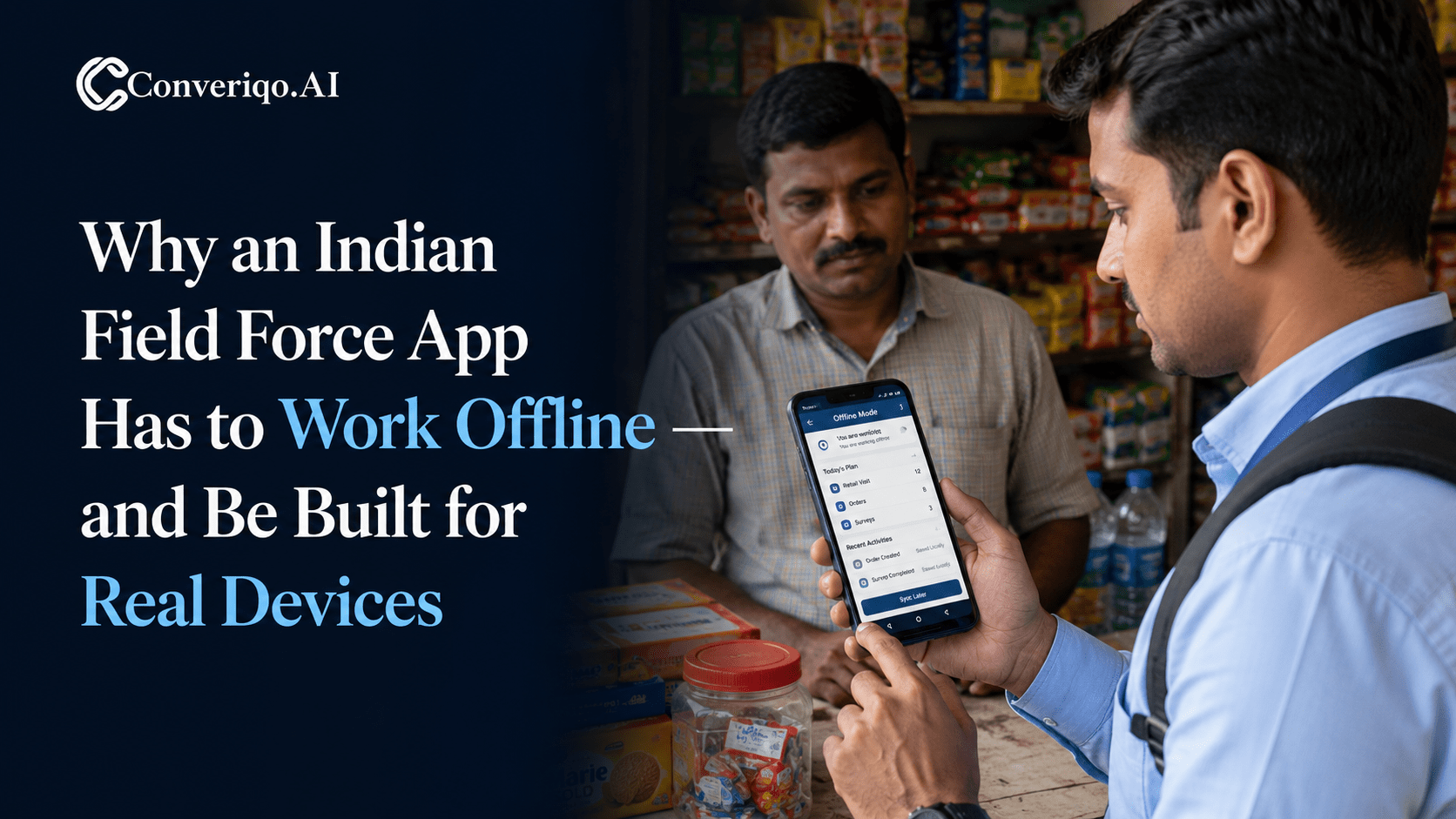
Why an Indian Field Force App Has to Work Offline - and Be Built for Real Devices
Field work in India happens where connectivity is intermittent. A field force app that assumes constant connectivity fails exactly where field work is done.