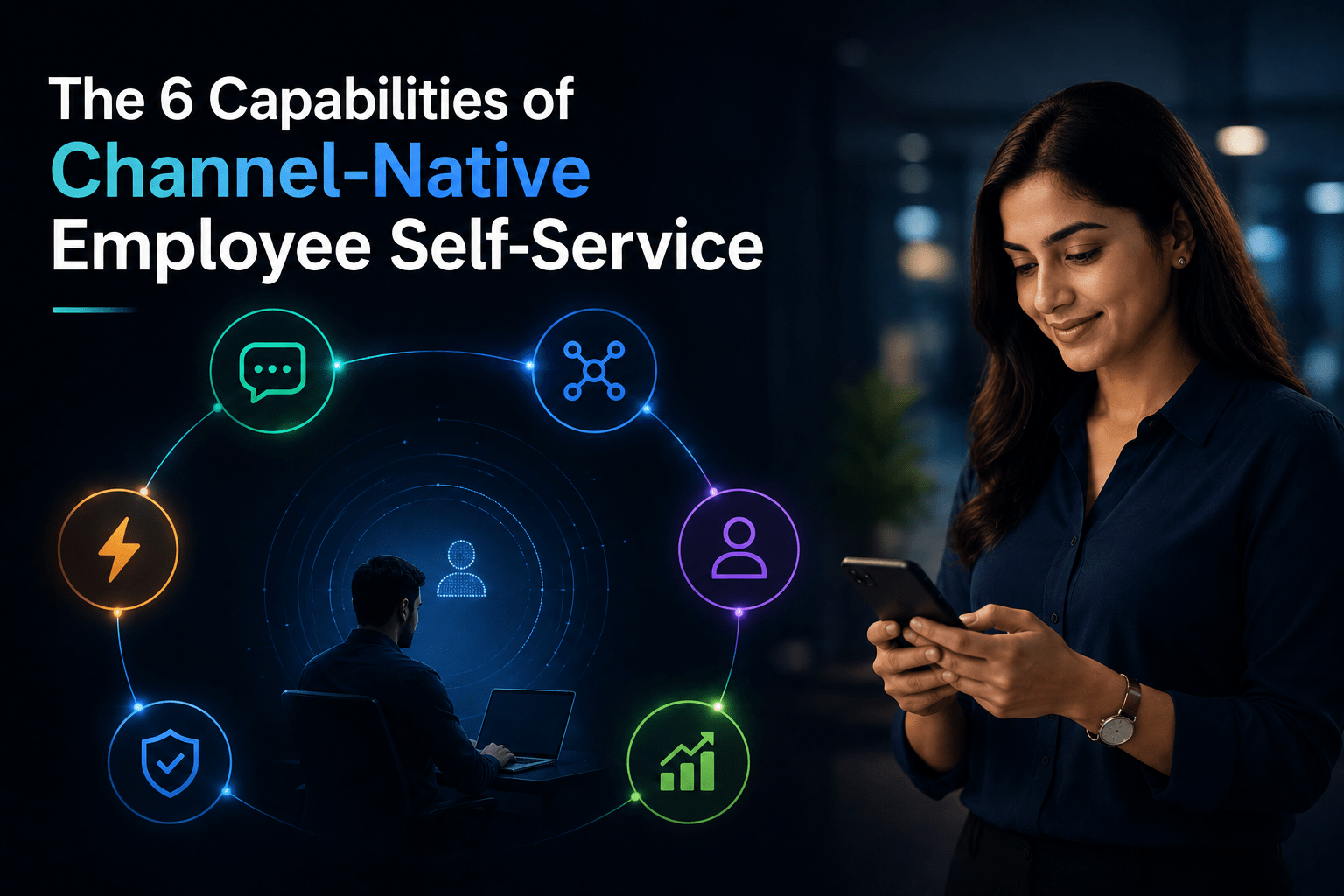
Real employee self-service automation is six capabilities working together. Each one replaces a specific workflow that today either runs through a low-adoption portal or sits on the HR team's plate. Walking through each - what it does, what it replaces, what breaks when it is missing.
Capability 1 - Channel-native delivery
What it does. Surfaces employee self-service inside the channels employees use for working communication. Slack workspaces with an HR app. MS Teams channels with an HR bot. WhatsApp Business numbers for distributed and blue-collar workforce. Email when employees prefer it. The portal as an option for power users. Same AI agent across channels; employees choose where to engage.
What it replaces. Portal-only delivery that forces employees to switch context for every HR query. Email-based HR helpdesk that creates ticket queues and slow responses. Standalone HR chatbots that exist on the portal page nobody visits.
What breaks when it is missing. Adoption stays at portal-baseline 10-25%. Routine queries continue to land on HR team Slack channels and email. The HRMS investment delivers infrastructure value but not workforce experience value.
Capability 2 - Conversational query handling
What it does. Answers routine employee queries through conversation. Leave balance, holiday calendar, payslip access, policy clarification (maternity, sabbatical, work-from-home, relocation, gratuity), reimbursement category eligibility, attendance summary, document checklist for onboarding, exit clearance status. Employee asks in natural language; agent responds with the right answer for the specific employee.
What it replaces. Static portal screens where the employee has to know exactly where to look. HR team time spent answering the same questions hundreds of times per month. Slack channel queries that wait for an HR team member to respond.
What breaks when it is missing. HR team time absorbed by routine queries. Strategic HR work crowded out by helpdesk volume. Employee experience varies based on which HR team member happens to respond and how busy they are.
Capability 3 - Transactional execution
What it does. Executes routine HR transactions end-to-end against the HRMS through conversation. Apply for leave, update bank account, submit reimbursement claim, request a document letter (employment, salary, no-objection, address proof), raise an attendance correction, register a complaint, access OD or work-from-home approval. The AI agent gathers required information conversationally, validates against policy and data quality rules, writes to the HRMS, and confirms completion.
What it replaces. Portal forms where the employee navigates menus, fills fields, attaches documents, and clicks submit. HR-team-handled transaction processing where the employee emails a request and waits for HR to update the HRMS manually.
What breaks when it is missing. Even with portal adoption, transactions break down at the boundaries - incomplete information, validation failures, attachment issues. HR ends up handling the broken transactions, eroding the self-service value.
Capability 4 - Policy and document discovery
What it does. Retrieves the policy and document references applicable to the specific employee - their role, level, location, tenure, business unit. The maternity leave policy version for the employee's category. The relocation reimbursement applicable to their grade. The notice period for their specific level. Documents like offer letter, last six payslips, Form 16, tax declaration, retrievable on request.
What it replaces. Documents-section navigation through portal taxonomies that do not match employee mental models. HR team time spent answering 'what is our policy on X for someone like me.'
What breaks when it is missing. Employees ask the same policy question multiple times, sometimes to different HR team members, sometimes get different answers. Policy versioning issues - newer employees getting older policy answers, employees in different locations getting policies that do not apply to them.
Capability 5 - Approval workflow orchestration
What it does. Routes employee requests requiring approval to the right approver, in the approver's preferred channel, with one-click approve / reject. Tracks the approval SLA, escalates on no-response, and confirms outcome back to the employee. Updates the HRMS to reflect the approval state.
What it replaces. Email-chain approvals that require the manager to log into the HRMS portal. HR team time spent chasing pending approvals across hundreds of employees. Manual status updates back to the employee.
What breaks when it is missing. Approval requests sit in manager inboxes for days. Employees ping HR for status. HR pings managers. The approval cycle that should take hours takes days, and the manual chase work consumes HR capacity that the self-service was supposed to release.
Capability 6 - Compliance and audit
What it does. Captures DPDP Act consent for employee personal data with purpose separation. Maintains audit trails for every transaction - who requested what, who approved, when the HRMS was updated, what data was accessed. Supports sector-specific recordkeeping requirements where applicable. Provides exportable logs for compliance review and audit.
What it replaces. Manual audit log compilation when HR or compliance audits ask for trails. Inconsistent consent capture across different HR processes. Recordkeeping that lives in PDFs and spreadsheets rather than in queryable systems.
What breaks when it is missing. Compliance review surfaces gaps in trails. DPDP enforcement risk. Sector regulator audits find recordkeeping inconsistencies. The automation that was supposed to make HR more efficient creates a compliance exposure.
Why all six matter together
Channel delivery without conversational query handling is just a chatbot in Slack - quickly abandoned. Query handling without transactional execution leaves employees informed but still forced into the portal to act. Transactions without approval orchestration leave requests stuck waiting for manager response. Compliance without the rest is overhead without value. The capabilities work as a layer; gaps between them are where employees default back to pinging HR.
Employee self-service automation built as a unified layer addresses each of the structural reasons portals fail. Built as point tools - a Slack bot here, an approval workflow there, a separate transactional layer - leaves the seams that erode the experience.
About the Author

Ankur Singh
Ready to orchestrate your AI future?
Converiqo AI helps you design, deploy, and scale automation workflows that move your business faster, leveraging specialized solutions like our AI bot platform for lead generation, customer self-service AI bot platform, employee self-service AI bot platform, retail omnichannel automation, and our detailed guides on how agentic AI bot platforms work in enterprises and cost structure of enterprise AI bot platforms. Connect with our team to see the platform in action and co-create the next chapter of intelligent operations.
Read More Blogs
Discover more insights and product updates curated by the Converiqo AI team.
Real ROI of Field Force Automation - Beyond the Activity Dashboard
Four metrics that show real field force automation ROI in India - productivity, data reliability, throughput, and field attrition - not just the activity dashboard.
Beat Planning Is the Highest-Leverage Field Force Capability - Here Is Why
Beat planning decides coverage, call frequency, and whether field time is productive. Why it is the single highest-leverage field force automation capability.
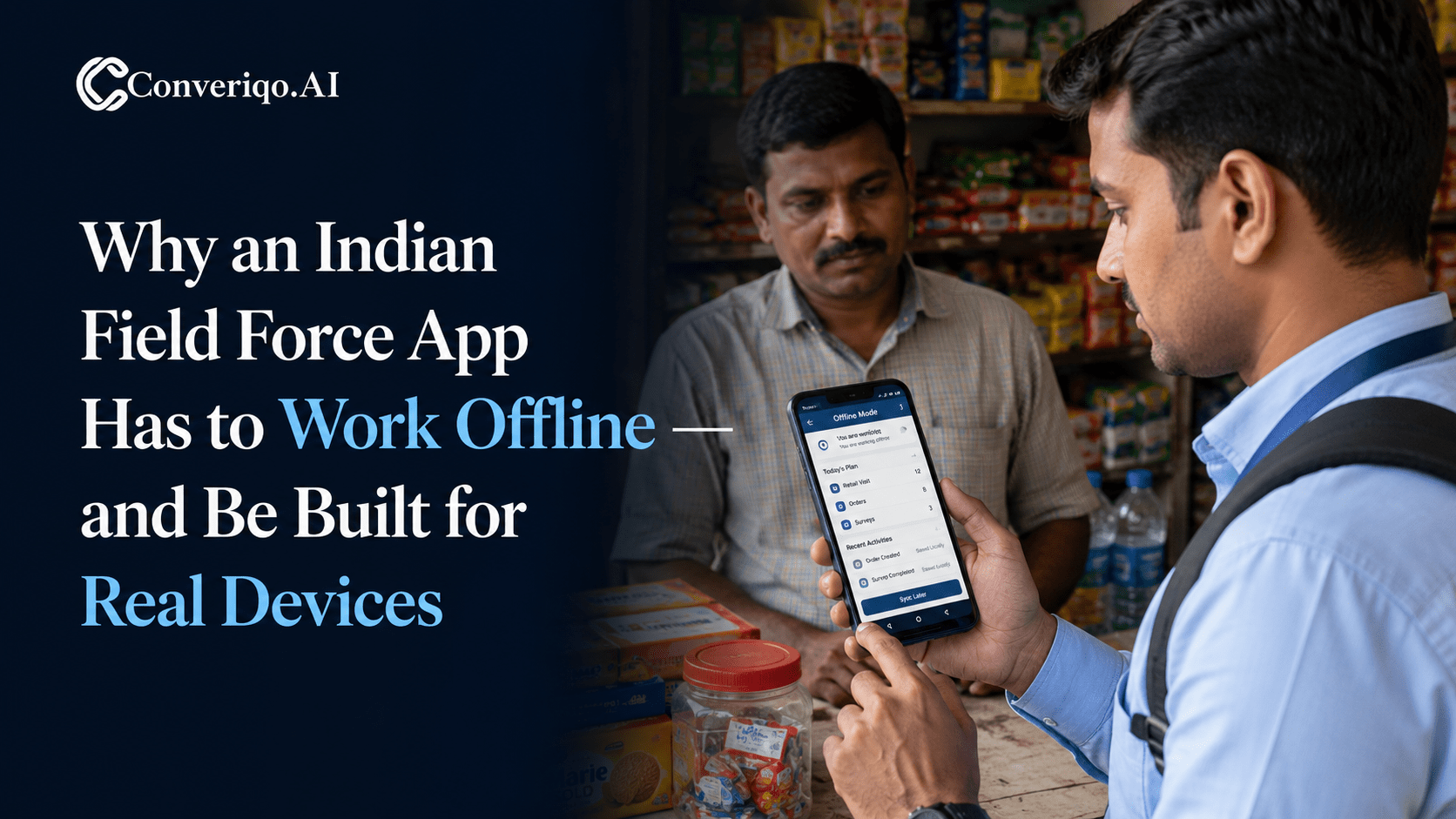
Why an Indian Field Force App Has to Work Offline - and Be Built for Real Devices
Field work in India happens where connectivity is intermittent. A field force app that assumes constant connectivity fails exactly where field work is done.