How Agentic AIWorks in Enterprises
Understand the inner workings of Agentic AI Bot Platforms in enterprise environments: from autonomous reasoning to secure integration and scalability.
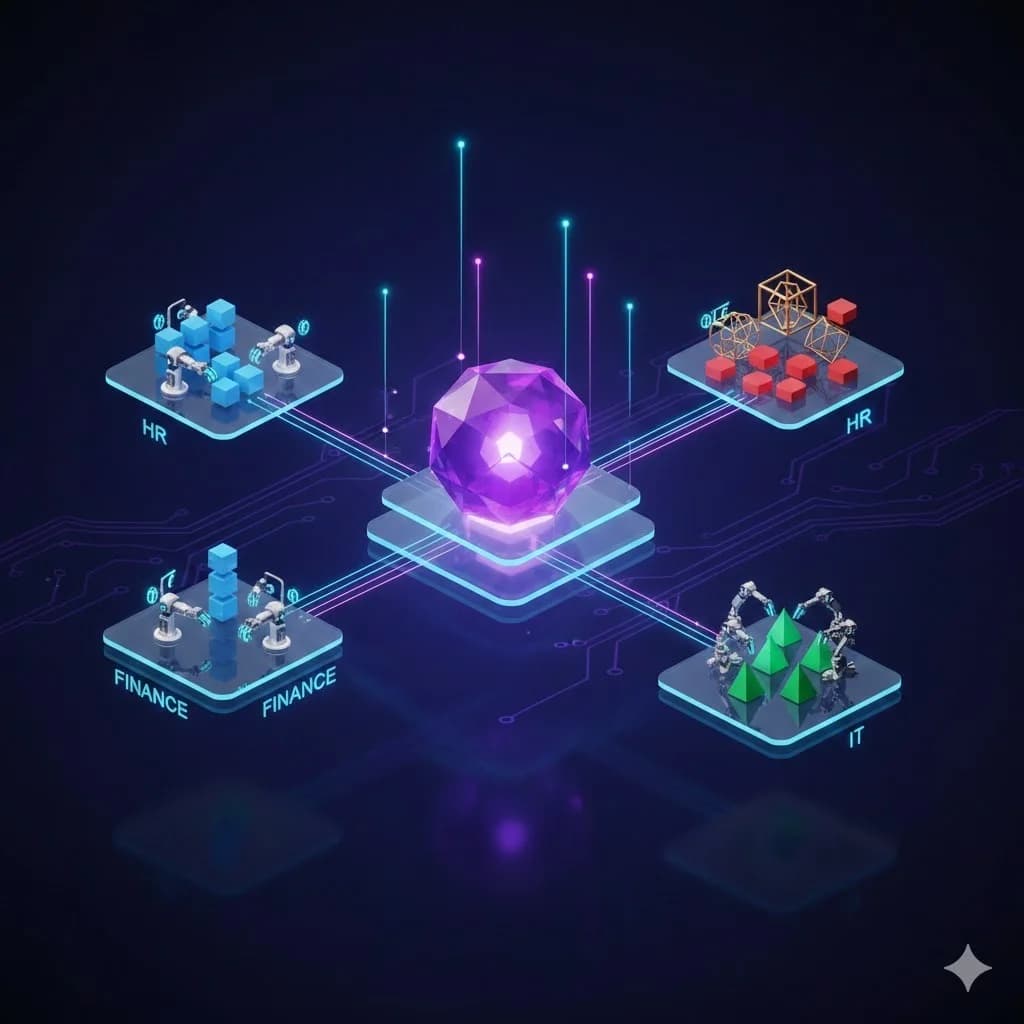

Architectural Vision
Orchestration across business silos
The Operational Mechanics
of Agentic AI
In an enterprise, an Agentic AI BOT Platform works as an intelligent workforce layer sitting above your existing systems. Instead of just following pre-set rules, it uses a central 'Orchestrator' to understand business intent. This Orchestrator breaks down complex requests (like 'Onboard a new vendor') into smaller tasks, assigns them to specialized agents (e.g., Document Verifier, Database Updater), retrieves necessary policy data via RAG, and executes actions directly in your ERP or CRM, all while maintaining strict security protocols and human oversight.
Standard Automation vs. Agentic Workflow
Why moving from "If-This-Then-That" to "Observe-Think-Act" changes everything for the enterprise.
- Breaks if interface or data format changes slightly.
- Requires defining every single step in advance.
- Linear execution; cannot handle exceptions gracefully.
- Resilient to UI changes; understands semantic intent.
- Dynamically figures out steps based on the goal.
- Handles exceptions by replanning or asking for help.
Inside the Machine: The Execution Flow
Intent Recognition & Planning
Step 01The core engine analyzes user requests to understand the 'why' and plans a multi-step execution strategy.
Task Delegation to Agents
Step 02The plan is devolved into sub-tasks assigned to specialized micro-agents (e.g., Code Agent, Email Agent).
Contextual Data Retrieval
Step 03Agents pull real-time data from internal wikis, databases, and logs to ensure decisions are fact-based.
Secure Execution
Step 04Actions are performed via secure APIs with role-based access controls, ensuring no unauthorized changes.
Looping & Self-Correction
Step 05If an error occurs, the agents self-correct or escalate to a human, learning from the resolution.

Enterprise Setup Components
Agents at Work
Practical examples of automated reasoning solving daily enterprise challenges.
Invoice Processing
Agents read PDFs, match POs in ERP, update inventory, and schedule payments autonomously.
Employee Onboarding
Agents provision IT accounts, schedule training, and verify tax documents with zero delay.
Incident Response
Agents detect system outages, reroute traffic, and notify stakeholders instantly.
Market Analysis
Agents scrape competitor pricing, analyze trends, and suggest strategy adjustments.
Critical Enterprise Requirements
For an Agentic Platform to work in an enterprise, it needs more than just intelligence. It requires a robust infrastructure of control, observability, and integration.
Implementation Resources

The "Human in the Loop" Guarantee
Converiqo ensures that no agent goes rogue. By defining strict boundaries and requiring human approval for high-impact actions (like large financial transfers), we make autonomous AI safe for business critical operations.
Traceability
Every decision log is retained
API Security
OAuth2 & SOC2 compliant access
Executive Takeaway
Implementing Agentic AI is not just about adopting a new tool; it's about restructuring how work flows through your organization. By moving to a model where agents understand intent, execute workflows independently, and learn from outcomes, enterprises can achieve a level of agility and efficiency previously impossible with static automation. The "How" is in the orchestration—unifying diverse systems under a single reasoning engine. Review our cost structure of enterprise AI bot platforms to plan your budget.
Related Agentic AI Platform Pages
Explore more resources and solutions on agentic workflows and AI-driven business systems.
Agentic AI for Businesses
Deploy custom, pre-built agentic workflows for 213+ different business types.
Customer Self-Service AI Bot Platforms
Automate customer interactions and support queries using cognitive agent networks.
Employee Self-Service AI Bot Platforms
Simplify HR, IT, and internal employee operations with secure automated workflows.
Unified AI Bot Platforms for Lead Generation
Orchestrate sales pipelines, qualify visitors, and drive high-intent leads autonomously.
Converiqo Automations & Workflows
Explore the comprehensive directory of our workflow automation solutions.
Cost Structure of Enterprise AI Bot Platforms
Detailed guide to licensing, cloud computing costs, vector storage, and Opex vs Capex.
Want to see Agentic AI in Action?
Don't just read about it. Watch our platform orchestrate a complex enterprise workflow in real-time.
References, Sources & Empirical Evidence
Academic & Industry Citations
- “Gartner Top Strategic Technology Trends for 2025: Agentic AI” — Gartner Research (2024)Source
Highlights how autonomous agentic systems reason, plan, and take actions to meet user goals.
- “The economic potential of generative AI: The next productivity frontier” — McKinsey & Company (2023)Source
Details operational efficiency gains from deploying workflow automation and autonomous agents in enterprises.