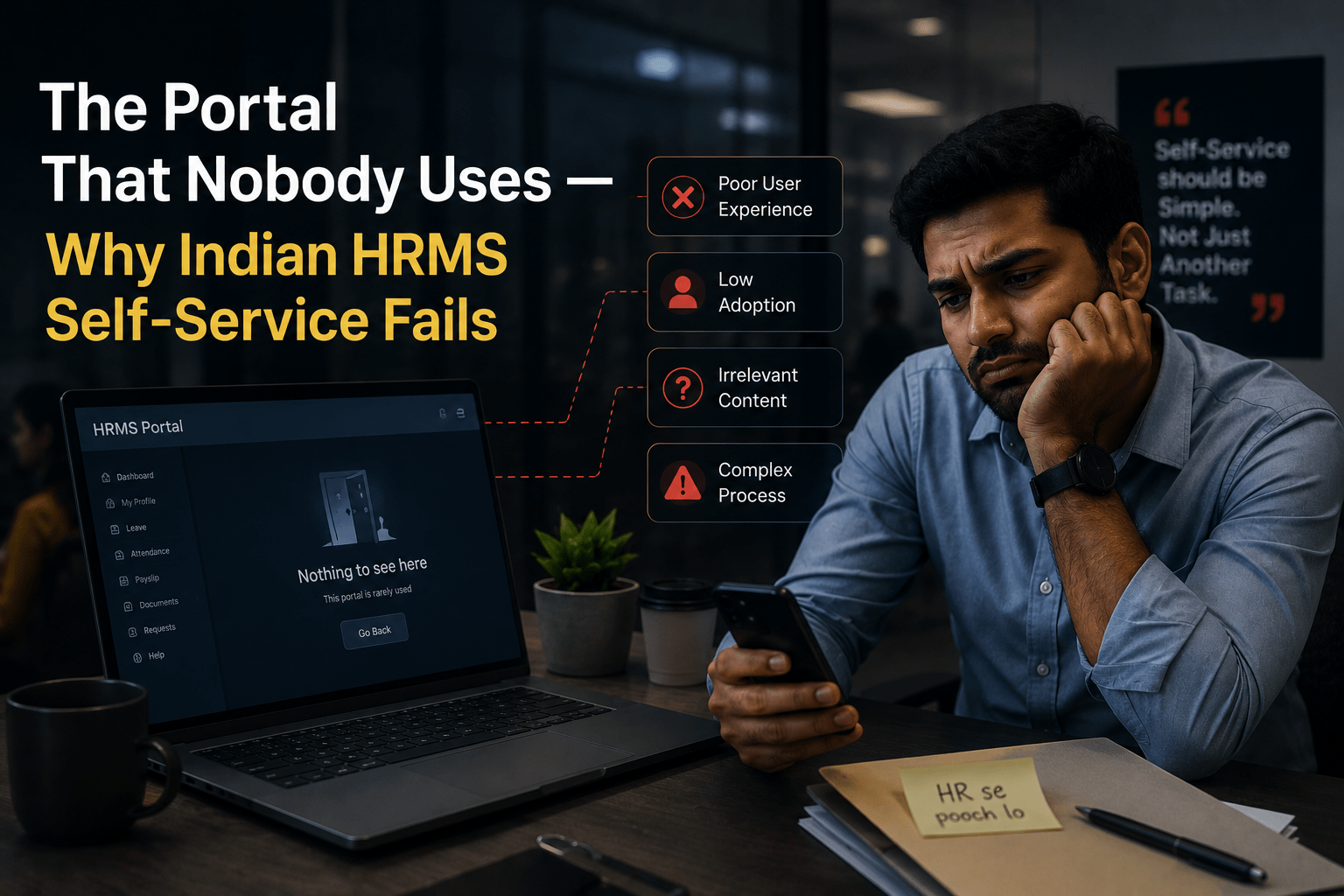
Walk into any Indian company between 300 and 5,000 employees and ask the CHRO about employee self-service. Most will point to their HRMS - Keka, Darwinbox, Zoho People, GreytHR, SAP SuccessFactors, Workday, depending on what the company runs. They will describe the portal modules - leave, payroll, policies, documents, reimbursements. They will reference the implementation project that deployed it. They will describe the change management push that accompanied launch.
Then ask about adoption. The answer narrows. The portal works. The features are there. Adoption is at 18%, or 22%, or sometimes 30% on a good month. The HR team is still handling most routine queries on Slack, on email, on WhatsApp, in person. The portal sits as an option that employees choose not to use.
The diagnosis HR teams reach for first
Most HR teams diagnose low portal adoption as a change management problem. The employees did not get sufficient training. The communication was not clear enough. Managers are not pushing their teams to use the portal. The next quarter's plan involves more training, more communication, more manager nudging, sometimes a gamification layer to encourage portal logins.
None of these address the actual reason employees do not use the portal. The behaviour is not a knowledge gap. Most employees know the portal exists, know how to access it, and have used it at least once. They choose not to use it for routine queries because the alternative - asking a colleague or HR on Slack - is faster and easier.
The three structural reasons portals lose to Slack
Channel friction. The employee is already in Slack handling work communication. Asking the HR question in Slack costs nothing. Logging into a portal costs a context switch, a separate tab, navigation through menus, finding the right module. The friction per query is small. Multiplied across hundreds of routine queries per employee per year, the difference compounds. Employees consistently choose the lower-friction option.
Form-based interaction. Portals collect information through forms - date pickers, dropdowns, checkboxes, text fields, attach-file buttons. Forms work for transactions where the employee already knows the exact action they want to take. Forms fail for queries where the employee is asking for information, where the request involves judgement, or where the right answer depends on context - the employee's role, location, tenure, manager. Asking 'do I get parental leave for this situation' is a conversation, not a form.
Discovery problem. Even when the answer exists in the portal, employees struggle to find it. The maternity leave policy is in a documents section three clicks deep, named according to the policy taxonomy that HR uses internally rather than the words an employee would search. The reimbursement category breakdown is a help article in a section called 'Policies — Finance.' The holiday calendar for the employee's specific office is in a different module from the leave application. Each routine query requires the employee to remember where its answer lives - and most employees do not.
What more training does not fix
Most HR teams respond to low adoption by scheduling more training. The training is well-intentioned and largely irrelevant. Training teaches employees how to use the portal. The employees already know how. The barrier is not training. The barrier is that the portal experience is worse than the alternative for the majority of routine queries the employee actually has.
Training will not change the channel friction. Training will not change the form-based interaction. Training will not solve the discovery problem. Training will produce a small adoption bump for two to four weeks following the training, followed by adoption settling back to the baseline. This pattern repeats across companies and across training cycles.
What channel-native ESS does differently
Channel-native employee self-service automation addresses each of the three structural problems.
It eliminates channel friction by meeting employees where they already are. The employee asks the HR question in Slack, MS Teams, or WhatsApp - the same channel they use for working communication. No context switch. No separate login. No alternative path that takes longer than asking a human.
It replaces form-based with conversational. The employee describes what they need in natural language. The AI agent figures out the intent, asks clarifying questions where appropriate, and either answers or executes. The employee does not need to know the right menu, the right form, or the right policy taxonomy.
It solves discovery by handling it. The employee does not need to find the maternity leave policy. The AI agent retrieves and references the policy version applicable to that employee. Discovery becomes an internal function of the system, not a burden on the employee.
Channel-native ESS does not replace the HRMS. The HRMS continues to be the system of record. The portal continues to exist for power users and for the cases where a portal interface is genuinely the right interface (some bulk administrative tasks, for example). The interface for routine employee interaction shifts from portal to channel, and adoption shifts with it.
What changes when the diagnosis is honest
Companies that name the portal adoption problem accurately - as a structural mismatch between portal interface and employee behaviour, not as a change management failure - stop investing in training cycles that do not work and start investing in channel-native delivery that does. The HRMS investment is preserved; the access layer above it changes. The same data, the same workflows, the same compliance - accessed through Slack, MS Teams, and WhatsApp rather than through a portal employees did not want to use.
About the Author

Avni Chadha
Ready to orchestrate your AI future?
Converiqo AI helps you design, deploy, and scale automation workflows that move your business faster, leveraging specialized solutions like our AI bot platform for lead generation, customer self-service AI bot platform, employee self-service AI bot platform, retail omnichannel automation, and our detailed guides on how agentic AI bot platforms work in enterprises and cost structure of enterprise AI bot platforms. Connect with our team to see the platform in action and co-create the next chapter of intelligent operations.
Read More Blogs
Discover more insights and product updates curated by the Converiqo AI team.
Real ROI of Field Force Automation - Beyond the Activity Dashboard
Four metrics that show real field force automation ROI in India - productivity, data reliability, throughput, and field attrition - not just the activity dashboard.

Beat Planning Is the Highest-Leverage Field Force Capability - Here Is Why
Beat planning decides coverage, call frequency, and whether field time is productive. Why it is the single highest-leverage field force automation capability.
Why an Indian Field Force App Has to Work Offline - and Be Built for Real Devices
Field work in India happens where connectivity is intermittent. A field force app that assumes constant connectivity fails exactly where field work is done.