Most WhatsApp lead funnels do the first half well and the second half badly.
The qualification works. The information delivery works. The lead is interested. And then - the booking workflow breaks. A generic Calendly link gets sent. The lead is asked to switch apps. They open the link, see slots, get distracted, never come back.
Or worse - the lead is told 'our sales team will call you back.' That call comes 2 hours later, at a time the lead is busy, and the conversation never resumes.
Here is the booking workflow that actually converts qualified leads - kept inside WhatsApp, structured, calendar-integrated, automated for the standard path.
The principle - keep the booking inside the conversation
Every time you ask a WhatsApp lead to switch to another app, another website, another channel, you lose a meaningful share of them.
The strongest booking workflow keeps the entire interaction inside WhatsApp. The lead sees available slots in the chat. They pick one with a tap. They get confirmation in the same thread. They get reminders before the meeting.
This is now technically possible through WhatsApp Flows - Meta's structured form-and-screen interface inside the chat. A Flow-based slot picker shows real calendar availability, lets the lead select, and writes the booking back to your calendar.
The 4-step booking workflow
Step 1 - Booking proposal
After qualification and information delivery, the conversation reaches the point where a booking is the natural next step. The automated message proposes a booking specifically - not 'do you want to schedule a call?' (which leaves the lead doing the work), but 'would you like to book a 15-minute consultation with our specialist? Here are the next available slots.'
Specific. Concrete. Easy to act on.
Step 2 - Slot selection through a Flow
Flow-based slot picker shows the next 3 to 5 available slots - date, time, duration. Lead taps to select. The Flow can also collect supporting details if needed - meeting preference (in-person vs video), language preference, specific concern to discuss.
Step 3 - Confirmation and calendar invite
Within seconds of slot selection - confirmation message in WhatsApp with date, time, location or video link, and any preparation instructions. Calendar invite automatically generated and sent to the lead's email. Salesperson's calendar updated automatically.
Step 4 - Reminder sequence
Day-before reminder. Day-of reminder. For high-value meetings, an additional reminder 30 minutes before with the location link or video link readily clickable.
All template-based after the 24-hour window, all categorised as utility (transactional, tied to the lead's specific action).
What kills the booking workflow
1. Calendly links
Generic Calendly link in a WhatsApp message. Lead has to click, leave WhatsApp, navigate the Calendly interface, pick a slot, confirm. Each step loses customers.
Calendly is fine as a back-end calendar system. It is not fine as the front-end booking interface on WhatsApp.
2. 'We will call you back'
The lead is asked to wait for a callback at an unspecified time. They go back to their day. By the time the callback comes, they are busy, distracted, or no longer in the buying mindset.
The 'we will call you back' pattern converts dramatically worse than 'book a slot now' pattern. Yet it is the default for most Indian businesses.
3. Free-text time negotiation
'What time works for you?' Lead replies 'evening.' Bot replies 'how about 6 PM?' Lead replies 'too early, 8 PM.' Bot has to look up the salesperson's calendar manually.
This back-and-forth eats minutes and increases drop-off. Structured slot picker beats free-text negotiation every time.
4. No reminders
Booking is made on Monday for Thursday. By Thursday, the lead has forgotten or got busy. No-show rates spike.
Day-before and day-of reminders should be automated. They are utility-category templates so they are inexpensive. They lift show-up rates substantially.
Show-up rates - the underdone metric
Most Indian businesses measure cost per booking. They should measure cost per show-up, because a no-show is functionally a lost booking.
Reminders are the single biggest lever on show-up rates. A booking with no reminders has dramatically lower show-up than a booking with day-before and day-of reminders.
Other levers - clarity of meeting purpose (the lead knows what value they will get), trust signals before the meeting (a brief case study or success story sent the day before), and ease of joining or arriving (clickable location link, single-click video join).
Handling no-shows
Some no-shows are unavoidable. The workflow should handle them gracefully.
Within 30 minutes of the missed meeting - automated message acknowledging the no-show and offering to reschedule. One tap to book a new slot.
Day after - a softer follow-up with new available slots.
Week after - a template-based re-engagement, similar to other dormant lead nurture.
What does not work - sales team manually following up on no-shows. Most do not get followed up at all. Automating the rescheduling workflow recovers a meaningful share of no-shows that would otherwise be lost.
Post-meeting follow-up
The meeting happens. What next?
Within hours - a follow-up message from the salesperson (often manual but cued by the automation platform) covering what was discussed, any specific information promised, and the next step.
Day 1-3 - answers to any specific questions raised, materials shared, decision support.
Day 4-7 - gentle progression toward the next step. Another meeting, a proposal, a site visit, a closing.
Post-meeting is where the highest-intent leads sit. The automation should support the salesperson — surfacing context, sending materials, reminding about follow-up commitments - not replace them.
The shift to make
Stop treating the booking step as an afterthought to the qualification step.
Start treating it as the moment that decides whether a qualified lead becomes a meeting - and design the workflow with the same care you give to the rest of the funnel.
Keep the booking inside WhatsApp. Use Flow-based slot selection. Automate confirmation and reminders. Handle no-shows gracefully. Support the post-meeting follow-up.
The difference between a 30 percent qualification-to-meeting conversion and a 60 percent one is almost entirely in the booking workflow. The qualification work is done. Do not lose the lead at the finish line.
About the Author

Avni Chadha
Ready to orchestrate your AI future?
Converiqo AI helps you design, deploy, and scale automation workflows that move your business faster, leveraging specialized solutions like our AI bot platform for lead generation, customer self-service AI bot platform, employee self-service AI bot platform, retail omnichannel automation, and our detailed guides on how agentic AI bot platforms work in enterprises and cost structure of enterprise AI bot platforms. Connect with our team to see the platform in action and co-create the next chapter of intelligent operations.
Read More Blogs
Discover more insights and product updates curated by the Converiqo AI team.
Real ROI of Field Force Automation - Beyond the Activity Dashboard
Four metrics that show real field force automation ROI in India - productivity, data reliability, throughput, and field attrition - not just the activity dashboard.

Beat Planning Is the Highest-Leverage Field Force Capability - Here Is Why
Beat planning decides coverage, call frequency, and whether field time is productive. Why it is the single highest-leverage field force automation capability.
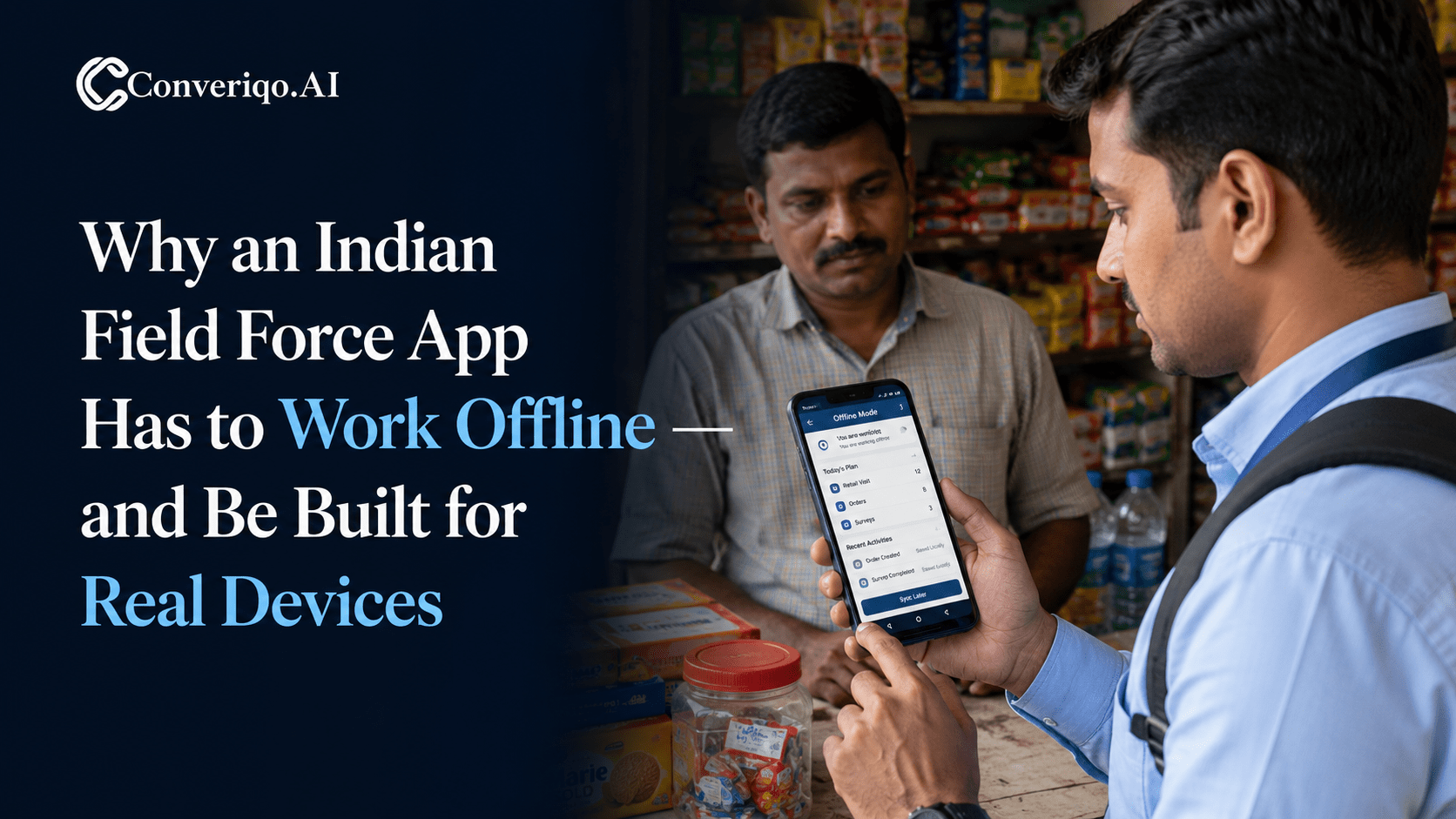
Why an Indian Field Force App Has to Work Offline - and Be Built for Real Devices
Field work in India happens where connectivity is intermittent. A field force app that assumes constant connectivity fails exactly where field work is done.