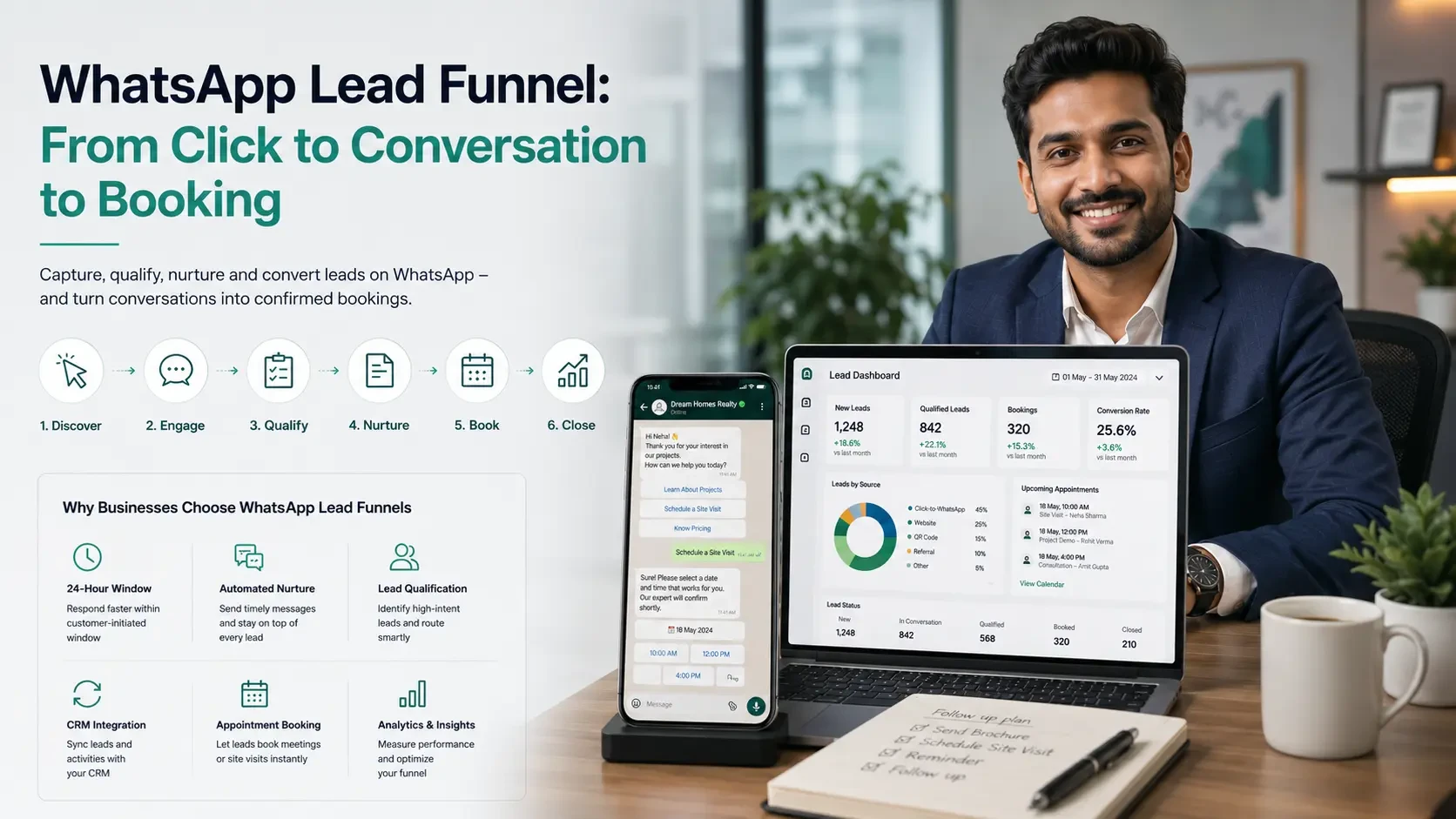
Not every business sells inside the WhatsApp conversation.
Real estate sales close at a site visit. Education enrolments close after a demo class. Insurance closes after a quote and a callback. Test drives close at the showroom. Doctor consultations close in the clinic. B2B deals close after a demo and several follow-ups.
For these businesses, WhatsApp is not the place the sale happens. It is the place the funnel starts.
And in India, this is where most lead funnels quietly bleed value. The click-to-WhatsApp ad fires. The lead arrives in the chat. And then - silence for two hours. A generic greeting. A salesperson who finally responds at 8 PM with no context. A booking link buried somewhere. A meeting that never gets scheduled. A lead that goes cold.
This pillar is about the workflow that fixes that. From click, to conversation, to qualified booking - done well, automated where it should be, human where it matters, integrated with the CRM and calendar that close the sale.
Why WhatsApp lead funnels need a different playbook from commerce
On the surface, both start the same way - a click-to-WhatsApp ad, a conversation, a qualification.
Underneath, the economics and the timing are very different.
Commerce funnels close in hours or days. The customer is buying a product. Decision cycle is short. Average order value is bounded. Conversion happens inside the same WhatsApp thread.
Lead funnels close in weeks or months. The customer is buying a high-consideration service or a property or an education programme. Decision cycle is long. Lifetime value is high. Conversion happens at a site visit, a clinic, a showroom, or a meeting - off the WhatsApp platform entirely.
Three implications for the funnel design.
Qualification matters more than at commerce. You are not just trying to close - you are trying to identify which leads are worth your sales team's time. Bad qualification means strong leads get the same treatment as window-shoppers.
Nurture matters more. Most leads will not convert in the first conversation. The funnel needs to follow up over days and weeks, in WhatsApp, without becoming spam.
The 24-hour rule matters dramatically. Outside the customer-initiated 24-hour window, you need template messages to reach out. Most Indian businesses misunderstand this and either spam customers with broken nurture or give up too early.
The 6-stage WhatsApp lead funnel
Stage 1 - Discovery and capture
How the lead enters the WhatsApp conversation. Click-to-WhatsApp ads are the dominant source in India for most categories. Other paths - website chat widget that opens WhatsApp, QR codes on offline material (brochures, hoardings, vehicle wraps, event banners), wa.me links in email signatures and SMS, social media bio links.
At discovery, the goal is just one thing - get the conversation started cleanly with enough context that the next stage can do its job.
Stage 2 - Welcome and intent qualifier
The first automated message sets the tone. Should arrive within seconds of the lead's first message.
What works - acknowledges what they came in for (if the source carried context, like the ad they clicked), thanks them for the interest, and asks one specific qualifying question that helps route the conversation. Not five questions. One.
What does not - generic 'Welcome! How can we help?' This forces the lead to do the framing work and signals that the business has no idea what they want.
Stage 3 - Need qualification
2 to 3 conversational questions that surface what the lead actually needs. These should feel like a knowledgeable salesperson asking the right questions, not a form.
For real estate - what configuration, what budget range, what location, when looking to buy.
For education - what stream, what level, what timeline, full-time or part-time.
For insurance - what type, what cover amount, any existing policies, age and dependents.
Done well, these questions feel like helpful narrowing. Done badly, they feel like an interrogation.
Stage 4 - Information delivery and trust building
Based on the qualification, share specific information that addresses what the lead asked about. Product details, brochures, price ranges, case studies, customer testimonials, virtual tour videos.
This is where the AI does most of the heavy lifting. Sharing the right brochure, the right price range, the right next-step suggestion based on what the qualification revealed.
Stage 5 - Booking or handoff
The funnel's core conversion event - book a site visit, demo class, test drive, consultation, or sales call.
Strong implementations offer calendar slots inside WhatsApp (often through a Flow-based booking interface) so the lead can pick a time without leaving the chat. The booking syncs to the salesperson's calendar automatically.
Weak implementations send a generic Calendly link and hope. Drop-off here is high.
Stage 6 - Confirmation, reminders, and post-meeting follow-up
Once the booking is made, automated workflows handle confirmation, calendar invite, day-before reminder, day-of reminder, and post-meeting follow-up.
Post-meeting follow-up matters disproportionately. A strong post-visit message - 'thanks for visiting, here is the brochure and pricing we discussed, here is the property comparison you asked about, when would be a good time for a follow-up call' - recovers a meaningful share of deals that would otherwise have gone quiet.
The 24-hour window - why most Indian businesses misunderstand it
WhatsApp Business API has a specific rule. Once a customer messages you, you can reply freely for 24 hours. After 24 hours of inactivity, you cannot send free-form messages - you can only send pre-approved template messages.
Most Indian businesses misunderstand this in two opposite directions.
Some assume they can keep messaging the customer indefinitely after they first reach out. They cannot. Templates must be used after 24 hours. Free-form responses are blocked.
Others assume once the 24-hour window passes, the relationship is over. It is not. Pre-approved template messages can re-engage leads weeks or months later - if the customer has opted in.
What the rule actually means for lead nurture
Inside the 24-hour window - free-form messages allowed. This is when the heavy lifting of qualification, information delivery, and booking happens.
Outside the 24-hour window - only template messages allowed. These need to be pre-approved by Meta. They are categorised (marketing, utility, authentication, service) and priced accordingly.
Re-engagement happens through templates. A 'thinking of you' message after 3 days of silence. A 'special offer' after a week. A 'we have new inventory matching what you wanted' after a month. All template-based, all categorised correctly, all sent only to leads who opted in.
What good 24-hour-aware nurture looks like
-
minute 0-30 - automated welcome and first qualifier
-
minute 30 to hour 2 - qualification follow-up if no response, then info delivery
-
hour 2-24 - booking attempt, with reminders if not yet booked
-
day 2-3 - template-based re-engagement if lead went quiet (categorised as utility - 'your enquiry from Date is still active, here is the info you asked about')
-
day 4-7 - template-based check-in (marketing category - 'a property similar to what you saw just got listed')
-
day 8-30 - periodic template-based re-engagement, decreasing in frequency
-
day 30+ quarterly check-in templates unless lead explicitly asks to be removed
Qualification 0 getting it right
Most WhatsApp lead funnels either over-qualify (scaring leads away with too many questions) or under-qualify (passing every lead to sales, including the time-wasters).
What good qualification looks like
2 to 3 questions, ordered from least sensitive to most sensitive. Each question conversational, not form-like. Each answer pre-filtered through structured options where possible (buttons, list pickers) so the lead does not have to type.
Example for real estate - 'are you looking for residential or commercial' (button), 'what configuration are you interested in' (list picker - 2BHK, 3BHK, 4BHK, plot), 'when are you planning to buy' (list picker - immediately, in 3-6 months, exploring options).
Three short questions. Each answer narrows the lead. By the end, the salesperson knows whether this lead is worth a follow-up call tomorrow or a generic nurture sequence.
What bad qualification looks like
10 questions before the lead has shown serious intent. Each one asked in free-form text. Long forms thrown at the lead in the first 5 minutes. Sensitive questions (budget, identity verification, personal details) asked too early.
Or - the opposite - no qualification at all. Every lead routed to a human salesperson who has to do all the qualifying themselves over the phone or in person. Sales team burns out. Strong leads get lost in the noise of weak ones.
Integrating with the CRM and calendar
A lead in WhatsApp that does not flow into the CRM is a lead that will be forgotten.
What integration enables - lead automatically created in the CRM the moment the conversation starts, qualification answers populated as CRM fields, conversation history accessible from the CRM record, sales rep can pick up from WhatsApp on their CRM dashboard, calendar bookings sync both ways, follow-up tasks created automatically based on conversation outcome.
Standard integrations Indian businesses need - Salesforce, Zoho CRM, HubSpot, LeadSquared, Microsoft Dynamics, Pipedrive. Plus Google Calendar, Outlook Calendar. Plus the call dialler if outbound calls are part of the funnel.
Where integration breaks down, the whole funnel breaks down. Leads sit in a WhatsApp dashboard, the CRM has stale data, salespeople work from spreadsheets, and the same lead gets contacted by three people who do not know about each other.
Industries where WhatsApp lead funnels work best in India
Real estate
The single largest WhatsApp lead funnel category in India. CTWA ads to project pages. Qualification on configuration, budget, timeline. Information delivery - floor plans, pricing, virtual tours. Site visit booking. Post-visit follow-up. Long nurture cycles because real estate decisions take months.
Education and EdTech
Coaching centres, EdTech platforms, schools, colleges, overseas education consultants, professional courses. CTWA ads to course pages. Qualification on programme, level, timeline, working status. Demo class booking. Counsellor consultation booking. Long enrolment cycles especially for higher-ticket programmes.
Insurance
Life, health, motor, term, child plans. CTWA ads to specific product pages. Qualification on type, cover amount, dependents, existing policies. Quote delivery. Callback booking. Especially strong fit because insurance decisions involve trust-building over multiple conversations.
Automotive
Car dealerships, two-wheeler dealerships, electric vehicle showrooms. CTWA ads to specific models. Qualification on model interest, budget, financing needs. Test drive booking. Showroom appointment. Post-test-drive follow-up.
Healthcare
Hospitals, multi-specialty clinics, diagnostic chains, specialist practices, second-opinion services. CTWA ads to specific specialities or services. Qualification on condition, urgency, insurance. Appointment booking. Post-consultation follow-up.
B2B services
SaaS, consulting, agencies, professional services. CTWA ads to specific service pages. Qualification on company size, role, specific need, timeline. Demo or discovery call booking. Multi-touch nurture over weeks.
Costs and economics
WhatsApp lead funnel economics in India typically work out favourably compared to alternatives.
Cost per qualified lead is often lower than equivalent Google Ads, Meta web ads, or other paid channels — because the conversation does work that a landing page cannot do. Qualification happens in the same channel as the click. Lead-to-meeting conversion is meaningfully higher than lead-to-form-fill conversion.
What kills the economics - slow response times (a 2-hour response converts dramatically worse than a 2-minute response), no qualification logic (sales team burns through unqualified leads), no nurture for leads that go quiet, no integration with the CRM (leads get lost in handoff).
Done well, a strong Indian WhatsApp lead funnel typically pays back its automation platform cost many times over within the first few months. Done badly, it consumes ad spend and sales time without producing proportional pipeline.
What good Indian WhatsApp lead funnels look like
-
click-to-WhatsApp ad opens conversation with context-aware welcome
-
first response within seconds - automated, contextual, asking one qualifying question
-
2 to 3 structured qualification questions over the next 5 minutes
-
information delivery tailored to the qualification answers
-
booking through a Flow-based slot picker that syncs to the salesperson's calendar
-
confirmation, day-before reminder, day-of reminder - all automated
-
post-meeting follow-up within hours of the meeting
-
template-based nurture for leads that go quiet, paced over days and weeks
-
deep CRM integration so the salesperson has full context at every touchpoint
-
performance measured - cost per qualified lead, qualification rate, booking conversion, show-up rate, deal conversion
What bad Indian WhatsApp lead funnels look like
-
first response in 2-6 hours, after the lead has gone cold
-
generic 'How can we help' welcome message that puts the framing burden on the lead
-
no automated qualification - every lead handled manually by a sales team that cannot keep up
-
long forms or 10 questions thrown at the lead in the first 5 minutes
-
Calendly link buried in a long message instead of an in-chat booking
-
no follow-up after the meeting - the lead either calls back or is lost
-
no understanding of the 24-hour rule - either ghosting the lead after 24 hours or trying to send free-form messages that get blocked
-
leads sit in a WhatsApp dashboard that does not talk to the CRM
-
no measurement - no cost per qualified lead, no conversion rates by stage, no clarity on what is working
The shift to make
Stop treating WhatsApp as a lead-capture form that happens to live in a chat.
Start treating it as the end-to-end funnel - discovery, qualification, information delivery, booking, reminders, follow-up, nurture - with automation handling the standard path and humans handling the moments that need them.
The Indian businesses winning on WhatsApp lead generation in 2026 are not the ones spending more on ads. They are the ones converting more of the leads the ads bring in, by running a properly designed funnel inside the conversation.
The ad spend and the salespeople you already have produce dramatically different pipeline depending on whether the funnel between them is built well or not. That is the gap most businesses underestimate.
Frequently asked questions
How fast does the first response need to be?
Seconds, not hours. A lead who clicks a CTWA ad is at peak intent in the first 2 to 5 minutes. After 30 minutes, conversion rates drop substantially. After 2 hours, they drop dramatically. The first response should be automated, contextual, and immediate.
How many qualification questions are too many?
Three is typically right. Five is the upper limit before drop-off becomes significant. Anything beyond five feels like an interrogation. The exception - B2B funnels where high-value deals justify deeper upfront qualification.
What happens to leads who do not book in the first conversation?
They go into a template-based nurture sequence. Day 3 check-in. Day 7 re-engagement with new information. Day 14 specific offer or value-add. Day 30 quarterly check-in. Each message is a pre-approved template, sent only to leads who opted in.
Do leads find WhatsApp lead funnels intrusive?
Most do not - if the funnel is well-designed. The conversation is one they started by clicking an ad. The pace is reasonable. The qualification is conversational. The booking is easy. Leads who do find it intrusive are usually responding to bad funnel design - too many messages, irrelevant content, ignored opt-out requests.
How does this integrate with our existing sales team?
Sales team gets qualified leads with full context and a booked meeting on their calendar. They do not waste time on initial qualification, scheduling back-and-forth, or chasing cold leads. They focus on the moments that need a human - the meeting, the close, the relationship.
Can this work for high-ticket B2B sales?
Yes, with adjustments. B2B funnels typically have deeper qualification (more questions, more nuanced), longer nurture cycles (weeks to months), and the WhatsApp conversation is one of multiple touchpoints (email, LinkedIn, phone calls). The principles are the same - fast response, smart qualification, automated nurture, deep CRM integration.
About the Author

Md Ashik Alam
Ready to orchestrate your AI future?
Converiqo AI helps you design, deploy, and scale automation workflows that move your business faster, leveraging specialized solutions like our AI bot platform for lead generation, customer self-service AI bot platform, employee self-service AI bot platform, retail omnichannel automation, and our detailed guides on how agentic AI bot platforms work in enterprises and cost structure of enterprise AI bot platforms. Connect with our team to see the platform in action and co-create the next chapter of intelligent operations.
Read More Blogs
Discover more insights and product updates curated by the Converiqo AI team.
Real ROI of Field Force Automation - Beyond the Activity Dashboard
Four metrics that show real field force automation ROI in India - productivity, data reliability, throughput, and field attrition - not just the activity dashboard.
Beat Planning Is the Highest-Leverage Field Force Capability - Here Is Why
Beat planning decides coverage, call frequency, and whether field time is productive. Why it is the single highest-leverage field force automation capability.
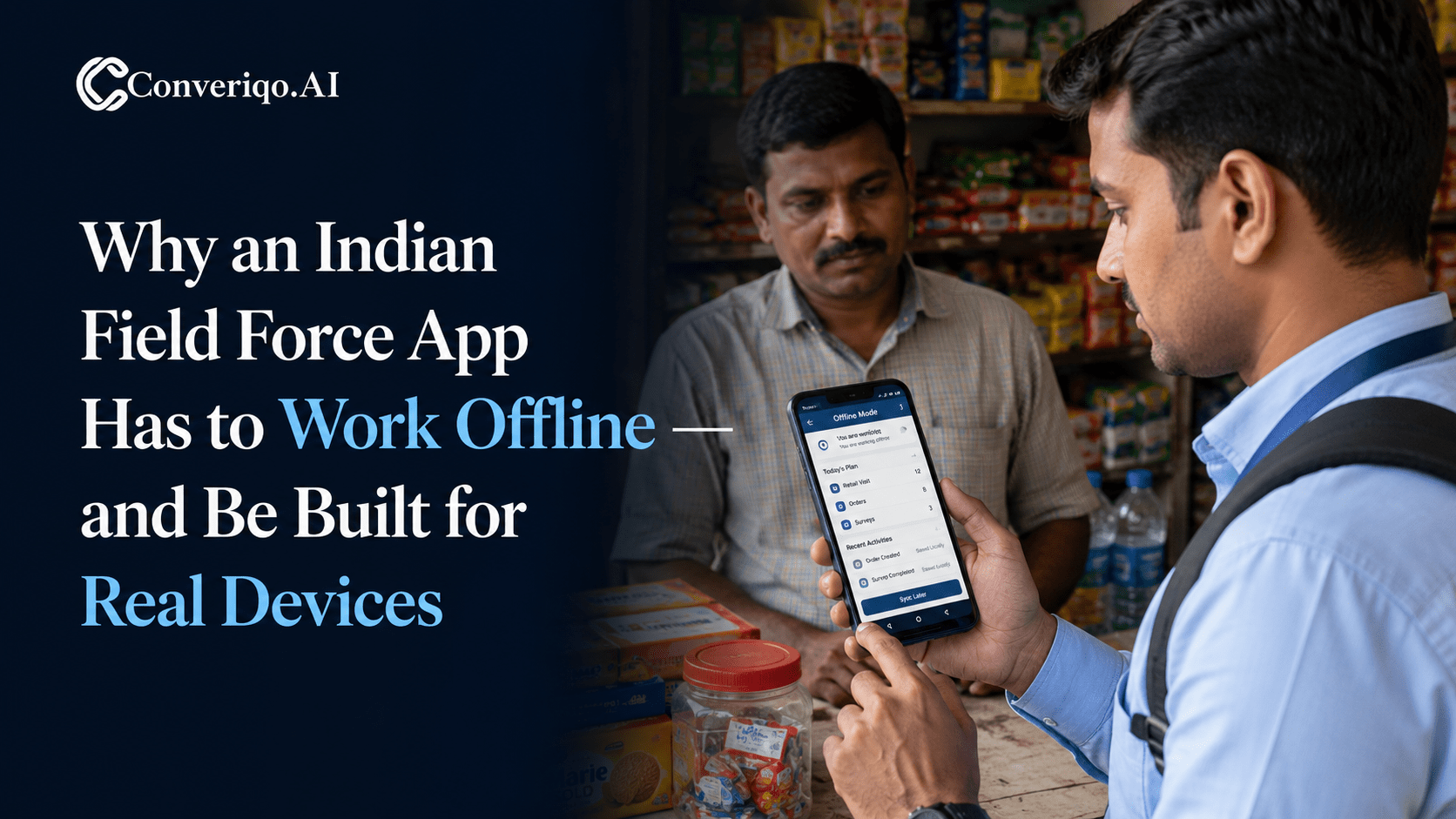
Why an Indian Field Force App Has to Work Offline - and Be Built for Real Devices
Field work in India happens where connectivity is intermittent. A field force app that assumes constant connectivity fails exactly where field work is done.