
Most WhatsApp lead funnels in India get qualification wrong in one of two opposite directions.
Some over-qualify - 10 questions in the first 5 minutes, leads disappear before they answer the third.
Others under-qualify - no automated questions at all, every lead pushed straight to a sales team that has to do the qualifying themselves over the phone or in person.
The middle path - 2 to 3 structured questions, conversationally framed, button-based answers where possible - produces dramatically better economics than either extreme.
What good qualification does
Three things at once.
It tells you which leads are serious. The ones who answer all three questions seriously are higher intent than the ones who drop off after the first one.
It tells you what each serious lead actually wants. Answers feed directly into how the conversation continues — what information to share, which salesperson to route to, which calendar slots to offer.
It saves the sales team's time. They take warm, qualified leads with context. They do not waste hours on cold leads who never had real intent.
The 3-question framework
Three questions, ordered from least sensitive to most sensitive. Each one feels conversational, not form-like. Each answer through structured options (buttons, list pickers) so the lead does not have to type.
Question 1 - Intent qualifier
What are they actually looking for? This filters the broadest category.
Real estate - residential or commercial.
Education - UG, PG, working professional course, school.
Insurance - health, life, motor, term.
Automotive - specific model, comparison shopping, financing.
Healthcare - appointment with specific specialist, second opinion, diagnostic.
B2B - specific service, problem they are solving, evaluation stage.
Should be answerable with one tap on a button. Three to five options.
Question 2 - Need qualifier
What specifically are they trying to achieve? This narrows the conversation.
Real estate - what configuration (2BHK, 3BHK, 4BHK, plot, villa).
Education - what programme or stream.
Insurance - what coverage amount range.
Automotive - what variant, what features matter.
Healthcare - symptom or condition, urgency.
B2B - team size, current pain point, current solution if any.
Question 3 - Timeline qualifier
When are they planning to act? This separates buyers from browsers.
List picker with 3 to 4 options - immediately, in 1-3 months, in 3-6 months, exploring.
The answer to this question alone is often the strongest predictor of whether the lead converts. 'Immediately' goes to the senior sales team. 'Exploring' goes into a longer nurture sequence.
Sensitive questions that should NOT be asked in the first 5 minutes
-
exact budget or current financial situation
-
identity proof or document numbers
-
current address or employer details
-
names of family members
-
specific medical history or conditions beyond what is needed for routing
-
current spending on competing products or services
These belong later in the funnel - after trust has been built, after the lead has seen value, after they have agreed to a meeting.
Structured vs free-text answers
Structured answers (buttons, list pickers) convert dramatically better than free-text questions.
Three reasons. One - speed. A button takes one tap. Typing takes 10 seconds and most leads will skip. Two - data quality. Structured answers slot directly into CRM fields and routing logic. Free text needs interpretation. Three - drop-off. Free-text questions feel like effort. Buttons feel like progress.
Use free text only when the question genuinely needs it - describing a specific medical concern, sharing a property preference outside the standard options, describing a B2B problem in their own words. Even then, keep it to one free-text question maximum.
The lead-scoring layer
Once qualification answers are captured, they should automatically score the lead.
Simple scoring - immediate timeline + specific need + relevant intent = hot lead, route to senior sales. 1-3 month timeline + specific need = warm lead, route to standard sales. Exploring timeline = cold lead, route to nurture.
More sophisticated scoring layers in additional signals - engagement level in the conversation, source of the lead, demographic match with ideal customer profile.
The scoring should happen automatically and trigger the correct downstream workflow. Manual scoring by the sales team defeats the purpose.
The shift to make
Stop using qualification to gate-keep - making leads jump through hoops to prove they are serious.
Start using qualification to route - sending each lead to the right next-step based on what they actually need.
Three questions, conversational, button-based, automatically scored, instantly routed. That is what separates a WhatsApp lead funnel from a WhatsApp inbox.
About the Author

Himani Chaudhary
Ready to orchestrate your AI future?
Converiqo AI helps you design, deploy, and scale automation workflows that move your business faster, leveraging specialized solutions like our AI bot platform for lead generation, customer self-service AI bot platform, employee self-service AI bot platform, retail omnichannel automation, and our detailed guides on how agentic AI bot platforms work in enterprises and cost structure of enterprise AI bot platforms. Connect with our team to see the platform in action and co-create the next chapter of intelligent operations.
Read More Blogs
Discover more insights and product updates curated by the Converiqo AI team.

Real ROI of Field Force Automation - Beyond the Activity Dashboard
Four metrics that show real field force automation ROI in India - productivity, data reliability, throughput, and field attrition - not just the…

Beat Planning Is the Highest-Leverage Field Force Capability - Here Is Why
Beat planning decides coverage, call frequency, and whether field time is productive. Why it is the single highest-leverage field force automation…
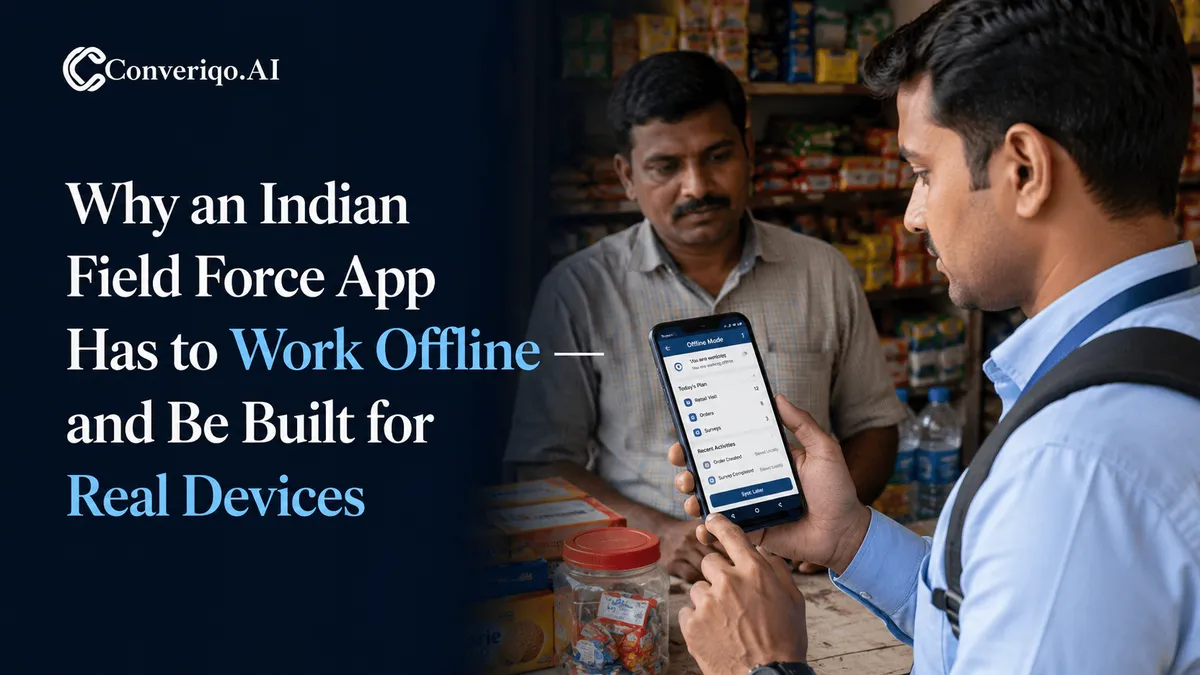
Why an Indian Field Force App Has to Work Offline - and Be Built for Real Devices
Field work in India happens where connectivity is intermittent. A field force app that assumes constant connectivity fails exactly where field work…