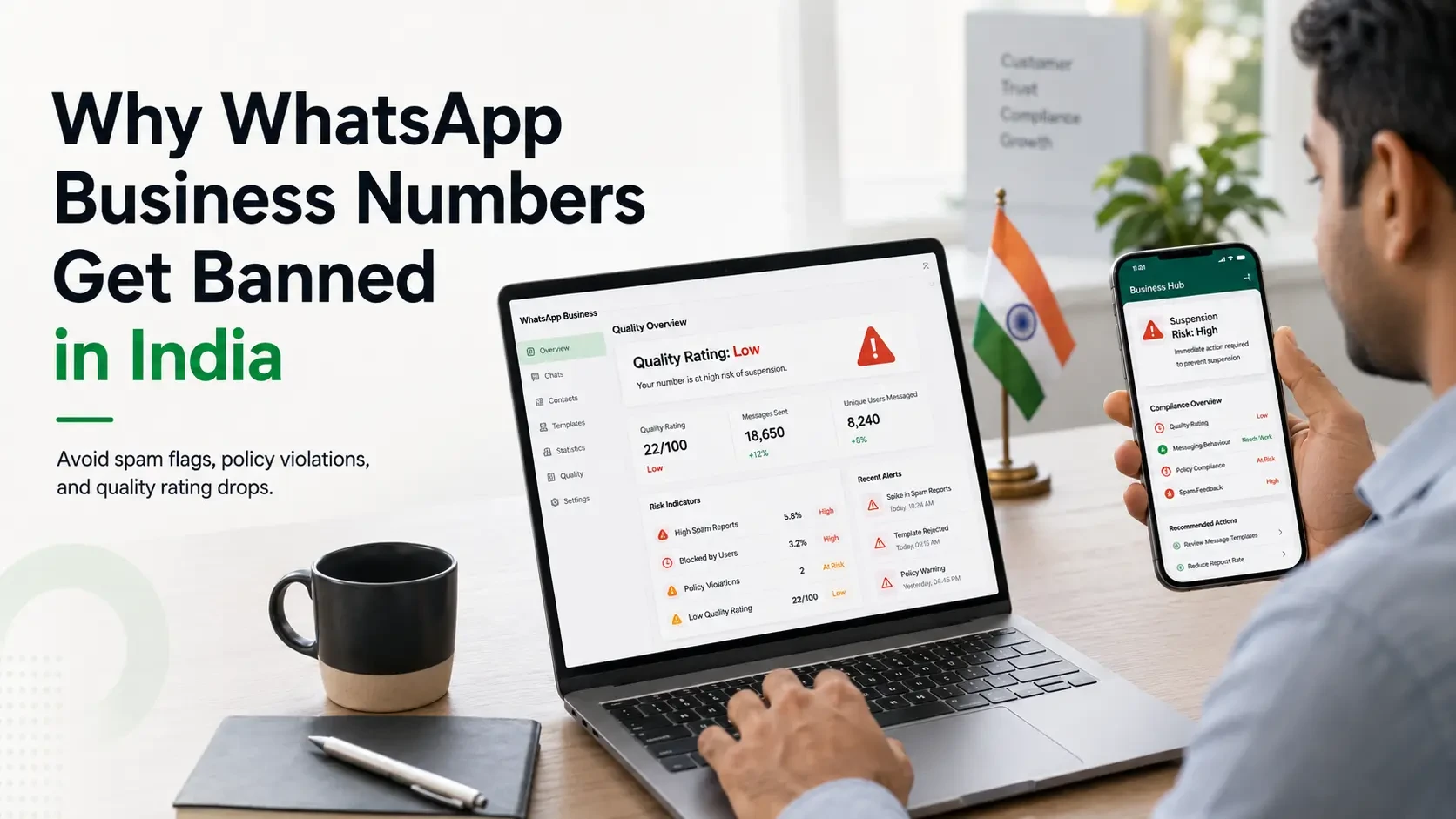
Indian businesses lose WhatsApp Business numbers every week.
Usually to avoidable mistakes.
Meta enforces WhatsApp Business policies through automated systems and human review. Numbers that violate policies get throttled, suspended, or permanently banned. Recovery from suspension is uncertain. Permanent bans are not reversed.
This article is the field guide. The mistakes that consistently cost businesses their numbers - and what to do instead.
Understanding quality rating
Every API number has a quality rating - High, Medium, or Low.
Quality rating affects daily send limits. A High-rated number can send to tens of thousands of unique users per day. A Low-rated number is restricted to far fewer.
Quality rating drops when - too many recipients block the number, too many recipients report spam, marketing template open rates are very low, conversations have unusually low engagement, or the business violates messaging policies.
Quality recovery is slow. A drop from High to Low can take weeks of clean behaviour to recover. Some numbers never fully recover.
Mistake 1 - Sending marketing without proper opt-in
The single most common cause of quality drops and bans.
Buying contact lists. Sending to users who never opted in. Importing your CRM and blasting marketing templates. Using opt-in language so vague it does not count as consent.
What works - explicit opt-in at the point of data capture. Documented, timestamped, source-tracked. Easy opt-out in every marketing message. Honoured opt-outs immediately.
Mistake 2 - Mislabelling marketing as utility
Sending marketing content using Utility templates to dodge marketing pricing.
Example - "Your account was created. Use code WELCOME10 for 10 percent off your first order." The discount makes it marketing. Sent as utility, this gets flagged.
Meta's automated systems detect this through pattern analysis on template content. The first time, you get warnings. Repeated, you get template rejections and quality drops.
Mistake 3 - High block and report rate
Sending to recipients who block or report your number is the fastest way to lose quality rating.
What causes blocks - irrelevant marketing to wrong audience, sending too frequently, sending to people who never opted in, sending in wrong language for the recipient.
Monitor block rate closely. If it exceeds your BSP's normal range, pause campaigns and audit your list.
Mistake 4 - Sending at off-hours
Marketing or utility messages at 2 AM. Templates triggered by automated flows that ignore time-of-day rules.
Indian users are particularly sensitive to off-hours business messages - reports and blocks spike. Quality rating tanks.
Set send-time rules. 9 AM to 9 PM in your recipient's local timezone is a safe default. Anything outside should be exceptional and justified.
Mistake 5 - Generic mass campaigns to unsegmented lists
Sending the same marketing template to your entire user base regardless of behaviour, location, language, or product interest.
What this produces - low relevance, high block rate, falling quality rating.
Segment campaigns. Even basic segmentation (last purchase, location, language preference) reduces block rate substantially.
Mistake 6 - Re-engaging dormant users with cold marketing
Users who have not interacted with your business in months suddenly receive marketing messages. They have forgotten they ever opted in. They block.
What works - re-engage with utility-style messages first (e.g., account update, relevant transactional touch), then move to marketing only for those who engage.
Mistake 7 - Personal numbers for high-volume business chats
Using a personal WhatsApp (consumer app) to handle business-scale chats. Meta's policies prohibit business use of personal accounts at scale.
Account gets flagged, then suspended. Sometimes recovered. Sometimes not.
Move to the Business app or API before volume scales.
Mistake 8 - Forwarding-style content
Sending the same template to many users in rapid succession through automation that looks like forwarding patterns. Meta's systems flag this as bulk-spam behaviour.
Pacing matters. Even legitimate broadcasts to opted-in users should be paced - not blasted in one burst.
Mistake 9 - Ignoring opt-outs
User says STOP. Marketing keeps coming. User reports. Quality drops, then ban.
Honour opt-outs immediately. Have automated systems that remove opted-out users from all future marketing lists, across all your campaigns.
Mistake 10 - Buying or sharing contact lists
Purchased lists. Contact databases shared between businesses. Numbers scraped from other sources.
These users did not consent to receive your marketing. Block rate is high. Reports are high. Bans follow.
Build your own opt-in list. Slower. Far more sustainable.
What to do if quality drops
Pause all marketing campaigns immediately.
Audit recent campaigns for any of the mistakes above.
Continue only service and utility messaging for 2 to 4 weeks.
When quality recovers, resume marketing only with cleaner segmentation, better content, and stricter opt-in compliance.
If suspended - appeal through your BSP. Provide documentation of opt-in compliance, opt-out handling, and campaign improvements. Recovery is possible but not guaranteed.
The shift to make
Stop treating WhatsApp like an SMS blast channel.
Start treating it as a conversation platform where every recipient is a real person who can block you, report you, or quietly cost you your quality rating.
The Indian businesses with the longest-running, highest-volume WhatsApp programs are also the ones with the cleanest opt-in discipline. That is not coincidence.
About the Author

Tanishka Raina
Ready to orchestrate your AI future?
Converiqo AI helps you design, deploy, and scale automation workflows that move your business faster, leveraging specialized solutions like our AI bot platform for lead generation, customer self-service AI bot platform, employee self-service AI bot platform, retail omnichannel automation, and our detailed guides on how agentic AI bot platforms work in enterprises and cost structure of enterprise AI bot platforms. Connect with our team to see the platform in action and co-create the next chapter of intelligent operations.
Read More Blogs
Discover more insights and product updates curated by the Converiqo AI team.

Real ROI of Field Force Automation - Beyond the Activity Dashboard
Four metrics that show real field force automation ROI in India - productivity, data reliability, throughput, and field attrition - not just the activity dashboard.

Beat Planning Is the Highest-Leverage Field Force Capability - Here Is Why
Beat planning decides coverage, call frequency, and whether field time is productive. Why it is the single highest-leverage field force automation capability.
Why an Indian Field Force App Has to Work Offline - and Be Built for Real Devices
Field work in India happens where connectivity is intermittent. A field force app that assumes constant connectivity fails exactly where field work is done.