One of the most common mistakes businesses make with pre-sales automation is starting in the wrong place.
Many teams try to automate full sales conversations too early. While this may seem like a fast path to efficiency, it often results in poor buyer experience and low internal confidence in the system.
The better approach is to focus on the work that surrounds the sales conversation, not the conversation itself.
Where Pre-Sales Automation Should Start
The strongest early wins come from automating tasks that are repetitive, structured, and directly impact meeting readiness. These are the areas where automation reduces friction without affecting trust.
Ideal characteristics of early pre-sales automation:
- Repetitive across most leads
- Clearly structured and predictable
- Operationally expensive to handle manually
- Easy to track and measure
- Critical for preparing leads before a meeting
Focusing on these areas improves pipeline quality while keeping the sales experience strong.
The Best Pre-Sales Tasks to Automate First
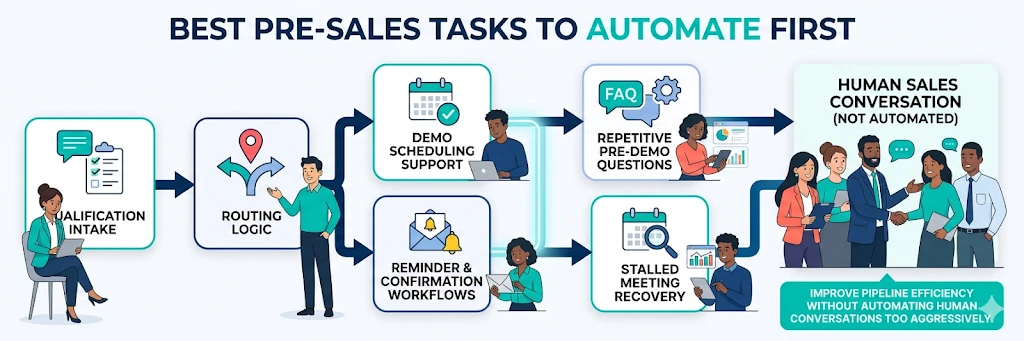
Qualification Intake
Capturing key details before the sales call ensures that the conversation starts with context rather than basic screening.
Routing Logic
Leads should reach the right team or representative quickly. Proper routing reduces delays and improves relevance.
Demo Scheduling Support
Automation can simplify the path from interest to booking, reducing friction and increasing meeting conversion.
Reminder and Confirmation Workflows
Timely reminders help improve show-up rates and ensure that both the buyer and the sales team are prepared.
Repetitive Pre-Demo Questions
Handling common queries in advance reduces manual effort and allows sales reps to focus on higher-value discussions.
Stalled Meeting Recovery
Following up on incomplete bookings or inactive leads helps recover opportunities that would otherwise be lost.
These tasks are strong starting points because they improve efficiency without trying to replace human selling.
What Not to Automate First
Some parts of the sales process require human judgment, trust, and adaptability. Automating these too early can damage both experience and outcomes.
Avoid starting with:
- Negotiation-heavy sales calls
- Trust-building conversations
- Complex objection handling
- Multi-stakeholder discovery discussions
- Pricing conflict resolution
- Emotionally sensitive commercial interactions
Automation can support these areas later, but it should not take ownership at the beginning.
Conclusion
The goal of pre-sales automation is not to replace selling. It is to remove avoidable friction before the sales conversation begins.
By focusing on structured and repetitive tasks first, businesses can improve meeting quality, increase efficiency, and create better conditions for successful sales interactions. This is where the fastest and most reliable gains are achieved.
CTA Section
Not sure what your business should automate first in pre-sales? See What We Should Automate First
FAQs
What pre-sales tasks are easiest to automate first?
Qualification intake, routing, demo scheduling support, reminders, repetitive pre-demo questions, and stalled opportunity follow-up are usually the best starting points.
Why not automate complex sales conversations first?
Because those interactions require human trust, judgment, and flexibility, which automation cannot fully replicate early on.
Can automation support deeper sales workflows later?
Yes. Once the foundation is strong, automation can assist more advanced processes alongside human teams.
How do businesses identify repetitive pre-sales tasks?
By looking at how often tasks repeat, how predictable they are, and how much manual effort they currently require.
What is the main benefit of starting with simple automation?
It improves pipeline efficiency, reduces manual workload, and enhances meeting readiness without compromising the sales experience.