Many businesses believe that sales conversion begins when the salesperson joins the call.
In reality, the quality of the sales conversation is shaped much earlier. What happens during the pre-sales stage determines whether the meeting is even worth having.
Factors such as how leads are qualified, how quickly enquiries are routed, how much context is collected, and whether follow-up happens on time all influence the effectiveness of the eventual sales interaction.
When this stage is manual or inconsistent, the outcome is predictable. Meetings lack quality, demos are missed, and sales teams spend time on basic screening instead of meaningful conversations.
Why Pre-Sales Workflow Matters More Than Teams Realize
Many organizations invest heavily in lead generation and assume the sales team will handle everything that follows. However, pre-sales friction often weakens opportunities before they reach the sales stage.
This friction appears in the form of poor qualification, slow response times, unclear ownership, and repetitive manual tasks. Leads may lose interest before booking a meeting, or show up unprepared.
As a result, pre-sales directly impacts meeting quality, show-up rates, pipeline velocity, and overall sales efficiency. It is not just a coordination layer. It is a revenue driver.
What Sales Support and Pre-Sales Automation Actually Means
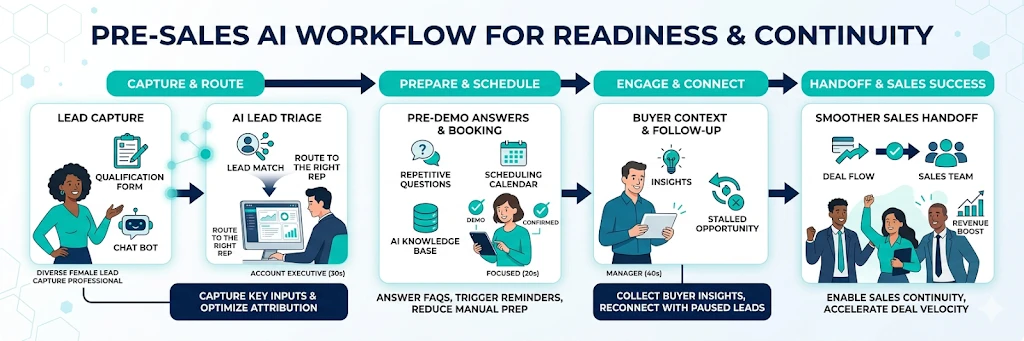
Pre-sales automation is often misunderstood as simple reminders or email sequences. In practice, it is a structured workflow that supports everything leading up to the sales conversation.
A well-designed system helps capture qualification inputs, route leads correctly, answer common pre-demo questions, schedule meetings, send confirmations, and collect context before the call. It also supports follow-up and recovery for leads that stall before reaching the demo stage.
This ensures that by the time a salesperson engages, the interaction is more focused and valuable.
The Biggest Mistake Businesses Make with Pre-Sales Automation
A common mistake is trying to automate the selling process itself without structuring the support around it.
This leads to poor qualification, generic communication, weak meeting readiness, and low-quality interactions.
The better approach is to automate repetitive pre-sales tasks, structure workflows, and allow human sales teams to focus on trust-building and closing.
The 5 Stages of a Strong Pre-Sales Workflow
Enquiry or Interest Capture
The journey begins when a lead expresses interest through channels such as websites, chat, WhatsApp, or forms.
Qualification and Context Collection
Before the call, key information such as use case, urgency, and readiness should be captured to improve meeting quality.
Routing and Next-Step Logic
Leads should be directed to the right path, whether that is a demo, callback, or follow-up. This reduces delays and confusion.
Demo Readiness or Meeting Preparation
A structured workflow ensures that the buyer understands the next steps, receives reminders, and arrives prepared. This significantly improves conversation quality.
Follow-Up and Recovery
If the lead stalls, the system should trigger reminders, re-engagement, or rescheduling to maintain pipeline momentum.
Why Manual Pre-Sales Handling Breaks Down
Manual processes become unreliable as volume increases. Teams may follow inconsistent qualification logic, miss follow-ups, and struggle with coordination.
This results in weaker meetings, slower response cycles, and lost opportunities before the sales conversation even begins.
Structured workflows solve this by standardizing processes and improving visibility across the pipeline.
Why Demo Readiness Matters So Much
Many businesses focus on improving sales performance during the demo itself. However, the quality of the demo often depends on what happens beforehand.
Poor preparation leads to unclear expectations, weak context, and inefficient conversations.
A strong pre-sales workflow ensures that the demo starts with clarity, relevance, and momentum, giving the sales team a significant advantage.
Best Businesses for Pre-Sales Automation
Pre-sales automation is particularly valuable in businesses where the path to conversion involves qualification, demos, or consultations.
Common use cases include:
- B2B SaaS and IT services
- Agencies and consulting firms
- Real estate
- Education counselling
- Enterprise solution sales
- Healthcare consultation services
- Recruitment and staffing
In these environments, improving pre-sales workflows directly enhances pipeline efficiency.
What Businesses Should Automate First
Instead of automating complex sales interactions, businesses should start with structured pre-sales tasks.
Recommended starting points include:
- Qualification intake
- Demo scheduling support
- Meeting confirmations and reminders
- Repetitive pre-demo questions
- Routing logic
- Meeting preparation inputs
- Follow-up for stalled opportunities
These areas are measurable and closely tied to revenue outcomes.
The Difference Between Sales Automation and Pre-Sales Workflow Automation
Sales automation is often misunderstood as automating selling itself. Pre-sales workflow automation focuses on improving everything around the sales conversation.
This includes qualification, routing, preparation, reminders, and follow-up. It ensures that sales teams spend their time on high-value interactions rather than repetitive tasks.
A Practical Pre-Sales Automation Framework
Map the Journey
Identify the steps between first enquiry and the sales meeting.
Identify Friction Points
Locate where leads slow down or drop off.
Group Tasks by Complexity
Separate repetitive, structured tasks from those requiring human judgment.
Define Routing and Readiness Logic
Ensure leads are directed appropriately and arrive prepared for meetings.
Build Follow-Up and Recovery
Set up workflows to handle incomplete bookings and stalled leads.
Track Outcomes
Measure qualification rates, meeting quality, show-up rates, and time savings.
This approach transforms pre-sales into a structured system rather than an ad hoc process.
Conclusion
Sales teams do not just need more meetings. They need better-prepared meetings, stronger qualification, and less repetitive pre-call work.
By improving pre-sales workflows, businesses can increase efficiency, enhance buyer readiness, and protect valuable opportunities before the sales conversation even begins.
Instead of focusing only on closing techniques, businesses should examine how much value is being lost due to weak pre-sales processes. That is often where the largest pipeline gap exists.
Want to see where your pre-sales workflow is slowing down your pipeline?
Explore how to automate qualification, routing, demo scheduling, reminders, context collection, and stalled opportunity recovery.
FAQs
What is sales support and pre-sales automation?
It is the use of structured workflows to improve qualification, routing, readiness, and follow-up before the sales conversation.
Why does pre-sales automation matter?
Because many opportunities are lost or weakened before reaching the sales stage due to poor qualification and manual processes.
What should businesses automate first in pre-sales?
They should start with qualification intake, scheduling, reminders, routing, and repetitive pre-demo interactions.
Is this about replacing sales reps?
No. It is about improving workflows so that sales teams can focus on high-value conversations.
How can businesses avoid poor pre-sales automation?
By starting with structured, repetitive tasks and maintaining human involvement where judgment and trust-building are required.