
A common objection to pre-sales automation is the fear that it will make the buyer experience feel robotic.
This concern is valid. Poorly designed automation can come across as generic, repetitive, and disconnected from where the buyer actually is in the process.
However, this is not a problem with automation itself. It is a result of poor workflow design. With the right structure, pre-sales automation can be a powerful tool without diminishing the customer experience.
What Makes Pre-Sales Follow-Up Feel Bad
When pre-sales follow-up feels robotic, it typically exhibits several key flaws:
- No context: Generic messages without any relevance to the buyer's journey
- Repeated generic reminders: Too many follow-ups with no real value or differentiation
- Unclear next step: Lack of direction on what the buyer should do next
- Wrong timing: Sending messages at the wrong moments in the buyer’s process
- Too many nudges: Overwhelming the buyer with reminders or follow-ups
- Poor channel choice: Using the wrong channel to communicate with the buyer
- No distinction between interested and weak-fit buyers: Treating all buyers the same regardless of their stage or intent
These issues reduce the effectiveness of follow-up and frustrate buyers, making the entire experience feel robotic.
What Makes Pre-Sales Follow-Up Feel Useful
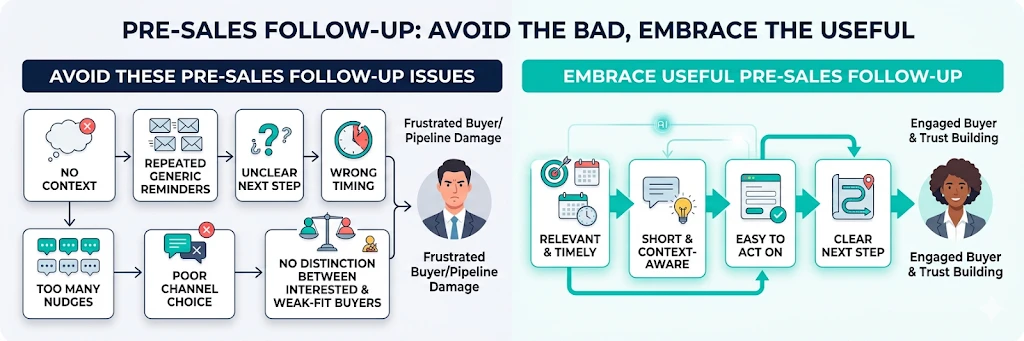
Good follow-up, on the other hand, feels tailored and relevant. It is about providing value and guiding the buyer smoothly toward the next step.
Key features of effective pre-sales follow-up:
- Relevance: Follow-ups should be tailored to where the buyer is in the journey
- Timeliness: Messages should arrive at the right moment, not too soon or too late
- Brevity: Keep messages concise and to the point
- Context-awareness: Acknowledge the buyer’s previous actions and engagement
- Clarity on next steps: Make it clear what the buyer should do next
- Easy to act on: Encourage quick, simple actions
These practices protect the pipeline and help buyers feel supported, not bombarded.
Conclusion
The goal of pre-sales automation is not to increase message volume. It is to ensure continuity, readiness, and a smooth transition toward conversion.
This can only be achieved when follow-up is designed around context and action, rather than repetitive, impersonal outreach.
CTA Section
FAQs
Why does some pre-sales follow-up feel robotic?
It feels robotic when it is repetitive, generic, and poorly timed, lacking personalization or relevance.
How do you make pre-sales automation feel better?
By using context, proper timing, clear next steps, and appropriate channel choices, you can create follow-up that feels useful and natural.
Should every lead get the same follow-up?
No. Different stages of the buyer’s journey require different workflows based on their level of intent and engagement.
Can automation still feel useful to the buyer?
Yes. With good workflow design, automation can be highly relevant and supportive without feeling impersonal.
What should businesses focus on first in pre-sales automation?
Start with clear context collection, tailored next steps, and avoiding overuse of generic messaging.
About the Author
Ankur Singh
Ready to orchestrate your AI future?
Converiqo AI helps you design, deploy, and scale automation workflows that move your business faster, leveraging specialized solutions like our AI bot platform for lead generation, customer self-service AI bot platform, employee self-service AI bot platform, retail omnichannel automation, and our detailed guides on how agentic AI bot platforms work in enterprises and cost structure of enterprise AI bot platforms. Connect with our team to see the platform in action and co-create the next chapter of intelligent operations.
Read More Blogs
Discover more insights and product updates curated by the Converiqo AI team.

Real ROI of Field Force Automation - Beyond the Activity Dashboard
Four metrics that show real field force automation ROI in India - productivity, data reliability, throughput, and field attrition - not just the activity dashboard.

Beat Planning Is the Highest-Leverage Field Force Capability - Here Is Why
Beat planning decides coverage, call frequency, and whether field time is productive. Why it is the single highest-leverage field force automation capability.
Why an Indian Field Force App Has to Work Offline - and Be Built for Real Devices
Field work in India happens where connectivity is intermittent. A field force app that assumes constant connectivity fails exactly where field work is done.