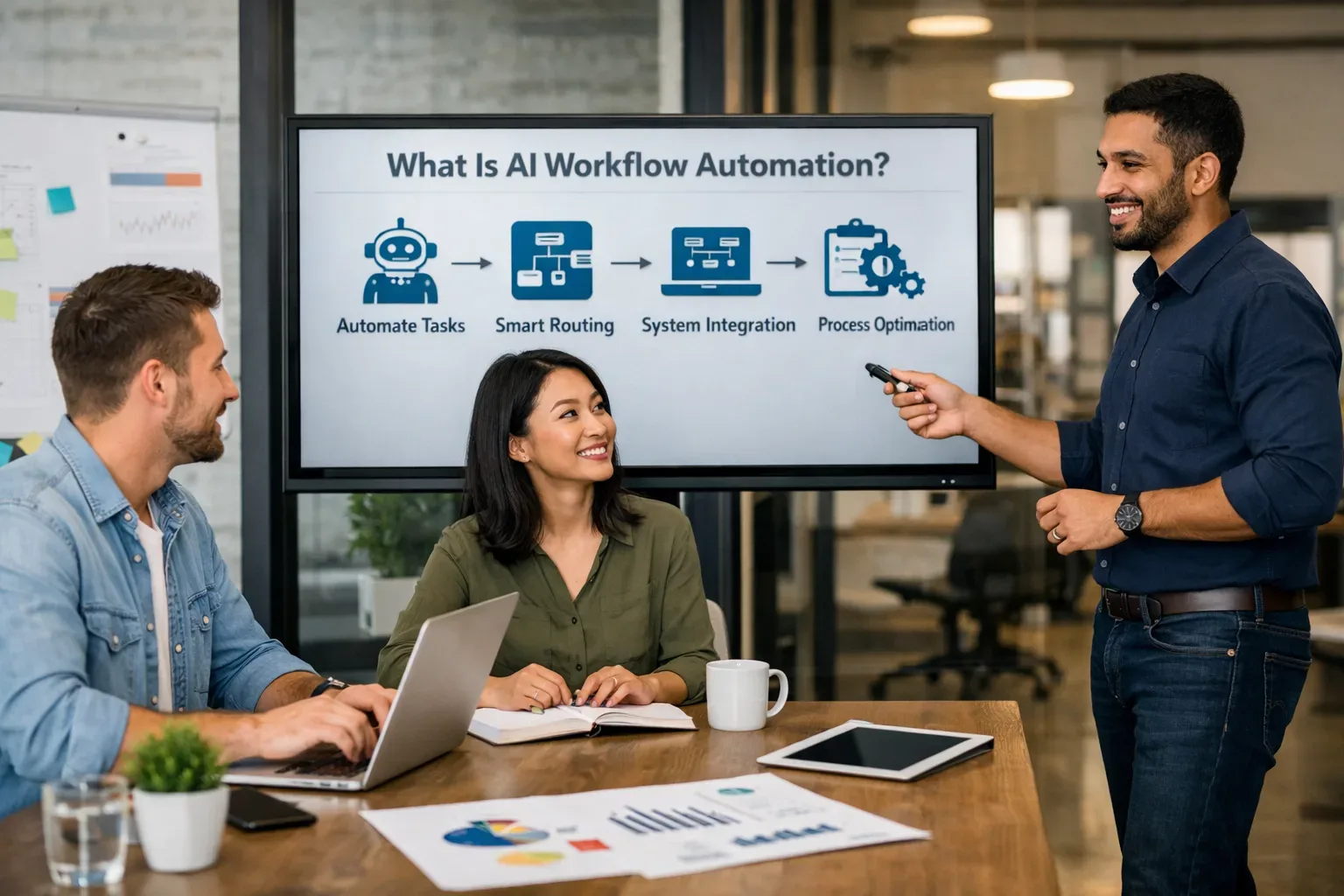
Modern businesses are under constant pressure to move faster, serve customers better, and manage operations more efficiently. Yet many organizations still depend on manual processes, delayed approvals, disconnected tools, and fragmented communication. These inefficiencies slow down lead response, weaken customer support, delay employee workflows, and create avoidable operational friction.
As businesses grow, these issues become harder to manage. A missed follow-up can turn into a lost deal. A delayed support response can affect customer trust. An unresolved internal request can reduce productivity across teams. This is why workflow efficiency is no longer just an operational concern. It is now a business growth priority.
AI workflow automation addresses this challenge by helping businesses automate repetitive actions, route tasks intelligently, connect business systems, and improve coordination across departments such as sales, HR, finance, operations, and customer support. For Converiqo, this topic is especially relevant because the platform is built around automating lead generation, customer support, and employee workflows for modern businesses.
What Is AI Workflow Automation?
AI workflow automation is the use of artificial intelligence and workflow logic to automate business processes from start to finish. Instead of relying on people to manually assign tasks, send follow-ups, review requests, or track approvals, the system manages these steps automatically based on business rules and real-time inputs.
This is what makes it different from basic automation. Traditional automation usually handles one repetitive action at a time. AI workflow automation helps manage how work moves through an entire process. It can understand intent, guide the next step, connect tools, and keep the workflow moving with greater speed and consistency.
For modern businesses, this means less dependence on manual coordination and more control over how tasks are handled at scale.
How AI Workflow Automation Works in a Business
1. A request enters the system
Every workflow begins with an event. This could be a website form submission, a customer support message, an employee request, an appointment booking, or an internal task raised by a team member.
2. AI identifies the intent
Once the request enters the system, AI helps determine what the request is about. It can recognize whether the user is asking for sales support, customer assistance, internal help, or another service. This reduces the need for manual triaging.
3. Workflow logic decides the next step
After the intent is identified, predefined business rules guide what happens next. The request may be assigned to a sales rep, moved into a support queue, routed for approval, or escalated based on urgency.
4. Connected tools keep information aligned
AI workflow automation usually connects with systems such as CRM platforms, helpdesk software, HRMS tools, ERP solutions, email platforms, and scheduling systems. This keeps data synchronized and reduces duplication of effort.
5. Actions are triggered automatically
The workflow can send confirmations, create tickets, notify teams, start follow-up sequences, or escalate unresolved issues. This reduces response delays and improves execution consistency.
6. Performance can be monitored and improved
Once the workflow is live, businesses can track how it performs, identify bottlenecks, and improve weak points. This makes AI workflow automation not just efficient, but also measurable.
Why AI Workflow Automation Matters for Modern Businesses
Businesses are not struggling because teams are unwilling to work hard. They struggle because too much of the work is still handled manually. Manual operations may seem manageable at first, but they create compounding inefficiencies as demand increases.
Slower response times hurt business outcomes
Modern customers and prospects expect fast responses. When inquiries wait in inboxes, support tickets sit unresolved, or approvals are delayed, the business loses momentum. AI workflow automation improves speed by ensuring that requests are captured, understood, and routed without delay.
Fragmented systems create operational friction
Many companies use separate systems for sales, support, HR, and operations. Without a structured workflow layer, these systems remain disconnected. Teams end up chasing information across tools, which slows decisions and creates confusion.
Inconsistency reduces trust and quality
Manual workflows often depend on how well an individual follows the process. One person may respond quickly, while another misses a step. One employee request may be resolved on time, while another is forgotten. Automation creates consistency and makes execution more reliable.
Growth becomes harder without structured workflows
As organizations scale, the number of requests, tasks, and internal dependencies rises sharply. AI workflow automation helps businesses handle more volume without increasing disorder. That is why it matters not only for efficiency, but for scalability.
Key Business Problems AI Workflow Automation Solves
Slow lead response and weak follow-up
Many businesses lose qualified leads simply because follow-up is delayed or inconsistent. AI workflow automation helps capture leads instantly, assign them correctly, and trigger timely actions so opportunities do not slip away.
Delayed customer support resolution
Support teams often deal with high ticket volumes and mixed request types. AI helps classify issues, route them properly, and improve response flow so customers get a faster and more predictable experience.
Internal workflow bottlenecks
Employee requests related to HR, admin, finance, or IT often slow down because they depend on manual approvals or unclear ownership. Automation improves clarity, speed, and accountability in these internal processes.
Lack of operational visibility
Without structured workflows, managers often struggle to understand what is pending, who owns a task, and where the delay actually is. AI workflow automation makes process tracking easier and improves operational transparency.
Where AI Workflow Automation Helps Most Lead generation and sales workflows
Sales teams benefit when incoming inquiries are handled quickly and consistently. AI workflow automation can capture leads from forms and campaigns, qualify them using business logic, assign them to the right team member, and trigger follow-up tasks automatically. This improves response speed and strengthens conversion potential.
Customer support workflows
Support operations improve when incoming queries are structured from the beginning. AI workflow automation can convert requests into tickets, classify issues, route them to the correct queue, and support better escalation handling. This leads to faster acknowledgments and more consistent service delivery.
Employee workflows
Internal operations also benefit significantly. Leave requests, onboarding steps, reimbursements, approvals, policy queries, and internal service requests can all move through a defined workflow. This reduces long email chains, removes confusion, and improves the employee experience across departments.
Major Benefits of AI Workflow Automation
Saves time across teams
Routine actions are handled faster because workflows no longer depend entirely on human follow-up at every stage.
Improves productivity
Teams can focus more on decision-making, customer relationships, and strategic work rather than repetitive process administration.
Strengthens conversion opportunities
When lead capture and response workflows improve, businesses are better positioned to convert demand into revenue.
Enhances customer experience
Faster routing, consistent handling, and reduced delays create a smoother experience for customers.
Reduces operational inefficiency
Businesses spend less time managing manual handoffs, duplicate work, and unclear task ownership.
Supports scalable growth
As volumes increase, automated workflows help maintain speed and control without forcing teams into chaos.
Why This Topic Is Important for Converiqo
This topic directly supports Converiqo’s positioning because the platform is built around AI workflow automation for modern business operations. It also addresses real pain points faced by founders, CX leaders, and operations teams who struggle with fragmented systems, slow responses, and inefficient execution.
Just as importantly, this is a strong foundational topic for content strategy. It naturally opens the door to more focused blogs around lead generation automation, customer support automation, employee self-service workflows, and AI workflow orchestration. That makes it valuable not only for awareness, but for long-term SEO and topic clustering as well.
Conclusion
AI workflow automation matters because modern businesses cannot scale efficiently through manual, disconnected, and inconsistent processes. As customer expectations rise and operational complexity increases, organizations need systems that can reduce repetitive work, improve response speed, and coordinate actions across teams more intelligently.
That is where AI workflow automation creates real business value. It helps companies improve lead generation, strengthen customer support, streamline employee workflows, and build a more scalable operating model. For businesses looking to modernize how work gets done, AI workflow automation is no longer an optional enhancement. It is becoming a core capability.
For Converiqo, this makes the topic strategically important because it reflects the exact business challenges the platform is designed to solve.
FAQs
What is AI workflow automation?
AI workflow automation is the use of artificial intelligence and workflow logic to automate tasks, approvals, routing, follow-ups, and operational actions across different business functions.
Why is AI workflow automation important for modern businesses?
It is important because it reduces manual work, improves process speed, removes inefficiencies, and helps businesses scale with more consistency and control.
Which departments can benefit from AI workflow automation?
Sales, customer support, HR, finance, operations, and internal support teams can all benefit because they deal with repeated requests, approvals, coordination, and service delivery tasks.
Can AI workflow automation improve lead generation?
Yes. It can capture leads faster, qualify them automatically, route them correctly, and support timely follow-up actions that reduce lead leakage.
Why is converiqo.ai relevant to this topic?
converiqo.ai is relevant because it helps businesses automate lead generation, customer support, and employee workflows using AI-powered workflow automation designed for modern business operations.
About the Author

Akanksha
Ready to orchestrate your AI future?
Converiqo AI helps you design, deploy, and scale automation workflows that move your business faster, leveraging specialized solutions like our AI bot platform for lead generation, customer self-service AI bot platform, employee self-service AI bot platform, retail omnichannel automation, and our detailed guides on how agentic AI bot platforms work in enterprises and cost structure of enterprise AI bot platforms. Connect with our team to see the platform in action and co-create the next chapter of intelligent operations.
Read More Blogs
Discover more insights and product updates curated by the Converiqo AI team.

Real ROI of Field Force Automation - Beyond the Activity Dashboard
Four metrics that show real field force automation ROI in India - productivity, data reliability, throughput, and field attrition - not just the activity dashboard.

Beat Planning Is the Highest-Leverage Field Force Capability - Here Is Why
Beat planning decides coverage, call frequency, and whether field time is productive. Why it is the single highest-leverage field force automation capability.

Why an Indian Field Force App Has to Work Offline - and Be Built for Real Devices
Field work in India happens where connectivity is intermittent. A field force app that assumes constant connectivity fails exactly where field work is done.