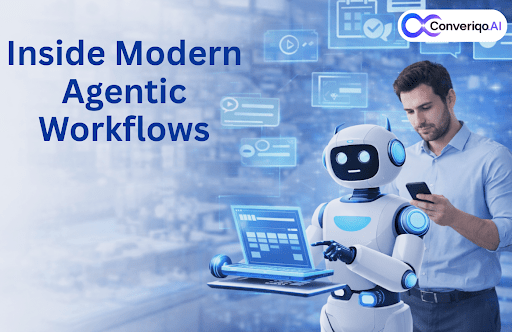
For years, artificial intelligence in software applications has been largely conversational. Chatbots answered questions. Assistants suggested actions. Automation tools triggered rules.
But modern applications are no longer satisfied with suggestions or responses.
They need execution.
They need AI systems that can:
- Decide what to do next
- Coordinate multiple steps
- Interact with systems
- Recover from failure
- Complete tasks end-to-end
This shift has given rise to AI agentic workflows a new architectural model where AI doesn’t just respond, but acts.
This blog explains what AI agentic workflows really are, how they differ from traditional automation and chatbots, where they’re already being used, and how platforms like Converiqo are turning agentic AI into production-ready systems with help from enterprise implementation partners like Mobiloitte.
Why Traditional AI Automation Has Hit a Ceiling
Most AI systems deployed in businesses today fall into one of three categories:
- Rule-based automation
- Conversational AI (chatbots, assistants)
- Task-level RPA
Each has value. Each also has limits.
Rule-based automation breaks when conditions change.
Chatbots stop at conversation.
RPA struggles with unstructured decisions.
As applications become more complex and user expectations increase, these models fail to deliver end-to-end outcomes.
What’s missing is agency.
What “Agentic” Actually Means in AI Systems
The term agentic comes from the concept of agency - the ability to take initiative, make decisions, and act toward a goal.
An AI agent is not just a model that predicts text.
It is a system that can:
- Interpret goals
- Decide next actions
- Execute steps
- Monitor outcomes
- Adapt when conditions change
An AI agentic workflow is the structured environment where this agency operates.
Defining AI Agentic Workflows
An AI agentic workflow is a system where AI agents are responsible for driving multi-step processes across applications, data sources, and human handoffs - without requiring manual orchestration at every step.
Instead of:
“User asks → system responds”
The flow becomes:
“Goal defined → agent plans → agent executes → agent verifies → agent escalates if needed”
This is the fundamental shift.
How Agentic Workflows Differ from Traditional Workflows
Traditional Workflow Automation
- Predefined steps
- Fixed decision paths
- Breaks on edge cases
- Requires constant manual updates
Agentic Workflows
- Goal-oriented, not step-oriented
- Dynamic decision-making
- Handles ambiguity
- Can loop, retry, or escalate
This makes agentic workflows far more suitable for modern, real-world applications.
Core Components of an AI Agentic Workflow
A production-grade agentic workflow typically includes:
1. Goal Definition Layer
Defines what needs to be achieved, not how.
Example:
- “Onboard a distributor”
- “Resolve a customer issue”
- “Convert a lead into a booking”
2. Decision Engine
Uses AI reasoning to determine:
- Which actions are required
- In what sequence
- Based on current context
This is where LLMs and logic engines work together.
3. Action Execution Layer
Executes actions such as:
- API calls
- Database updates
- CRM changes
- Notifications
- Document processing
This is where most chatbots fail - they don’t execute.
4. State & Memory Management
Tracks:
- What’s been done
- What’s pending
- What failed
- What needs escalation
Without state, agents become unreliable.
5. Human-in-the-Loop Controls
Allows humans to:
- Approve decisions
- Handle exceptions
- Override actions
This is critical for regulated and enterprise environments.
Why AI Agentic Workflows Are Critical for Modern Applications
Modern applications operate in environments that are:
- Multi-system
- Multi-stakeholder
- High-volume
- Time-sensitive
Static automation cannot keep up.
Agentic workflows enable applications to:
- Scale decision-making
- Reduce manual coordination
- Maintain consistency
- Adapt to change
This is why agentic AI is becoming foundational, not experimental.
Real-World Use Cases of Agentic Workflows
Customer Support Operations
Agents:
- Understand the issue
- Create tickets
- Route based on priority
- Track resolution
- Escalate automatically
This goes far beyond FAQ chatbots.
Sales & Lead Management
Agents:
- Qualify leads
- Assign owners
- Trigger follow-ups
- Update CRM
- Monitor conversion
No human micromanagement required.
Partner & Distributor Onboarding
Agents:
- Collect documents
- Validate data
- Trigger approvals
- Activate accounts
- Monitor compliance
This is impossible with static workflows.
Internal Operations & Approvals
Agents:
- Interpret requests
- Route approvals
- Enforce policies
- Maintain audit trails
Critical for enterprise governance.
Why Most “AI Agents” Fail in Production
Many teams attempt to build agentic systems and fail because they:
- Over-index on LLMs
- Under-engineer workflows
- Ignore state management
- Skip governance
An AI agent without workflow control becomes unpredictable.
This is where platform architecture matters more than models.
Converiqo’s Approach to Agentic AI Workflows
Converiqo is built as a workflow-first, agentic AI platform - not a chatbot layer.
Its architecture focuses on:
- Executable workflows
- Controlled agency
- Real system integration
- Outcome tracking
With Converiqo:
- Conversations trigger actions
- Actions update systems
- Systems feed context back to agents
This closed loop is what makes agentic workflows reliable.
What Converiqo Enables in Practice
Using Converiqo, organizations deploy:
- Agentic workflows for sales, support, operations
- AI agents that execute, not just respond
- Multi-step processes with visibility and control
This makes AI usable at scale - not just impressive in demos.
Why Implementation Determines Success or Failure
Agentic workflows touch:
- CRMs
- ERPs
- Support systems
- Compliance layers
This requires deep engineering and domain expertise.
Mobiloitte plays a critical role here by:
- Designing enterprise-grade agentic workflows
- Implementing secure integrations
- Ensuring governance and scalability
- Translating business processes into executable AI systems
Without this layer, most agentic initiatives stall.
For a practical view of how agentic workflows are applied across sales, support, operations, and partner management, this page outlines the automation modules that translate AI decisions into real system actions.
Governance, Safety, and Control in Agentic Systems
Agentic AI must be:
- Observable
- Auditable
- Controllable
Converiqo enforces this through:
- Role-based controls
- Approval checkpoints
- Action logs
- Fail-safe escalation
This is what makes it viable for real businesses.
Agentic Workflows vs Autonomous Chaos
A common fear is:
“Will agents act on their own?”
Well-designed agentic workflows are not autonomous chaos.
They are:
- Goal-driven
- Rule-bounded
- Observable
- Human-overrideable
Agency does not mean lack of control.
When Should Organizations Adopt Agentic Workflows?
If your application:
- Handles high-volume operations
- Relies on manual coordination
- Suffers from workflow delays
- Depends heavily on human follow-ups
Agentic workflows are not optional they are inevitable.
Final Thoughts
AI agentic workflows represent the shift from AI that talks to AI that works.
They are not about replacing humans.
They are about removing friction, delay, and inconsistency from complex systems.
Platforms like Converiqo, combined with execution partners like Mobiloitte, are making agentic AI practical, governable, and production-ready for modern applications.
The future of AI is not conversational.
It is agentic.
FAQs: AI Agentic Workflows
1. What are AI agentic workflows?
AI agentic workflows are systems where AI agents drive multi-step processes toward a goal by making decisions, executing actions, tracking state, and escalating when required. Converiqo implements agentic workflows that connect conversations directly to execution.
2. How are agentic workflows different from chatbots?
Chatbots respond to inputs. Agentic workflows execute tasks. With Converiqo, AI agents don’t stop at replies they trigger real workflows such as onboarding, follow-ups, approvals, and system updates.
3. Are AI agentic workflows safe for enterprise use?
Yes, when designed correctly. Converiqo includes governance, audit trails, and human-in-the-loop controls, while Mobiloitte ensures secure, compliant implementation.
4. Do agentic workflows require large AI teams?
No. Platforms like Converiqo abstract complexity so teams can deploy agentic workflows without building everything from scratch.
5. Where are agentic workflows used today?
They are already used in sales automation, customer support, partner onboarding, internal approvals, and operational coordination.
6. How does Converiqo support agentic AI?
Converiqo provides a workflow-first architecture where AI agents execute tasks, integrate with systems, and maintain visibility across processes.
7. How do organizations start with agentic workflows?
Most start with one high-impact process. With Converiqo and Mobiloitte, teams can deploy quickly, validate outcomes, and scale safely.
If your application still relies on chatbots that stop at responses or automation that breaks when conditions change, it’s time to move toward execution-driven AI. A Converiqo demo shows how agentic workflows plan tasks, execute actions across systems, maintain state, and escalate intelligently-turning AI from a conversational layer into an operational backbone for modern applications.
About the Author

Md Ashik Alam
Ready to orchestrate your AI future?
Converiqo AI helps you design, deploy, and scale automation workflows that move your business faster, leveraging specialized solutions like our AI bot platform for lead generation, customer self-service AI bot platform, employee self-service AI bot platform, retail omnichannel automation, and our detailed guides on how agentic AI bot platforms work in enterprises and cost structure of enterprise AI bot platforms. Connect with our team to see the platform in action and co-create the next chapter of intelligent operations.
Read More Blogs
Discover more insights and product updates curated by the Converiqo AI team.
Real ROI of Field Force Automation - Beyond the Activity Dashboard
Four metrics that show real field force automation ROI in India - productivity, data reliability, throughput, and field attrition - not just the activity dashboard.
Beat Planning Is the Highest-Leverage Field Force Capability - Here Is Why
Beat planning decides coverage, call frequency, and whether field time is productive. Why it is the single highest-leverage field force automation capability.
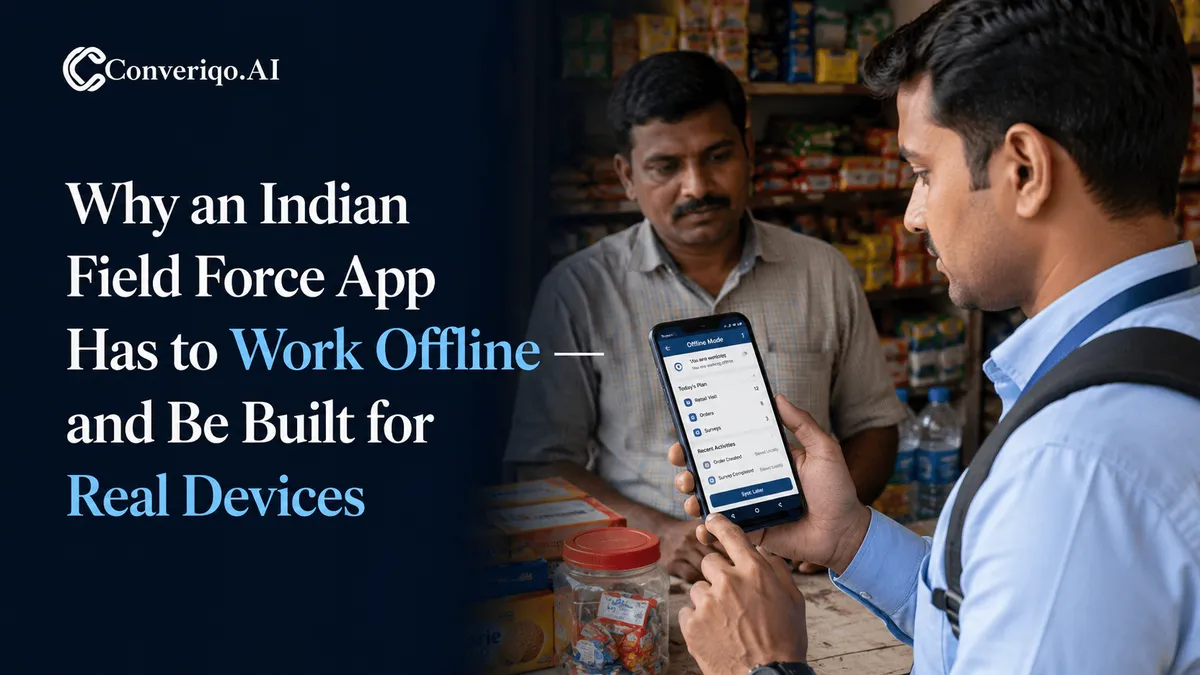
Why an Indian Field Force App Has to Work Offline - and Be Built for Real Devices
Field work in India happens where connectivity is intermittent. A field force app that assumes constant connectivity fails exactly where field work is done.