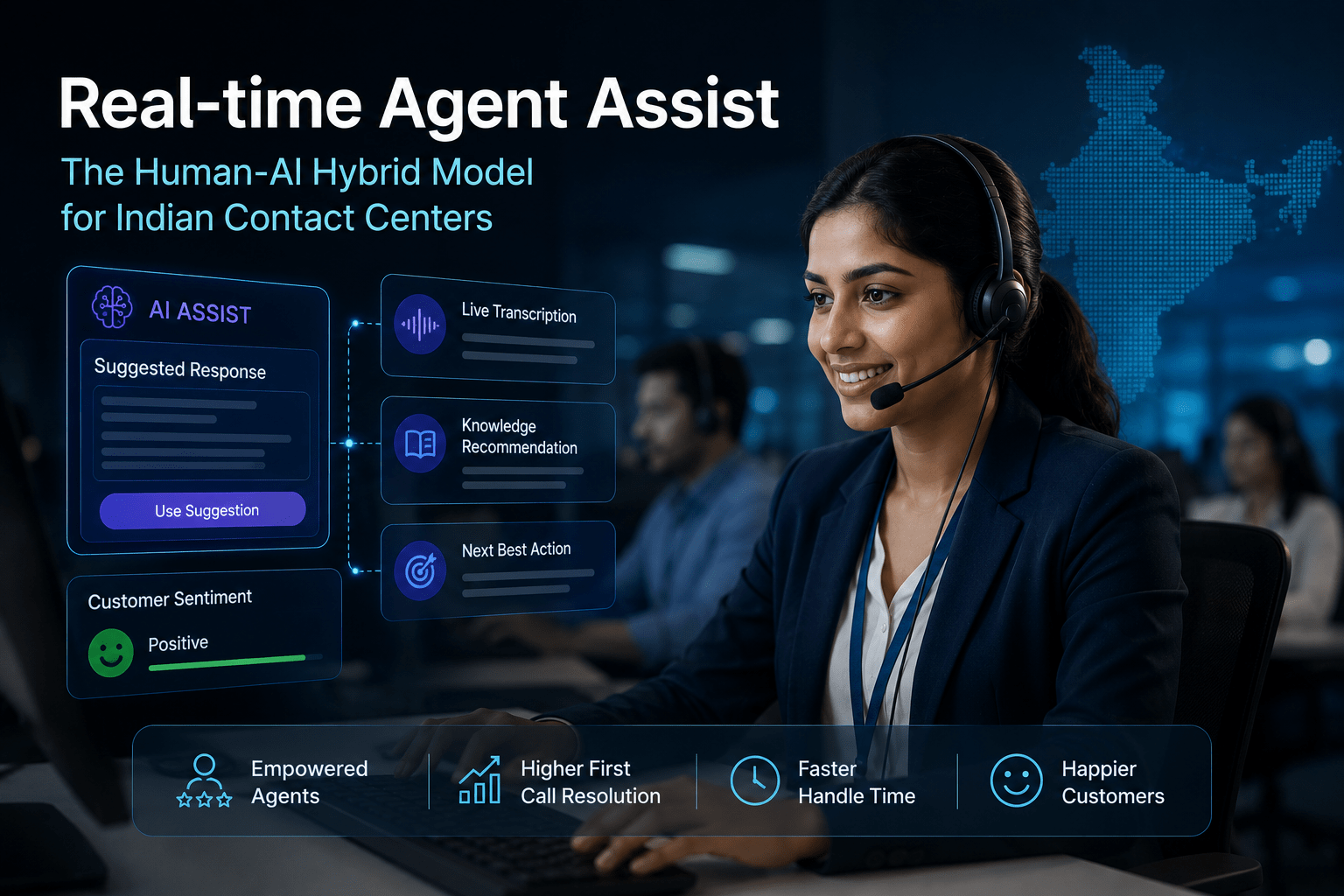
Most discussion of call center automation focuses on AI voice agents handling calls end-to-end - the deflection layer. The deflection layer is important and where the largest cost savings show up. The capability getting under-discussed is the layer that runs alongside the deflection layer - real-time agent assist for the human agents handling the calls AI does not.
Real-time agent assist is AI listening to a live call alongside the human agent, watching what is being said, accessing relevant context from CRM and knowledge base, and surfacing next-best-actions to the agent's screen as the call unfolds. The agent stays in control of the conversation. The AI is the silent assistant that compresses the moments when the agent would otherwise need to put the caller on hold to look something up.
What real-time agent assist actually surfaces
Five categories of information typically surfaced during a live call.
Caller context. The caller's account history, recent transactions, past calls and their outcomes, current open tickets, sentiment trajectory from previous calls. Appears on the agent's screen as soon as the call connects, refreshed as new context becomes relevant.
Knowledge base matches. As the caller describes their issue, the AI identifies the matching knowledge base article or resolution path and surfaces it to the agent. The agent sees the resolution steps before they would have thought to search for them. AHT compresses because the looking-up moment goes away.
Next-best-action suggestions. Based on the call's progression, the AI suggests what to ask next, what to verify, what offer might be appropriate, what to escalate. The agent can take the suggestion, ignore it, or choose differently - the AI advises, the agent decides.
Compliance reminders. For regulated conversations - insurance disclosure, financial product suitability, healthcare consent - the AI flags the required disclosures at the appropriate moment in the conversation. The agent does not forget the mandatory disclosure because it slipped in the flow.
Sentiment and friction signals. The AI surfaces signals when the caller's sentiment is shifting - frustration rising, satisfaction recovering, confusion accumulating. The agent gets a heads-up before the situation deteriorates, with suggested language to course-correct.
What changes when real-time agent assist is in place
Three measurable shifts.
Average handle time drops by 15% to 25% in mature deployments. The compression comes from eliminating the look-up moments, the put-on-hold-while-I-check moments, the looking-up-procedure moments. The agent stays in the conversation instead of pausing to search.
First call resolution lifts. Agents access context they previously had to dig for. They follow procedures more consistently because the AI surfaces the next step. They catch compliance requirements they might have missed. The combination produces calls that resolve in one attempt rather than requiring callbacks.
New agent ramp-up time compresses. Traditional contact centers run 60 to 90 day ramp-up before a new agent is fully productive. With real-time agent assist, the assist itself partially compensates for the experience the new agent does not yet have. Ramp-up compresses to 30 to 60 days in operations that deploy assist alongside agent training.
The discipline real-time agent assist requires
Three considerations for getting it right.
Information at the right moment, not all the time. A screen flooded with assist information becomes noise. The agent stops reading. Good agent assist surfaces what matters at the moment it matters, then clears. Cluttered screens defeat the purpose.
Suggestions as advisory, not directive. The agent has context the AI may not - the caller's emotional state, the conversational thread, the rapport already built. The AI suggests; the agent decides. Operations that try to enforce AI suggestions as required actions produce frustrated agents and worse calls.
Continuous tuning based on agent feedback. The agents using the assist daily know what surfaces are helpful and what are noise. Their feedback drives the tuning. Operations that deploy agent assist and forget it produce mediocre results; operations that treat it as a living system get better over months.
Why agent assist matters even where AI agent deflection is high
A reasonable question - if AI agents are handling 60% of routine calls, why invest in agent assist for the other 40%? The answer is that the other 40% is the complex tier, where the cost of a sub-optimal call is highest. The caller who reaches a human is by definition a more complex case - frustrated more easily, requiring more skill, more likely to leave a Glassdoor review or refer the experience to others.
The human agents handling the 40% complex tier need every assist available to deliver well on those calls. Real-time agent assist is the layer that makes them effective. Without it, the human tier handles harder calls without the support to handle them well, and the overall operation's CSAT lifts only as much as the deflection arithmetic allows.
The hybrid model works when both tiers - AI deflection and human-with-assist - are designed thoughtfully. Either layer alone underdelivers. Together they produce the operational improvement that justifies the investment.
About the Author

Yash Soni
Ready to orchestrate your AI future?
Converiqo AI helps you design, deploy, and scale automation workflows that move your business faster, leveraging specialized solutions like our AI bot platform for lead generation, customer self-service AI bot platform, employee self-service AI bot platform, retail omnichannel automation, and our detailed guides on how agentic AI bot platforms work in enterprises and cost structure of enterprise AI bot platforms. Connect with our team to see the platform in action and co-create the next chapter of intelligent operations.
Read More Blogs
Discover more insights and product updates curated by the Converiqo AI team.
Real ROI of Field Force Automation - Beyond the Activity Dashboard
Four metrics that show real field force automation ROI in India - productivity, data reliability, throughput, and field attrition - not just the activity dashboard.
Beat Planning Is the Highest-Leverage Field Force Capability - Here Is Why
Beat planning decides coverage, call frequency, and whether field time is productive. Why it is the single highest-leverage field force automation capability.
Why an Indian Field Force App Has to Work Offline - and Be Built for Real Devices
Field work in India happens where connectivity is intermittent. A field force app that assumes constant connectivity fails exactly where field work is done.