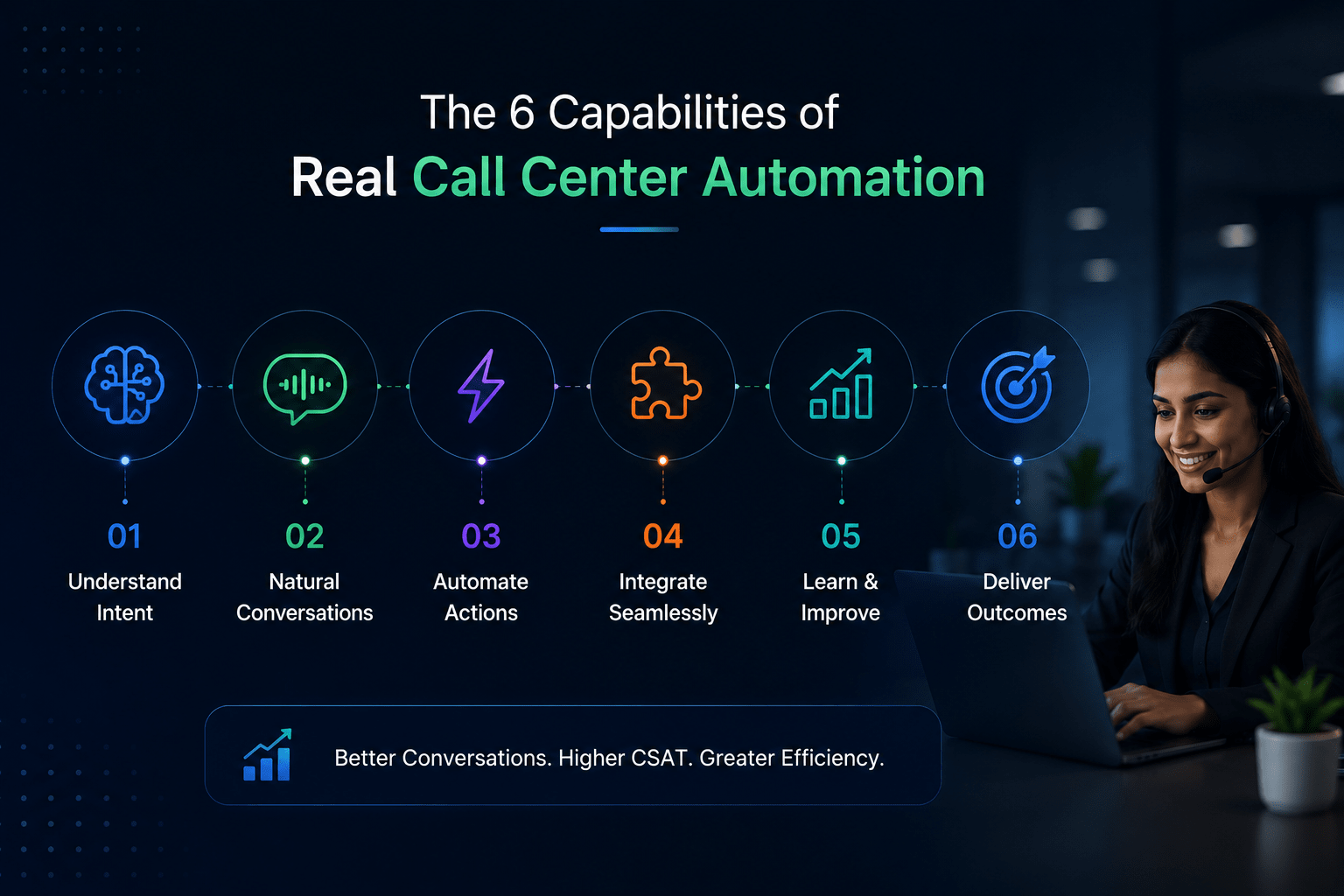
Real call center automation is six capabilities working together. Each one replaces a specific manual workflow that most Indian contact centers currently run. Walking through each - what the capability does, what it replaces, what breaks when it is missing.
Capability 1 - Intelligent inbound routing
What it does. Routes calls based on intent, language, skill match, caller history, and value tier. The caller states what they want in their own words. The system identifies the intent and routes accordingly - to an AI agent if the intent is routine, to a human agent with matching skill if the intent requires judgement. Language preference detected automatically and routed to language-capable resources.
What it replaces. Press-1 menu IVR. Voice menus that require the caller to navigate a tree. Round-robin or least-busy routing that ignores skill match. Manual transfers when the first agent realises the call should have gone elsewhere.
What breaks when it is missing. Callers bypass the menu by pressing zero. Skill mismatch between caller intent and agent capability. First-call resolution drops because agents transfer calls they cannot handle. Caller frustration accumulates before the meaningful conversation begins.
Capability 2 - Autonomous AI voice agents
What it does. Handles routine call types end-to-end. The caller speaks naturally in their preferred language. The AI agent listens, identifies intent, accesses backend systems through API integration, completes the transaction or answers the question, confirms with the caller, and closes the call. Handles 50% to 70% of routine call volume in most Indian domains as of 2026.
What it replaces. Human agents handling routine calls - balance enquiries, order status, appointment scheduling, policy details, recharge confirmations, password resets. These calls consume agent time without requiring agent judgement. The repetition burns agents out and produces the attrition cycle that operations heads spend significantly on managing.
What breaks when it is missing. Agent hours go to routine work that has been done thousands of times before. Queue depth increases during peak. Routine call types crowd out complex calls that need humans. Agent attrition rises because the work is repetitive. Wage and incentive interventions treat symptoms; the root cause stays.
Capability 3 - Real-time human agent assist
What it does. For calls that route to human agents - complex queries, escalations, sensitive issues - AI listens to the live call alongside the agent. The AI surfaces relevant context (past calls, account details, similar resolved cases, knowledge base articles) to the agent's screen in real time. It suggests next-best-actions, flags compliance considerations, drafts response language for difficult moments. The agent stays in control; the AI is the silent assistant.
What it replaces. Agents searching CRM and knowledge base mid-call. Agents asking supervisors for help on tough calls. Agents missing compliance disclosures because they happen at the wrong moment in the flow. New agents struggling with calls they have not seen before.
What breaks when it is missing. AHT extends as agents search for information mid-call. FCR drops as agents miss context that would have resolved the call. Compliance breaches increase under load. Training new agents takes longer because they cannot rely on real-time assist to support them while they learn.
Capability 4 - Post-call workflow automation
What it does. The 60 to 180 seconds after each call when the agent writes wrap-up notes and updates CRM gets automated. AI generates the call summary, classifies the disposition, updates relevant CRM fields, fires follow-up actions, and routes the case to whichever workflow needs it next - tickets, callbacks, escalations, no further action. The agent ends the call and the system handles downstream.
What it replaces. Manual wrap-up note typing. Manual CRM field updates. Manual disposition classification. Manual decisions about whether to fire a follow-up. Inconsistent data quality based on how tired the agent is at the end of a shift.
What breaks when it is missing. Across a 1,000-call day at 90 seconds wrap-up each, 25 agent hours go to administrative work. CRM data quality drops as the day progresses. Follow-up actions get missed when wrap-up gets rushed. Reporting accuracy depends on disposition consistency, which depends on the agent's attention at minute 480 of the shift.
Capability 5 - Speech analytics across all calls
What it does. Runs speech analytics against every call - sentiment, compliance language, mention of competitors, frustration signals, recurring patterns. Surfaces issues for QA review rather than requiring QA to listen to samples. Identifies training opportunities at the individual agent level. Flags compliance breaches in near-real-time rather than weeks later.
What it replaces. Traditional QA sampling that listens to 1% to 5% of calls manually. The hope that compliance breaches will be caught before they recur. The assumption that random sampling represents what is actually happening across the call population.
What breaks when it is missing. 95%+ of customer signal stays buried in unreviewed call recordings. Compliance breaches recur because they are not surfaced. Training continues on intuition rather than data. Pattern issues - a product problem causing repeat calls, a policy change generating confusion - get noticed late or not at all.
Capability 6 - Compliant outbound calling
What it does. Executes outbound campaigns - collections, sales, surveys, retention - under TRAI National Customer Preference Register suppression checked per-call, DPDP Act consent capture for personal data collected during the call, sector-specific compliance overlays as applicable, intelligent call pacing (not just maximum throughput), and answering-machine versus live-answer detection to optimise agent connection time.
What it replaces. Bulk dialler that ignores DND lists or checks them weekly. Per-call compliance handling done by agent discretion. Outbound campaigns that maximise throughput at the expense of completion rates. Manual logging of consent capture that produces no usable audit trail.
What breaks when it is missing. TRAI compliance risk. Wasted agent time on answering machines and DND-listed numbers. Lower completion rates. Audit trail gaps that surface only when regulators ask. Reputational damage in customer networks where outbound calls feel intrusive.
Why all six matter together
Strong AI agents without good routing means routine calls still hit human queues first. Strong agent assist without speech analytics means the QA team cannot see whether the assist is actually working. Strong post-call workflow without compliant outbound means inbound looks great while outbound is exposing the operation to enforcement risk.
Call center automation is a layer, not a tool. Point tools for each capability leave seams between them. Seams are where calls drop, where agents work around the system, and where the metrics stay stuck.
About the Author

Md Ashik Alam
Ready to orchestrate your AI future?
Converiqo AI helps you design, deploy, and scale automation workflows that move your business faster, leveraging specialized solutions like our AI bot platform for lead generation, customer self-service AI bot platform, employee self-service AI bot platform, retail omnichannel automation, and our detailed guides on how agentic AI bot platforms work in enterprises and cost structure of enterprise AI bot platforms. Connect with our team to see the platform in action and co-create the next chapter of intelligent operations.
Read More Blogs
Discover more insights and product updates curated by the Converiqo AI team.
Real ROI of Field Force Automation - Beyond the Activity Dashboard
Four metrics that show real field force automation ROI in India - productivity, data reliability, throughput, and field attrition - not just the activity dashboard.
Beat Planning Is the Highest-Leverage Field Force Capability - Here Is Why
Beat planning decides coverage, call frequency, and whether field time is productive. Why it is the single highest-leverage field force automation capability.
Why an Indian Field Force App Has to Work Offline - and Be Built for Real Devices
Field work in India happens where connectivity is intermittent. A field force app that assumes constant connectivity fails exactly where field work is done.