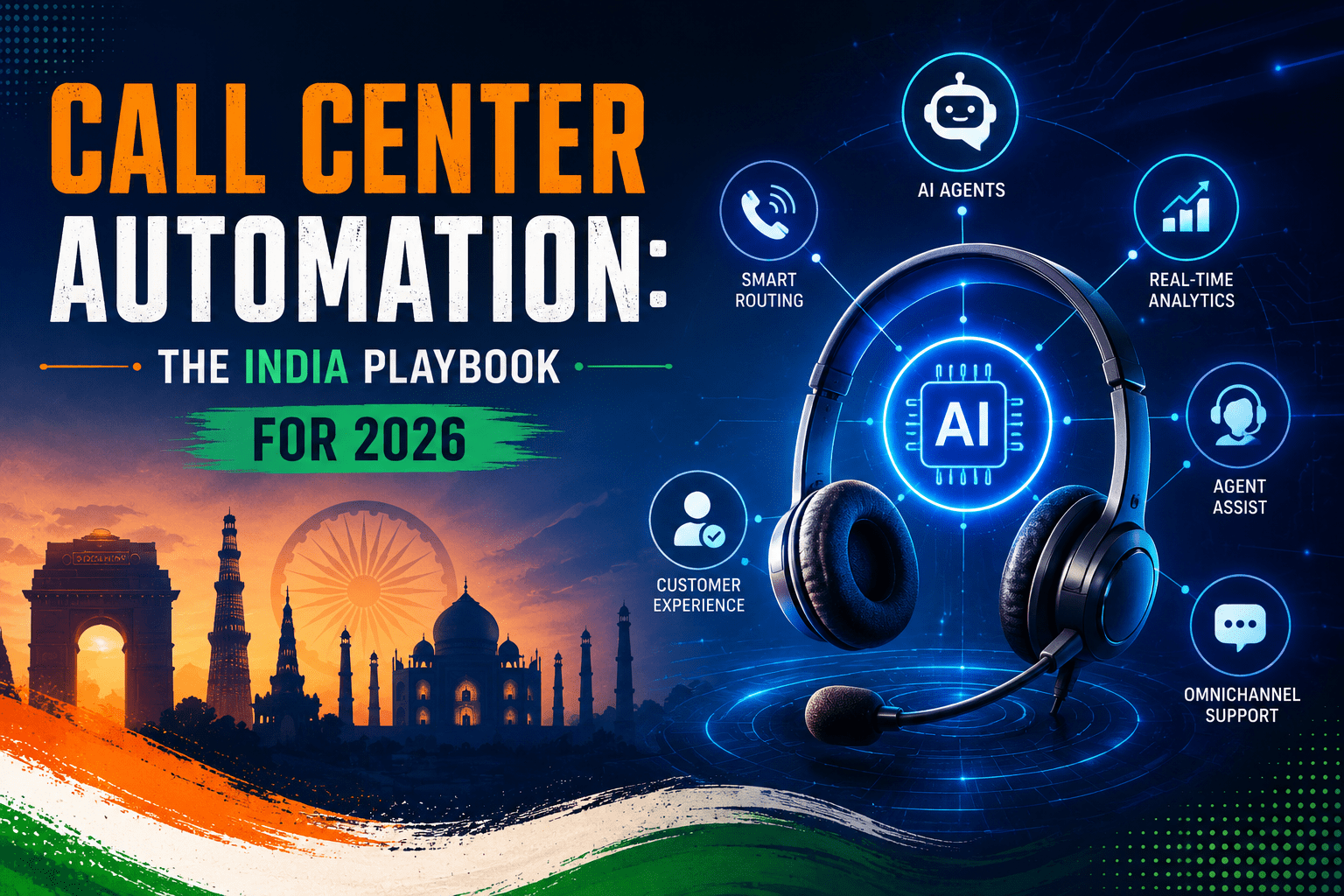
Walk into any Indian contact center floor - in-house at a bank, BPO at a telecom, e-commerce customer service hub, insurance company call centre - and the pattern is similar.
Banks of agents in headphones. Screens with the company's CRM open. A wallboard showing live metrics - calls in queue, average wait time, average handle time, calls abandoned. A supervisor walking the floor. The IVR up front, taking inbound calls and routing them through press-1, press-2, press-3 menus. Most callers pressing zero or saying 'agent' to bypass the menu. The wait time creeping up during peak hours.
Ask the operations head whether the contact center is automated. The answer will be yes. They have IVR. They have a workforce management system. They have a CRM with screen pop. They have call recording. They have a quality team listening to a random sample of calls each month. By the standard definition of a 2010 contact center, the place is automated.
By the standard definition of 2026, the place is barely automated at all. The IVR is not handling calls - it is filtering them and most callers are bypassing it. Agents are spending most of their day on the same routine queries answered the same way they have been answered for the last five years. The wrap-up after each call is manual data entry. The quality team is sampling under 2% of calls. The outbound campaigns running in parallel are exposed to TRAI DND violations because suppression is checked weekly rather than per-call.
Most Indian contact centers in 2026 have the infrastructure of contact centers and not the automation of contact centers. The result is the metrics every operations head watches creeping in the wrong direction — average handle time up, first-call resolution flat, agent attrition rising, customer satisfaction trending down despite no obvious cause.
This pillar is about what call center automation actually means in 2026 for Indian operations. The six capabilities that make up the orchestration layer. Why IVR-equals-automation is the same vocabulary mistake the marketing automation buyers made - different shape, same trap. What changed in voice AI quality in 2024-2025 that makes 2026 different from prior years. And what an Indian contact center needs to actually deploy this - including the Hindi voice AI realities, TRAI/IRDAI/RBI compliance layers, BPO economics, and the metrics that show real ROI versus the vanity dashboards most call center wallboards still display.
IVR is not call center automation
The vocabulary problem repeats. Most Indian contact center vendors describe their IVR with conversational AI bolted on as a call center automation platform. The pitch deck shows screens with AI agents handling calls. The reality after purchase - the IVR menu remains the front door, the AI bolt-on handles a narrow subset of intents, most callers still zero out, and the agents still take the bulk of routine queries.
IVR is a menu-driven routing system. Press 1 for accounts, press 2 for cards, press 3 for loans. The IVR collects intent through menu selection and routes the caller to a queue or to an agent. It does not handle the call. It does not understand language beyond menu numbers. When a caller says something that is not a menu option, the IVR fails over to an agent.
Call center automation is the orchestration that includes intelligent routing without menus, autonomous AI voice agents that handle calls end-to-end where appropriate, real-time assist for the human agents who do handle calls, post-call workflow that eliminates manual wrap-up, speech analytics that runs against every call rather than samples, and compliant outbound calling that respects DPDP and sector regulators.
Most Indian contact centers have IVR. Many do not have call center automation. The IVR is doing its 2010 job. The orchestration the modern contact center needs is missing.
What changed in 2024-2025 that makes 2026 different
AI voice agents have been pitched to Indian contact centers since at least 2018. For most of that period, the pitch was ahead of the reality - voice AI quality was insufficient in English for natural conversation, materially worse in Hindi, and largely unusable in regional Indian languages. Most early deployments became failed pilots that operations heads now reference when vendors return with new pitches.
What changed through 2024-2025 was specific and measurable. Hindi voice quality crossed a fluency threshold where extended conversations with callers no longer felt robotic. Regional language coverage improved - Tamil, Telugu, Marathi, Bengali, Gujarati, Kannada at production-grade fluency for at least the most common domains. Latency dropped - responses arrived in conversational time rather than awkward pauses. Code-switching handling improved - agents could follow callers who mix Hindi and English mid-sentence without breaking.
The result in 2026 is that AI voice agents reliably handle 50% to 70% of routine call types end-to-end in most Indian domains, without the failure modes that defined earlier deployments. Banking balance enquiries. Insurance policy status. E-commerce order tracking. Telecom recharge confirmation. Healthcare appointment scheduling. The routine calls that consumed agent hours for years are now containable by AI in production.
What still requires humans - complex troubleshooting, emotionally sensitive issues, exception handling, anything requiring genuine judgement on a case-by-case basis. These calls go to human agents, but they go faster because the routine calls are not in the queue ahead of them, and they go better because the AI prepares context for the agent in advance. The hybrid model - AI on routine, humans on complex, with handoff between them - is the working pattern for Indian contact centers in 2026.
The six capabilities of real call center automation
1. Intelligent inbound routing
Routing based on intent, language, and skill match rather than menu selection. The caller states what they want in their own words. The system identifies the intent and routes - to an AI agent if the intent is routine and contained, to a human agent with matching skill if the intent requires judgement. Routing also considers the caller's history, value tier, and current sentiment if available. The press-1 menu disappears. The caller talks. The system routes.
2. Autonomous AI voice agents
AI agents handle routine call types end-to-end. The caller speaks naturally. The agent listens, identifies intent, accesses the relevant backend systems through API integration, completes the transaction or answers the question, and closes the call. Average handle time on routine calls drops materially because the AI agent does not pause, does not need to look things up manually, and does not get tired across a shift. Hindi, English, and major regional languages handled at production quality for most domains.
3. Real-time human agent assist
For calls that route to human agents, AI listens to the live call alongside the agent. The AI surfaces relevant context - past calls, account details, similar resolved cases - to the agent's screen in real time. It suggests next-best-actions, flags compliance considerations, drafts response language for difficult moments. The agent stays in control; the AI is the assistant in the conversation. Handle time drops, first-call resolution lifts, agent confidence on difficult calls increases.
4. Post-call workflow automation
The 60 to 180 seconds an agent spends after each call writing wrap-up notes and updating CRM gets automated. AI generates the call summary, classifies the disposition, updates the relevant CRM fields, fires any follow-up actions, and routes the case to whichever workflow needs it next. The agent ends the call and the system handles everything downstream. Across a 1,000-call day, the time recovered is meaningful - and the data quality of the CRM improves because the wrap-up is consistent rather than dependent on how tired the agent is.
5. Speech analytics across all calls
Traditional contact center QA samples 1% to 5% of calls and listens to them manually. Speech analytics runs against every call, surfacing patterns - compliance breaches, mention of competitors, frustration signals, training opportunities, recurring questions that suggest a knowledge base gap or a product issue. The QA team shifts from listening to a small sample to investigating the patterns the analytics surfaces. The customer signal hidden in 95% of calls becomes visible.
6. Compliant outbound calling
Outbound campaigns - collections, sales, surveys, retention - operate under TRAI's National Customer Preference Register (DND) rules and any sector-specific regulator overlays. Compliant outbound automation suppresses against the NCPR per-call (not weekly), respects per-customer opt-out preferences, handles consent capture for any data shared during the call, paces calls intelligently (not just at maximum throughput), and detects answering machine versus live answer to optimise agent connection time.
The India-specific layer
Hindi and regional language voice quality
Hindi voice AI quality matters more than English voice AI quality for most Indian contact centers. The caller base is predominantly Hindi-comfortable for B2C operations across most domains. Regional language coverage matters for sector-specific operations - Tamil for telecom in Tamil Nadu, Bengali for banking in Bengal, Marathi for utilities in Maharashtra. The voice AI's quality in the caller's preferred language is the determinant of whether the AI agent will succeed or whether callers will zero out to humans.
Code-switching reality
Indian callers mix languages mid-call. A Hindi-speaking caller will switch to English for technical terms - 'mera card block ho gaya hai, can you check the transaction?' Voice AI that breaks on code-switching fails in production. Production-grade Indian voice AI handles the switching natively and continues the conversation without losing context.
Sector-specific compliance overlays
Banking call centers operate under RBI guidelines for customer verification, complaint handling, and call recording retention. Insurance call centers operate under IRDAI rules for disclosure, suitability, and pre-sale information requirements. Securities call centers operate under SEBI rules for product suitability and risk disclosure. Healthcare call centers under emerging telehealth and patient data rules. The call center automation platform needs to handle the sector-specific layer applicable to the operation - generic platforms that ignore this fail compliance audits silently.
TRAI and DPDP for outbound
TRAI's National Customer Preference Register requires that outbound commercial calls suppress against the DND list. Non-compliance triggers telecom-level enforcement and reputational damage. DPDP Act 2023 adds consent requirements for personal data collected during calls. Production call center automation handles both layers - NCPR suppression per-call, DPDP consent capture and audit trail - as built-in capabilities rather than custom configurations.
BPO economics
India hosts a large global BPO industry that serves Indian and international clients. BPO economics are different from in-house contact center economics - labour cost arbitrage, client SLAs, multi-tenant infrastructure, billed-per-call or per-minute revenue models. Call center automation in a BPO context needs to handle multi-tenant deployment, client-specific configurations, billing integration, and SLA reporting per client. Generic in-house platforms typically miss these requirements.
Agent attrition reality
Indian contact center agent attrition typically runs 30% to 80% annually depending on segment. Most attrition is driven by repetitive low-value calls that burn agents out and drive them to alternative employment. Call center automation that takes the routine work off human agents addresses the root cause of attrition that wage hikes and incentive programs do not. The attrition reduction is a real cost saving that does not always show up in the primary ROI calculation.
What to measure
The standard contact center metrics - AHT, FCR, CSAT, ASA, agent utilization - remain relevant. Call center automation should improve all of them. Two additional metrics matter specifically for automation ROI.
Deflection rate. The share of calls handled fully by AI without human escalation. Indian baselines vary widely; for routine-heavy domains (telecom, e-commerce, utilities), 40% to 70% deflection is achievable in mature deployments. For complex domains (BFSI advisory, healthcare), 20% to 40% is more typical. Deflection rate measures the depth of automation, not just its presence.
Agent attrition. Annualised attrition rate across the contact center workforce. Indian baselines run 30% to 80% by segment. Good automation deployments reduce attrition meaningfully — typically 10 to 25 percentage points over 12 to 18 months — because agents stop spending most of their time on routine work that drives burnout. Attrition reduction is the lagging metric that shows whether automation is actually changing agent experience or just shifting metrics around.
Beyond these, cost per contact (CPC) is the unit economics number that combines salary cost, infrastructure cost, and automation platform cost divided by handled contacts. CPC should improve year-over-year as automation depth increases. Flat CPC despite increasing automation suggests the deployment is not actually displacing work - just adding tooling.
Vendor evaluation rubric
When evaluating call center automation platforms for the Indian market, score against twelve criteria. Below 8 of 12 is incomplete.
Intelligent intent-based routing - no menu trees, language and skill matched.
Autonomous AI voice agents in Hindi at production-grade fluency, with regional language coverage for at least Tamil, Telugu, Marathi, Bengali, Gujarati, Kannada.
Code-switching handling across Indian language mixes without conversation breaks.
Real-time human agent assist with context surfacing and next-best-action suggestions.
Post-call summarization and CRM update automation.
Speech analytics across 100% of calls with compliance, sentiment, and pattern surfacing.
Compliant outbound with TRAI NCPR per-call suppression and DPDP consent capture.
Sector-specific compliance support - RBI / IRDAI / SEBI / healthcare overlays for the operation's domain.
API integration with the contact center stack - CRM, ticketing, workforce management, telephony platform.
Multi-tenant capability for BPO operations and per-client configuration.
Reporting on the six metrics - AHT, FCR, CSAT, deflection rate, agent attrition, cost per contact.
INR-denominated pricing and India-based 24x7 support.
30-60-90 day implementation roadmap
An Indian contact center deploying call center automation can sequence the work across three thirty-day blocks.
Days 1-30 - Foundation
Audit current call volume and disposition data. Identify the top five to ten call types by volume — these are the candidates for AI agent handling. Map the existing IVR, CRM, telephony, and workforce management stack. Pick one high-volume routine call type for the initial deployment — typically balance enquiry for banking, order status for e-commerce, policy details for insurance. Build the AI agent for that single intent. Integrate with the backend systems that intent needs. Configure TRAI and DPDP compliance for inbound. Launch with a small percentage of traffic and monitor closely.
Days 31-60 - Expansion
Expand to three to five additional routine call types based on Days 1-30 learnings. Add regional language coverage relevant to the operation's customer geography. Deploy real-time agent assist for the human agents handling the remaining call types. Build the post-call workflow automation. Set up the reporting dashboard for AHT, FCR, deflection rate, and agent feedback. Run the first formal weekly review with operations and agent supervisor feedback.
Days 61-90 - Optimisation
Tune AI agent flows based on actual call data — failure modes, escalation triggers, customer feedback. Deploy speech analytics across all calls. Add compliant outbound campaign automation if outbound is part of the operation. Build the sector-specific compliance configurations. Move reporting from activity metrics to outcome metrics — deflection rate, agent attrition trend, cost per contact. Set the monthly review cadence with operations, QA, and HR (for the attrition signal).
When NOT to use call center automation
Three situations.
If the call volume is under 200 calls per day, the automation platform's fixed cost typically exceeds the value. Small contact centers can run effectively on traditional infrastructure with strong agent training. Automation pays off when volume strains attention and routine work consumes the majority of agent time.
If the call domain is fundamentally relationship-driven — high-net-worth banking, complex enterprise B2B support, sensitive healthcare - and most calls require genuine human judgement, AI agent handling has limited applicability. In these cases, deploy the agent assist and post-call layers without the autonomous AI agent layer. Hybrid configurations work; full automation does not fit.
If the regulatory environment for the sector mandates human handling for specific call types (and some sectors and call categories do), automation deployment must respect those carve-outs. Compliance considerations override automation cost savings. Work with the compliance team before scoping deployment.
The Converiqo angle
Converiqo is built as a unified call center automation platform for Indian operations - agentic AI voice agents across Hindi, English, and major regional languages, intent-based routing without menu trees, real-time human agent assist, post-call workflow automation, speech analytics across 100% of calls, compliant outbound with TRAI NCPR and DPDP handling, sector-specific compliance support for BFSI, insurance, healthcare, and telecom, native API integration with the Indian contact center stack, multi-tenant capability for BPO operations, INR-priced.
The platform is the platform. The question worth answering for any contact center is whether the orchestration is actually wired — routing intent-based, AI agents handling routine end-to-end, human agents assisted in real time, post-call workflow automated, speech analytics across all calls, outbound compliant. If it is, call center automation is delivering. If not, the IVR is filtering calls and the orchestration is missing.
Frequently Asked Questions
What is call center automation?
Call center automation is the orchestration of intelligent routing, autonomous AI voice agents, real-time human agent assist, post-call workflow, speech analytics, and compliant outbound. It differs from IVR, which is a press-1 menu routing system, and from standalone AI voicebots, which are point tools rather than orchestrated systems.
How is call center automation different from IVR?
IVR is a menu-driven routing system - press 1 for accounts, press 2 for cards. It does not handle calls; it routes them based on menu selection. Call center automation is the orchestration that includes autonomous handling of calls end-to-end where appropriate, intelligent routing without menus, real-time assist for human agents, post-call automation, and analytics across all calls.
Can AI voice agents handle calls in Hindi and Indian regional languages?
Yes — Hindi voice AI quality crossed call-center-grade fluency through 2024-2025. Major regional languages including Tamil, Telugu, Marathi, Bengali, Gujarati, and Kannada are at production fluency for most common domains. Code-switching between Hindi and English mid-call is handled by production-grade platforms without conversation breaks.
What percentage of calls can AI agents handle end-to-end?
In 2026, agentic AI voice agents reliably handle 50% to 70% of routine call types end-to-end in most Indian domains. Routine-heavy operations like telecom, e-commerce, and utilities achieve higher deflection. Complex domains like advisory banking and healthcare see lower deflection - typically 20% to 40%.
What is the ROI of call center automation for an Indian operation?
For Indian contact centers above 30 seats, typical payback is 6 to 14 months. ROI shows up in deflection rate (calls fully handled by AI), reduced AHT, improved FCR, agent attrition reduction (often 10 to 25 percentage points over 12-18 months), and improved CSAT. Cost per contact is the unit economics metric to track.
How does TRAI compliance fit into call center automation for outbound?
TRAI's National Customer Preference Register requires outbound commercial calls to suppress against DND-registered numbers. Compliant call center automation checks the NCPR per-call (not periodically), respects per-customer opt-out preferences, and maintains audit logs for telecom-level review. Non-compliant outbound risks telecom-level enforcement.
How does call center automation work with sector-specific regulators?
BFSI operations need RBI-aligned recording and verification handling. Insurance operations need IRDAI-aligned disclosure and suitability flows. Securities operations need SEBI-aligned risk disclosure. Healthcare needs patient data handling under emerging frameworks. Production platforms handle sector-specific configurations as first-class capabilities, not custom builds.
Can call center automation reduce agent attrition?
Yes - significantly. Most agent attrition in Indian contact centers is driven by repetitive low-value calls that burn agents out. Taking routine calls off human agents addresses the root cause of attrition. Typical reduction is 10 to 25 percentage points over 12 to 18 months in operations that deploy AI agent handling thoughtfully alongside agent assist.
Should we replace our IVR or add automation alongside?
In most cases, automation deployments retire the IVR menu and replace it with intent-based routing - but the underlying telephony platform stays. The IVR menu is a small portion of the call center stack; replacing it with intent-based routing is part of the automation deployment, not a separate project. The full contact center infrastructure rarely needs replacement.
What metrics should we track for call center automation?
Standard contact center metrics - AHT, FCR, CSAT, ASA, agent utilization - remain relevant. Add deflection rate (share of calls handled fully by AI), agent attrition trend (the lagging indicator that shows whether automation is actually changing agent experience), and cost per contact (the unit economics number that combines all costs). Track all eight together, not any one in isolation.
Key Facts (Citable, single-sentence)
-
Call center automation covers six functional capabilities - intelligent routing, autonomous AI voice agents, real-time agent assist, post-call workflow, speech analytics, and compliant outbound.
-
IVR (interactive voice response) is a press-1 menu routing system, not call center automation; most Indian businesses confuse the two and the vendor marketing reinforces the confusion.
-
Approximately 70% of Indian callers press zero or shout 'agent' to bypass IVR menus, indicating the IVR is failing as a containment layer.
-
Agentic AI voice agents in 2026 reliably handle 50% to 70% of routine call types end-to-end in Hindi, English, and major Indian regional languages.
-
Hindi voice AI quality improved materially through 2024-2025 and now meets call-center-grade fluency for most domains; regional language coverage varies more.
-
Real-time agent assist - AI listening to live calls and suggesting next-best-action - reduces average handle time by 15% to 25% in mature deployments.
-
Post-call summarization automation eliminates 60 to 180 seconds of manual wrap-up per call, freeing significant agent time across a 1,000-call day.
-
Speech analytics run against all calls (not random samples) surfaces compliance breaches, training needs, and customer signal that traditional QA misses.
-
TRAI's National Customer Preference Register (NCPR / DND) requires outbound call suppression checks; non-compliant outbound campaigns risk telecom-level enforcement.
-
Sector-specific regulators add layers — IRDAI for insurance call centers (recording, disclosure), RBI for banking (verification, complaint handling), SEBI for securities (disclosure, suitability).
-
Average handle time (AHT), first call resolution (FCR), customer satisfaction (CSAT), and deflection rate are the core call center metrics; agent attrition is the lagging metric most operators under-track.
-
For Indian contact centers above 30 seats, full call center automation typically pays back in 6 to 14 months on combined AHT, deflection, agent productivity, and attrition reduction.
About the Author

Yash Soni
Ready to orchestrate your AI future?
Converiqo AI helps you design, deploy, and scale automation workflows that move your business faster, leveraging specialized solutions like our AI bot platform for lead generation, customer self-service AI bot platform, employee self-service AI bot platform, retail omnichannel automation, and our detailed guides on how agentic AI bot platforms work in enterprises and cost structure of enterprise AI bot platforms. Connect with our team to see the platform in action and co-create the next chapter of intelligent operations.
Read More Blogs
Discover more insights and product updates curated by the Converiqo AI team.
Real ROI of Field Force Automation - Beyond the Activity Dashboard
Four metrics that show real field force automation ROI in India - productivity, data reliability, throughput, and field attrition - not just the activity dashboard.
Beat Planning Is the Highest-Leverage Field Force Capability - Here Is Why
Beat planning decides coverage, call frequency, and whether field time is productive. Why it is the single highest-leverage field force automation capability.
Why an Indian Field Force App Has to Work Offline - and Be Built for Real Devices
Field work in India happens where connectivity is intermittent. A field force app that assumes constant connectivity fails exactly where field work is done.