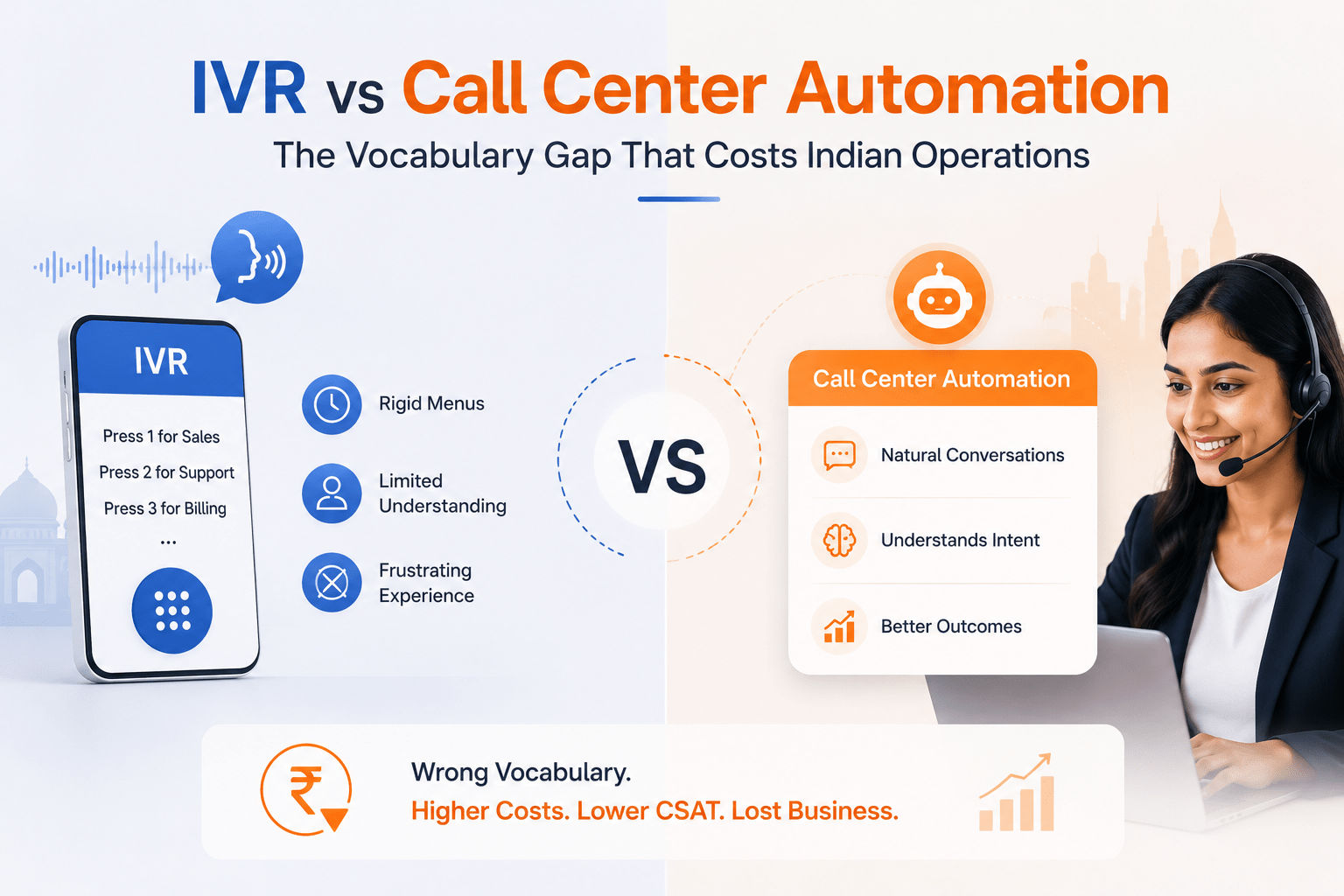
Ask the head of any Indian contact center whether the operation has call center automation. Most will say yes. Some will point to their IVR - the press-1-for-accounts menu callers navigate. Some will reference the auto-dialler that handles outbound. Some will mention the agent screens that pop the caller's record automatically. By the standard vocabulary of contact center vendors in 2026, all of this counts as automation.
It does not. Or rather - it is the 2010 definition of automation, applied to a 2026 industry that has moved on. The vocabulary lag is producing buying decisions that miss the actual category of capability the modern contact center needs.
What IVR actually is
An interactive voice response system is a menu-driven call routing tool. It plays a recorded greeting, presents menu options, captures the caller's selection through DTMF tones or limited voice recognition, and routes the call to a queue or agent. It does not understand language. It does not handle the call. It does not learn from previous interactions. It is a switchboard with a menu attached.
IVR was a significant capability when it emerged. It allowed contact centers to deflect routine routing decisions to a system rather than a human switchboard operator. It reduced wait times for callers who could navigate the menu and routed them more efficiently than human routing did. It saved meaningful operational cost.
Indian callers in 2026 mostly bypass it. Approximately 70% press zero, hold the line, or say 'agent' to escape the menu and reach a human. The IVR is no longer reducing routing cost meaningfully because it is no longer doing routing - it is just delaying the call to a human by 20 to 40 seconds. The containment value the IVR provided in 2010 has eroded as caller expectations and patience changed.
What call center automation actually is
Six capabilities working together - intelligent intent-based routing without menus, autonomous AI voice agents handling routine calls end-to-end, real-time agent assist during human-handled calls, post-call workflow automation, speech analytics across all calls, and compliant outbound calling. The categories are different. The skills the deployment team needs are different. The vendor evaluation criteria are different. The buyer journey ends in a different place.
Crucially, the underlying telephony platform - the PBX, the contact center suite, the call recording infrastructure - stays in most deployments. Call center automation is not a replacement of the contact center infrastructure. It is an orchestration layer that sits on top and replaces the IVR while preserving the rest.
Why the confusion persists
Three reasons specific to the Indian contact center market.
Vendor messaging blurs the line. Most Indian contact center technology vendors describe their IVR plus a voicebot bolt-on as 'AI-powered call center automation.' The bolt-on handles narrow intents. The buyer purchases under the marketing language, deploys it, and discovers post-deployment that 80% of calls still route to humans, the bolt-on covers 5% of call types, and the IVR menu is still the front door. The vocabulary mismatch is now embedded in the contract.
Operations heads inherited the 2010 mental model. Many Indian contact center leaders came up through the BPO era when IVR plus auto-dial plus screen-pop was the automation standard. The mental model is hard to update when most peer operations are running the same 2010 stack. The frame of reference for what 'automated' looks like is anchored to a decade-old definition.
The 2018-2022 voice AI false start. Most Indian contact centers tried voice AI in some form between 2018 and 2022. Most of those deployments failed because the voice quality, particularly in Hindi and regional languages, was insufficient for production. Operations heads now reference those failed pilots as proof that voice AI does not work. The 2024-2025 quality jump has not yet been validated in their operations - and the marketing claims now sound like the same claims that did not deliver four years ago.
What the gap costs
Three costs an operations head can quantify if they look.
Agent hours on routine work. Most Indian agents spend 40% to 70% of their handling time on the top five call types - typically queries with known answers that have been answered thousands of times by the same operation. AI agent handling at production-grade quality removes most of this volume from the human queue. The released agent hours either reduce headcount or redeploy to complex work that needs human judgement.
Agent attrition driven by routine burnout. The agents handling routine calls all day are the ones leaving fastest. Attrition runs 30% to 80% annually across Indian contact center segments. Most of that attrition is not about wages - it is about the daily experience of taking the same call hundreds of times. Automation that removes the routine work addresses the cause; wage hikes treat the symptom.
Customer experience erosion from queue depth. Callers waiting 4 to 12 minutes during peak hours because the queue is full of routine calls that should not be queuing in the first place. The CSAT scores drop. The Glassdoor reviews and Google reviews show up. The competitive comparison shifts. The cost is reputational and shows up as churn over months, not as a direct line item in the call center P&L.
The vocabulary gap - calling IVR what it is, and calling call center automation what it is - is the precondition for the buying decision that addresses these costs. As long as the contact center buyer treats them as the same category, the deployment will be smaller in scope than the operation needs.
About the Author

Avni Chadha
Ready to orchestrate your AI future?
Converiqo AI helps you design, deploy, and scale automation workflows that move your business faster, leveraging specialized solutions like our AI bot platform for lead generation, customer self-service AI bot platform, employee self-service AI bot platform, retail omnichannel automation, and our detailed guides on how agentic AI bot platforms work in enterprises and cost structure of enterprise AI bot platforms. Connect with our team to see the platform in action and co-create the next chapter of intelligent operations.
Read More Blogs
Discover more insights and product updates curated by the Converiqo AI team.
Real ROI of Field Force Automation - Beyond the Activity Dashboard
Four metrics that show real field force automation ROI in India - productivity, data reliability, throughput, and field attrition - not just the activity dashboard.
Beat Planning Is the Highest-Leverage Field Force Capability - Here Is Why
Beat planning decides coverage, call frequency, and whether field time is productive. Why it is the single highest-leverage field force automation capability.
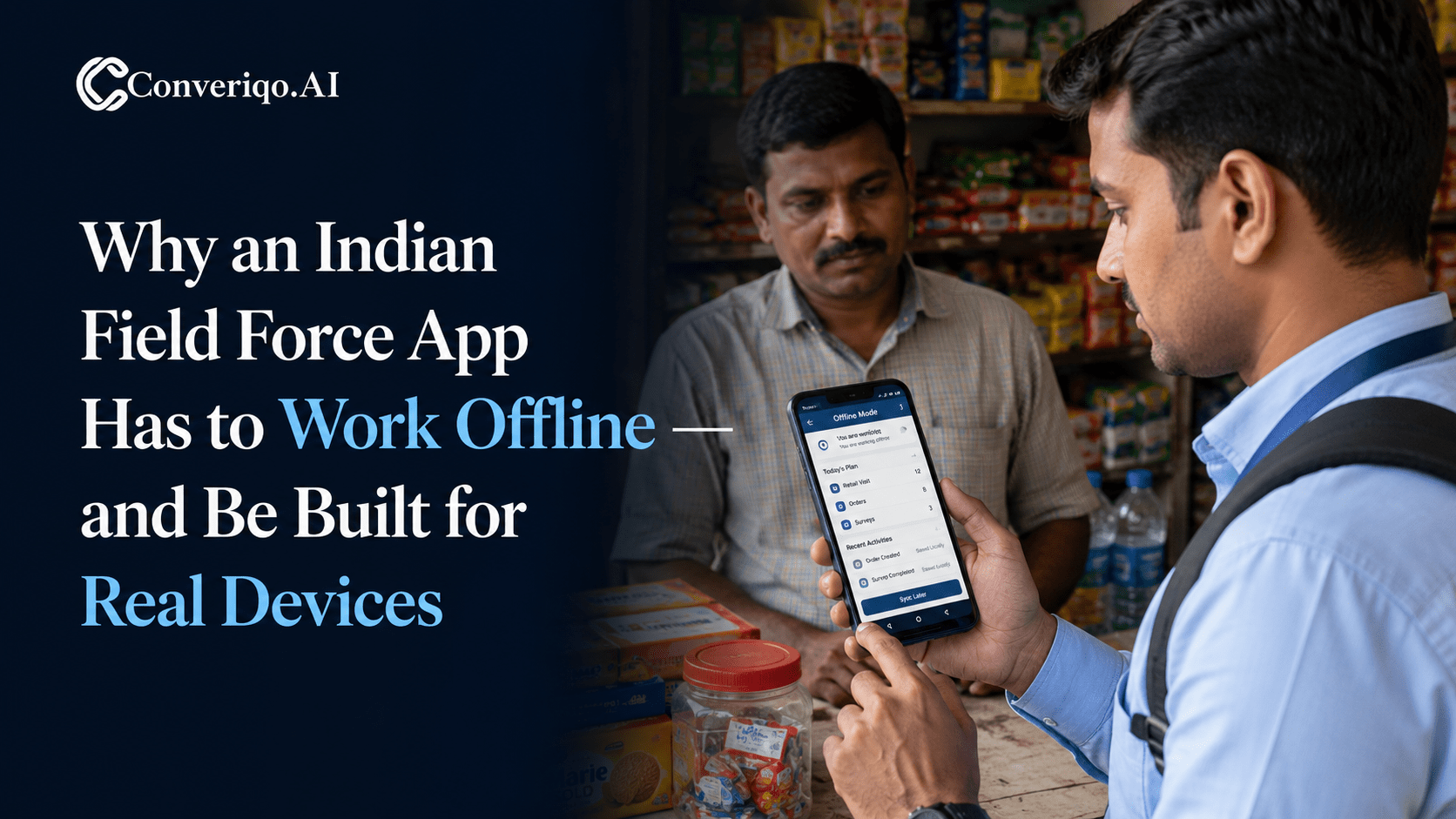
Why an Indian Field Force App Has to Work Offline - and Be Built for Real Devices
Field work in India happens where connectivity is intermittent. A field force app that assumes constant connectivity fails exactly where field work is done.