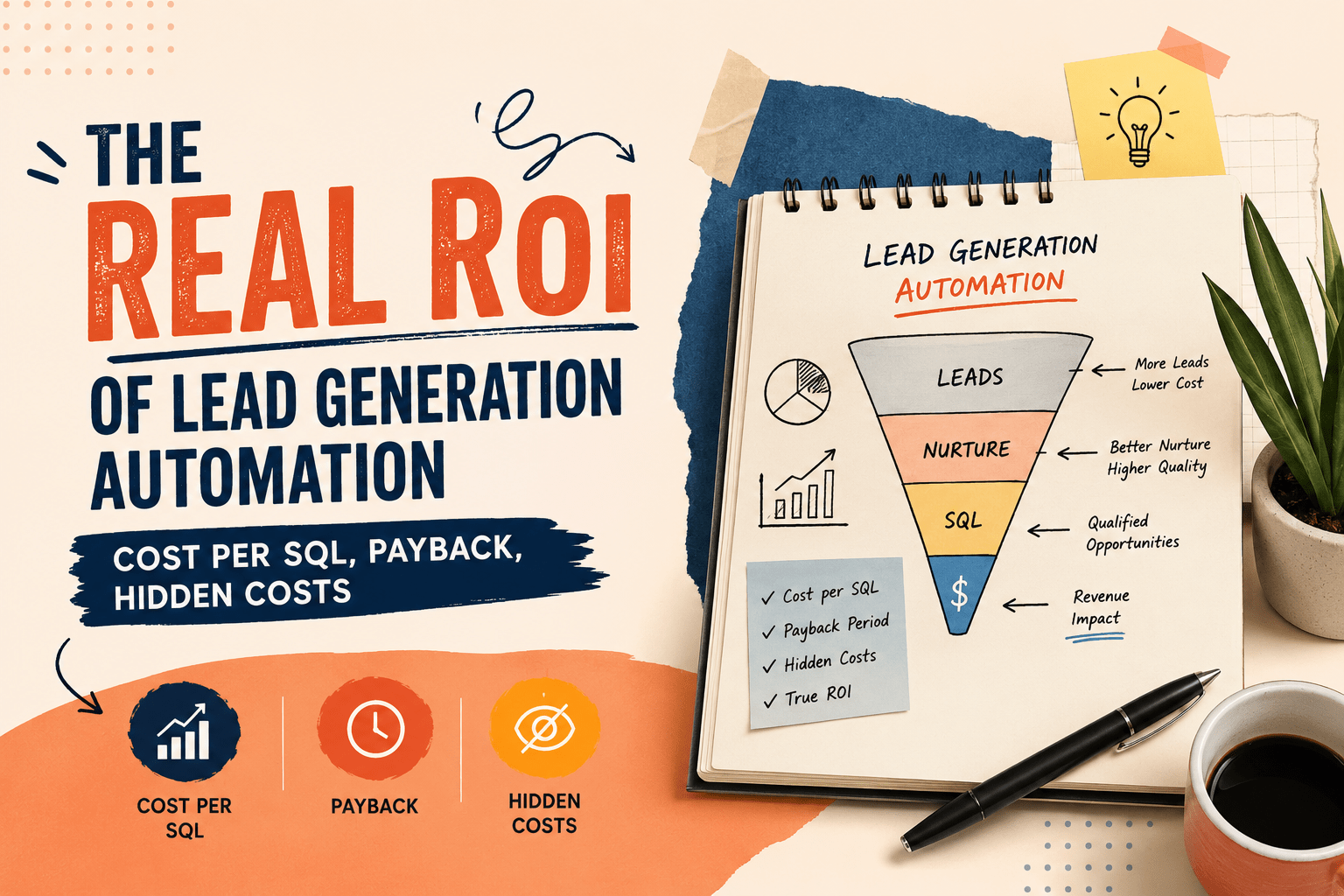
Most ROI calculations for lead generation automation that Indian businesses see during vendor evaluations are wrong in the same way - they measure cost per lead before and after, show the after is lower, and call that the ROI. This is a misleading framing. Cost per lead can drop while lead quality drops faster, leaving the business worse off.
The four numbers that show real ROI.
Number 1 - Cost per sales-qualified lead (CPSQL)
Not cost per lead. Cost per sales-qualified lead - the cost of producing one lead that sales agrees to work. CPSQL is calculated by taking total acquisition spend, dividing by the number of leads, then dividing by the sales-acceptance rate.
Example. INR 5 lakh ad spend, 1,000 leads, 30% sales-acceptance rate. CPL is INR 500. CPSQL is INR 500 divided by 0.30, which is INR 1,667. The real unit economics number is INR 1,667 per qualified lead, not INR 500 per captured lead.
Good lead generation automation typically lifts sales-acceptance rate by 20 to 40 percentage points by improving qualification depth. The same INR 500 CPL becomes INR 1,000 CPSQL at 50% acceptance - a 40% improvement in unit economics with no change in ad spend.
Number 2 - Speed-to-first-meaningful-response
The time from lead capture to the first human conversation with that lead. Not the auto-reply time. The meaningful conversation time.
The Indian baseline is typically 2 to 8 hours. Good lead generation automation collapses this to minutes for the AI qualification, and to under 30 minutes for the human handoff on qualified leads.
The ROI of this number shows up in two places - conversion rate (faster first response correlates strongly with higher conversion) and ad efficiency (faster funnel means the same ad spend produces more closed deals per period).
Number 3 - Sales-acceptance rate
Of the leads marketing hands to sales, what share does sales agree to work. This is a quality metric that matters more than volume.
Indian baseline ranges from 20% to 50% depending on industry. Good lead generation automation typically pushes this to 60% to 80% because the qualification layer filters out leads that historically went to sales as junk.
The hidden ROI here - sales team productivity. The same sales headcount working a higher-quality pipeline closes more deals at lower cost per close. The number does not show up in marketing dashboards but is real money in the P&L.
Number 4 - Time to close from capture
From the first touch to closed-won, in calendar days. This is the metric that ties lead generation back to revenue cycle.
Indian baseline ranges widely by industry - 7 to 14 days for SMB software, 30 to 60 days for real estate, 90 to 180 days for enterprise software. Good lead generation automation typically compresses this by 15% to 30% by removing handoff delays, nurture gaps, and re-qualification rounds.
Compressed time to close has two effects - cash flow improves (revenue arrives earlier) and ad spend efficiency improves (the same spend funds more closed deals per year because the cycle is faster).
Hidden costs the vendors do not mention
Three.
Implementation effort. Most automation platforms quote license fees and skip implementation. Real implementation includes CRM integration, qualification flow design, vernacular language tuning, template approval cycles, salesperson training, and reporting setup. For an Indian SMB, this is typically 80 to 200 hours of internal effort plus 1.5 to 4 lakh INR of consulting cost in the first 90 days.
Ongoing tuning. The qualification flows need adjustment based on actual sales-team feedback. The nurture sequences need iteration based on engagement data. The scoring thresholds need recalibration. Plan for 8 to 12 hours per month of internal effort on tuning - typically the marketing operations or RevOps role.
Channel-specific costs that show up later. WhatsApp Business API conversation pricing. Enrichment API costs. CRM seat costs that scale with usage. The license fee is rarely the whole picture. A pre-purchase TCO that includes 24 months of conversation volume and CRM scaling is the right framing.
Payback period
For Indian SMBs running paid acquisition above INR 5 lakh per month, typical payback is 4 to 9 months. The variance depends on three things - current sales-acceptance rate (lower baseline means bigger improvement), current speed-to-response (slower baseline means bigger gain), and how much of the implementation the business takes on in-house versus outsourced (in-house is slower to start but lower-cost overall).
Businesses with ad spend under INR 5 lakh per month should run the calculation carefully. The fixed implementation cost can exceed the variable benefit at low volumes. Below INR 2 lakh per month, manual operation with good discipline often beats automation on unit economics.
About the Author

Yash Soni
Ready to orchestrate your AI future?
Converiqo AI helps you design, deploy, and scale automation workflows that move your business faster, leveraging specialized solutions like our AI bot platform for lead generation, customer self-service AI bot platform, employee self-service AI bot platform, retail omnichannel automation, and our detailed guides on how agentic AI bot platforms work in enterprises and cost structure of enterprise AI bot platforms. Connect with our team to see the platform in action and co-create the next chapter of intelligent operations.
Read More Blogs
Discover more insights and product updates curated by the Converiqo AI team.
Real ROI of Field Force Automation - Beyond the Activity Dashboard
Four metrics that show real field force automation ROI in India - productivity, data reliability, throughput, and field attrition - not just the activity dashboard.
Beat Planning Is the Highest-Leverage Field Force Capability - Here Is Why
Beat planning decides coverage, call frequency, and whether field time is productive. Why it is the single highest-leverage field force automation capability.
Why an Indian Field Force App Has to Work Offline - and Be Built for Real Devices
Field work in India happens where connectivity is intermittent. A field force app that assumes constant connectivity fails exactly where field work is done.