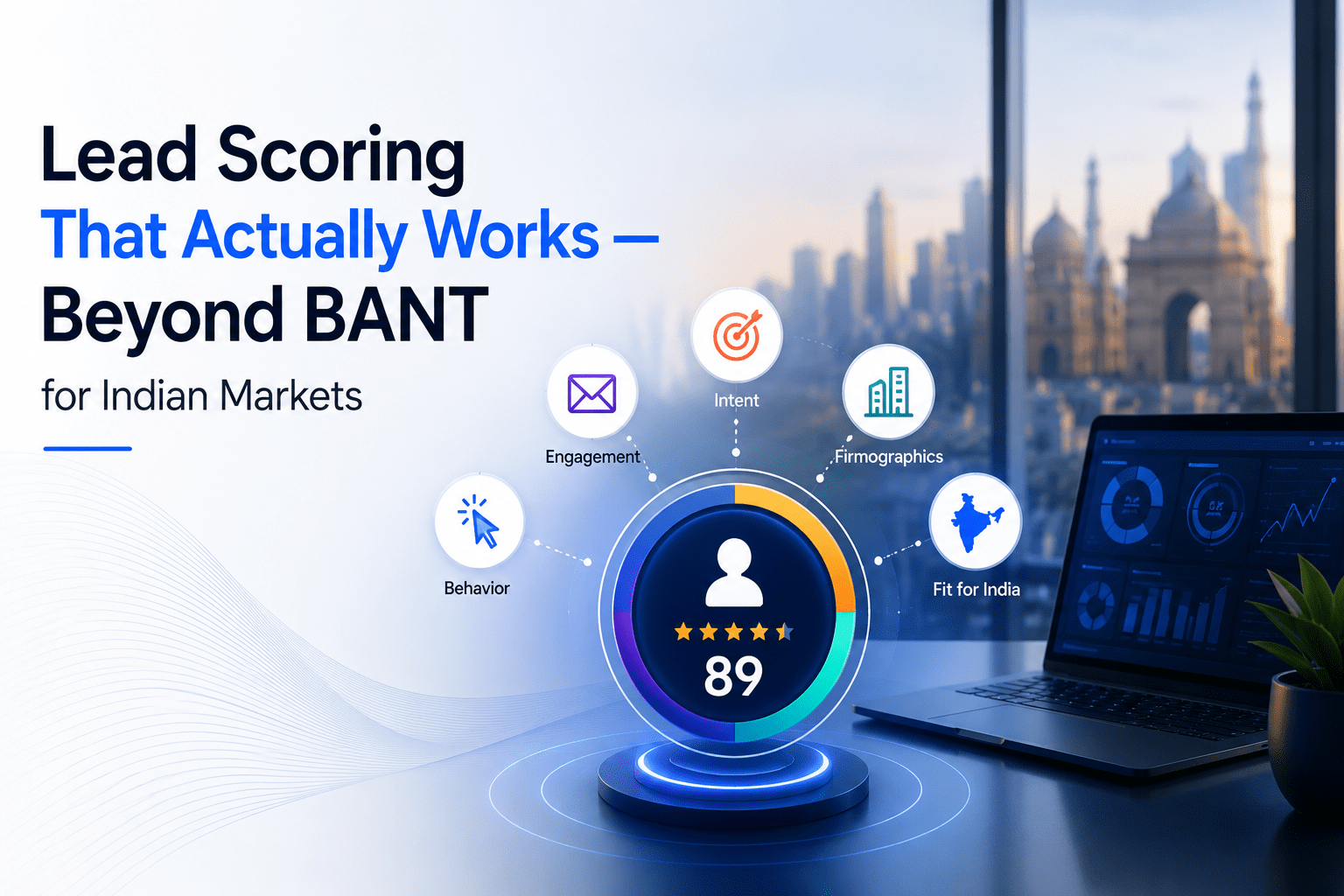
BANT is the lead qualification framework that most sales training materials teach. Budget, Authority, Need, Timeline. Score a prospect on each, total the score, decide whether to pursue. The framework is 60 years old. It was built for IBM's mainframe sales motion in the 1960s. It does not fit Indian SMB and mid-market buying patterns in 2026, and using it as the basis of lead scoring quietly costs Indian businesses qualified leads they wrongly disqualified.
Why BANT breaks in India
Budget is emergent, not pre-existing. An Indian SMB owner does not have a line item in a budget waiting for the right vendor to fill it. The budget gets created when the right solution shows up. A prospect who says 'I don't have budget right now' is often saying 'I have not yet decided this is worth budget' - which is exactly what qualification is supposed to resolve. Scoring them low on budget removes them from the funnel before the qualification conversation has actually happened.
Authority is distributed. A typical Indian SMB or mid-market purchase involves the founder, one or two senior managers, sometimes a board member, and the operational user - all weighing in. The single 'decision-maker' that BANT asks about does not exist as cleanly. Scoring authority as binary misses how Indian buying actually works.
Need is often unstated. Indian buyers, particularly in Tier 2 and Tier 3 cities, do not articulate problems in the vocabulary of the vendor's category. A real estate broker calls a CRM 'a way to remember who called.' A coaching centre owner calls lead generation automation 'a system to make sure no enquiry is missed.' Scoring need based on whether the prospect uses the vendor's preferred terminology misses willing buyers.
Timeline is fluid. 'When do you want to start' is a question that produces 'as soon as possible' or 'in a month or two' regardless of actual intent. The answer carries little signal. The signal is in what happens after the call - does the prospect respond to follow-ups, does the prospect bring in the second decision-maker, does the prospect engage with the next piece of content.
What works better - behavioural and contextual scoring
Score on what the lead does, not what the lead claims.
Engagement depth - how many messages exchanged in the qualification conversation, how many follow-up questions the lead asked back, whether the lead provided specifics or only vague answers.
Specificity of context - did the lead share a specific use case, a specific quantity, a specific timeline, a specific concern. Vague answers across the board scores low. Specifics in any dimension score higher.
Channel and timing - leads who came in through high-intent channels (search, comparison content, demo requests) score higher than leads from low-intent channels (display ads, top-of-funnel content). Leads who engage after business hours and on weekends often score higher because they are doing personal research, not casual browsing.
Follow-through signal - did the lead respond to the first nurture message within 24 hours, did they open the linked content, did they bring in a second person from their organisation. Behaviour two days after capture is more predictive than what the lead said at capture.
The scoring model that holds up in India
A four-factor model, weighted.
Specificity of context (35%) - concrete details across use case, quantity, timeline, concern.
Engagement depth (25%) - quality of the qualification conversation, follow-up questions asked.
Follow-through (25%) - behaviour in the 24 to 72 hours after capture.
Channel and timing signal (15%) - intent strength of the source channel, time-of-day signal.
Total of 70 or above - sales-qualified. 40 to 69 - nurture. Below 40 - disqualify. The thresholds need calibration against the business's actual sales-acceptance and close-rate data over the first 90 to 180 days. They are not absolute. They are a starting point.
What this looks like in practice
The qualification conversation no longer asks 'what's your budget' as a knockout question. It asks what the prospect is trying to achieve, lets the prospect describe it, listens for specificity, asks clarifying questions, and gives the AI scoring agent the inputs it needs to score on the four factors. The salesperson opens the lead and sees a score with reasoning - 'high specificity, deep engagement, fast follow-through, organic search channel' - not just a number.
The leads that get worked are the ones the data says will convert. The leads that get nurtured are the ones not yet there but moving in the right direction. The leads that get filtered out are the ones whose behaviour, not whose stated answers, predicts they will not close.
About the Author

Md Ashik Alam
Ready to orchestrate your AI future?
Converiqo AI helps you design, deploy, and scale automation workflows that move your business faster, leveraging specialized solutions like our AI bot platform for lead generation, customer self-service AI bot platform, employee self-service AI bot platform, retail omnichannel automation, and our detailed guides on how agentic AI bot platforms work in enterprises and cost structure of enterprise AI bot platforms. Connect with our team to see the platform in action and co-create the next chapter of intelligent operations.
Read More Blogs
Discover more insights and product updates curated by the Converiqo AI team.

Real ROI of Field Force Automation - Beyond the Activity Dashboard
Four metrics that show real field force automation ROI in India - productivity, data reliability, throughput, and field attrition - not just the activity dashboard.

Beat Planning Is the Highest-Leverage Field Force Capability - Here Is Why
Beat planning decides coverage, call frequency, and whether field time is productive. Why it is the single highest-leverage field force automation capability.
Why an Indian Field Force App Has to Work Offline - and Be Built for Real Devices
Field work in India happens where connectivity is intermittent. A field force app that assumes constant connectivity fails exactly where field work is done.