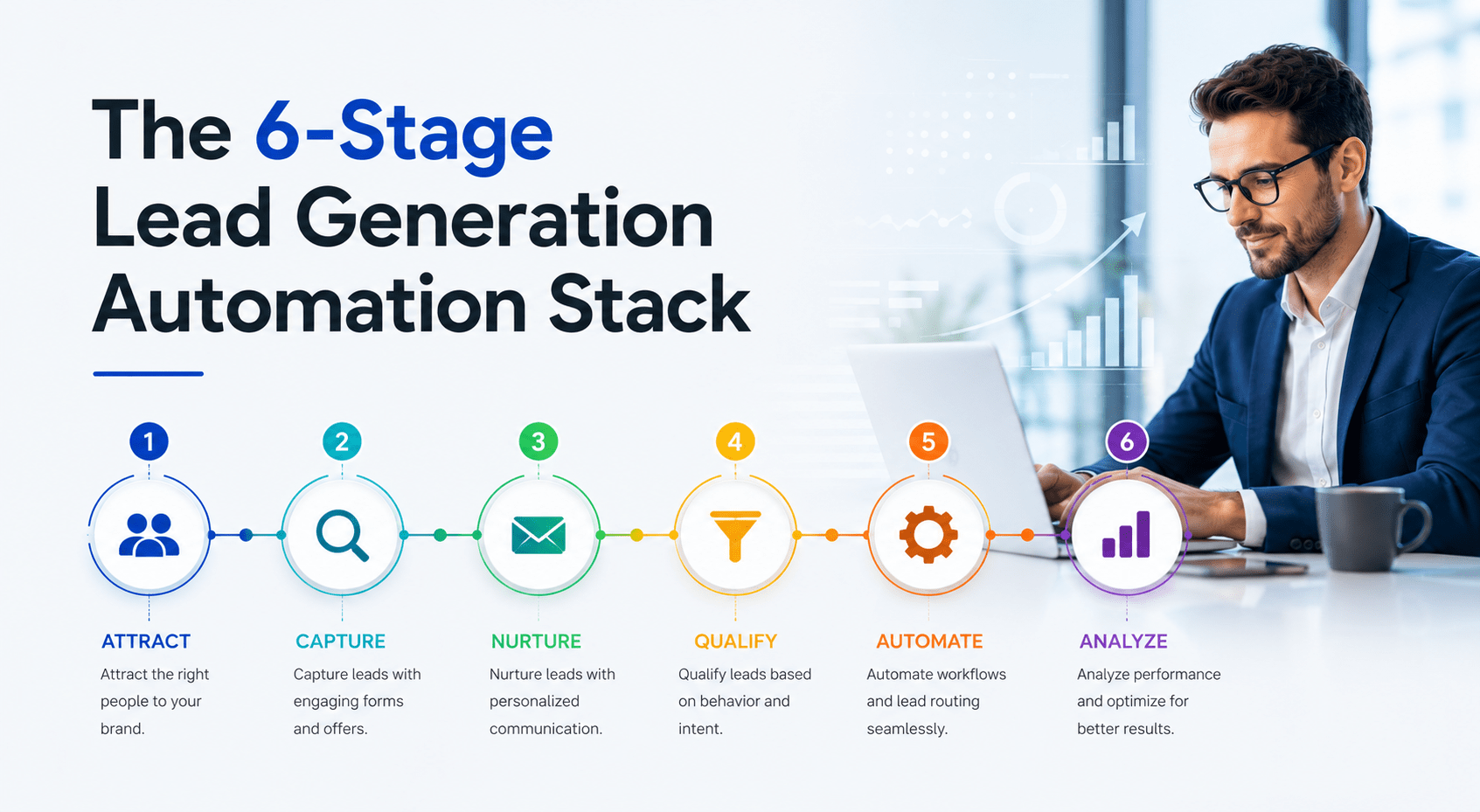
Lead generation automation is six connected layers. Each layer has its own job. Each layer can fail independently. A platform missing any one of them leaves a manual bottleneck in the pipeline.
Layer 1 - Capture
The job - convert intent into an identified prospect across whichever channel the prospect uses to express that intent. Capture surfaces include web forms (with smart fields and progressive profiling), click-to-WhatsApp entry from paid ads, click-to-call from search, organic chat widget on the website, Instagram and Facebook DMs, lead magnets behind email opt-in, and inbound voice calls. The capture layer is unified - every channel writes to one lead record, with channel attribution preserved for downstream routing and reporting.
Failure mode - channels operating as silos. Same prospect, three lead records, three salespeople.
Layer 2 - Qualification
The job - establish whether the captured prospect is a likely buyer, and gather the information needed to route and nurture them correctly. Done well, qualification is a conversation in the lead's preferred channel and language, asking the questions a human salesperson would ask, adapted in real time to what the prospect says. Done badly, it is a static form or a rule-based chatbot that breaks the moment the prospect deviates from the expected script.
Failure mode - qualification by form fields. The prospect says the minimum, the score reflects the minimum, the salesperson opens the lead and starts from scratch.
Layer 3 - Enrichment
The job - augment the lead record with information beyond what the prospect provided. For B2B, this means firmographic data - company size, industry, location, technology stack, funding stage. For B2C, this means behavioural and contextual data - pages viewed, ads clicked, content downloaded, geographic and device signals. The enriched record gives the salesperson context for the first conversation, and gives the routing logic data to work with.
Failure mode - manual enrichment. The salesperson Googles the prospect's company before each call, costing 5 to 10 minutes per lead and inconsistent depth.
Layer 4 - Routing
The job - get each lead to the right salesperson or queue, fast, with SLA enforcement. Routing logic combines territory, vertical, lead score, language, product line, and current salesperson load. Round-robin within rules. Re-route if the assigned salesperson does not respond within the SLA window - 5 minutes for hot leads, longer for warm.
Failure mode - manual routing or static round-robin. Leads sit unassigned when the assignee is on leave. Hot leads route to the same salesperson who already has a queue of 40.
Layer 5 - Nurture
The job - keep non-ready leads warm through structured, sequenced, conditional messaging until they re-enter the active pipeline or self-disqualify. Sequencing is conditional - different next message based on what the lead does or does not do. Vernacular branches. Channel preference respected. WhatsApp template categories handled correctly across the 24-hour window. Nurture is not broadcast.
Failure mode - single broadcast list. Every non-ready lead gets the same monthly newsletter regardless of stage, intent, or interest.
Layer 6 - Handoff
The job - transfer the sales-qualified lead to a human salesperson with full context, so the human conversation picks up where the AI left off rather than starting cold. The handoff package includes the qualification conversation transcript, the enrichment data, the nurture history, the lead score and its reasoning, and the preferred channel and language. The salesperson opens one tool and sees everything.
Failure mode - context loss at handoff. The salesperson opens the CRM and sees a name, a phone number, and 'interested in pricing' as the note. The first call starts with 'so what can I help you with today?'
Why all six matter together
Each layer compounds with the ones around it. Strong capture with weak qualification fills the pipeline with junk. Strong qualification with weak routing leaves qualified leads sitting in queues. Strong nurture with weak handoff loses the warmed-up lead at the moment of transfer.
Lead generation automation is a stack. Buying it as point tools - a capture vendor here, a chatbot vendor there, a nurture tool elsewhere - leaves seams. The seams are where leads die.
About the Author

Avni Chadha
Ready to orchestrate your AI future?
Converiqo AI helps you design, deploy, and scale automation workflows that move your business faster, leveraging specialized solutions like our AI bot platform for lead generation, customer self-service AI bot platform, employee self-service AI bot platform, retail omnichannel automation, and our detailed guides on how agentic AI bot platforms work in enterprises and cost structure of enterprise AI bot platforms. Connect with our team to see the platform in action and co-create the next chapter of intelligent operations.
Read More Blogs
Discover more insights and product updates curated by the Converiqo AI team.
Real ROI of Field Force Automation - Beyond the Activity Dashboard
Four metrics that show real field force automation ROI in India - productivity, data reliability, throughput, and field attrition - not just the activity dashboard.
Beat Planning Is the Highest-Leverage Field Force Capability - Here Is Why
Beat planning decides coverage, call frequency, and whether field time is productive. Why it is the single highest-leverage field force automation capability.
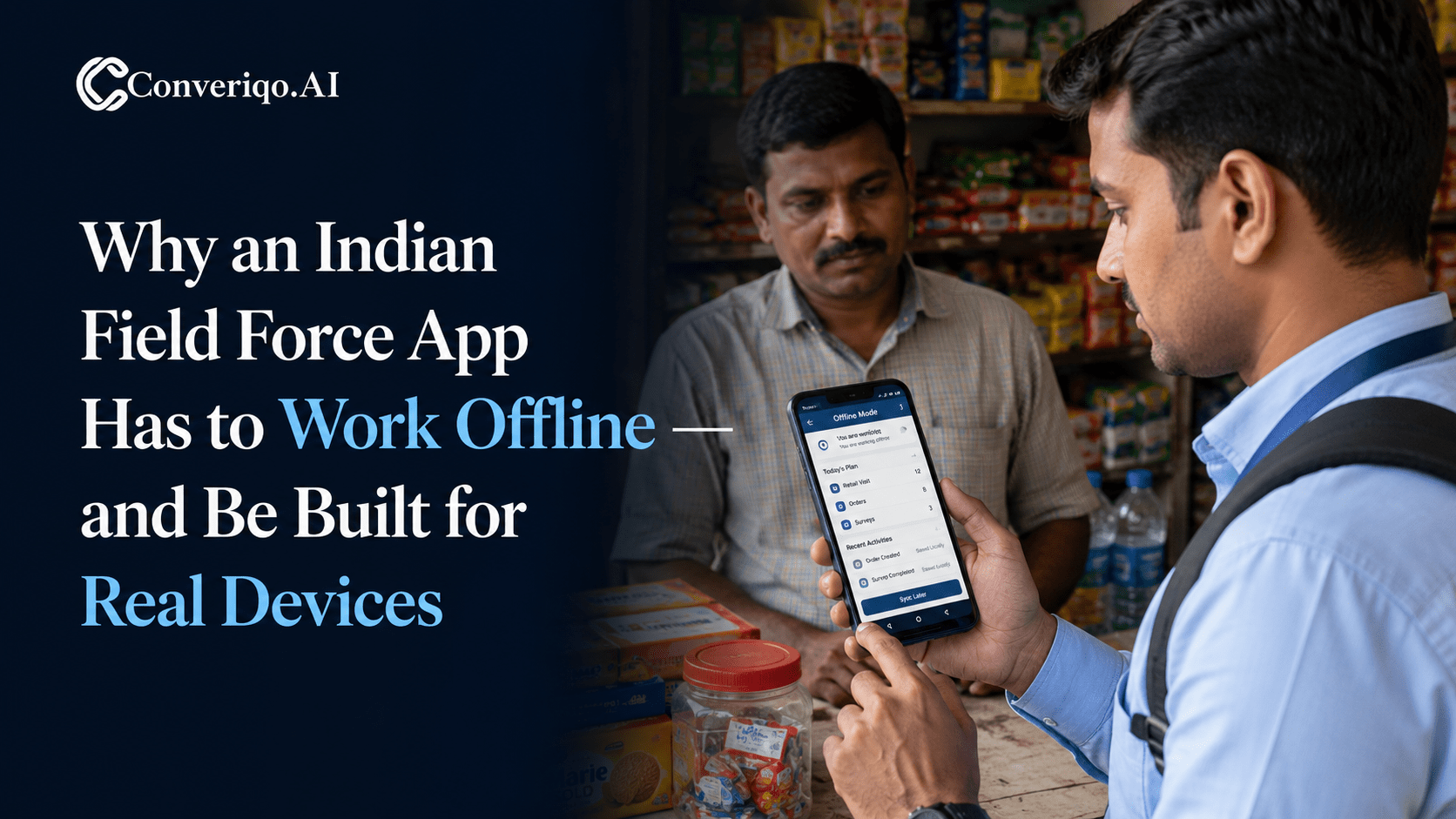
Why an Indian Field Force App Has to Work Offline - and Be Built for Real Devices
Field work in India happens where connectivity is intermittent. A field force app that assumes constant connectivity fails exactly where field work is done.