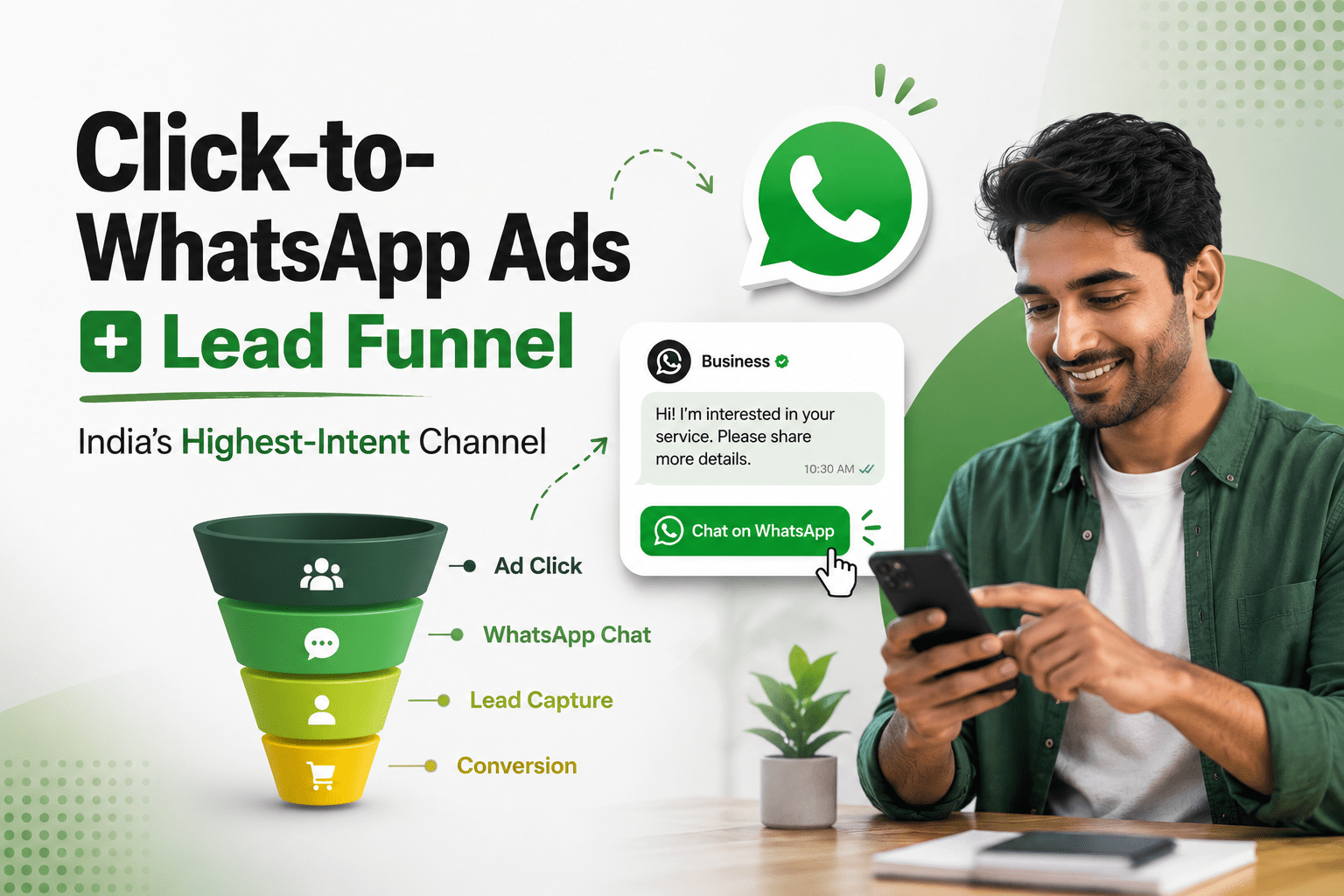
Across most Indian B2C and SMB-B2B verticals in 2026, click-to-WhatsApp ads are the highest-intent lead channel by cost per qualified lead. The reason is straightforward - a click-to-WhatsApp ad bypasses the form abandonment problem entirely. The prospect does not have to type their details into a form, wait for a confirmation, then wait again for someone to call back. The click opens a WhatsApp conversation. Within seconds, the prospect is talking to the business.
Why click-to-WhatsApp outperforms
Three structural reasons.
Friction collapse. A web form requires the prospect to leave the ad context, fill 4 to 7 fields, and trust that someone will respond. A click-to-WhatsApp ad requires one tap and the prospect is in their existing app, in a conversation. Drop-off between ad click and first message is dramatically lower than between ad click and form completion.
Channel familiarity. WhatsApp is where most Indian consumers and SMB buyers already conduct most of their daily commerce communication. Asking them to move to email, phone, or a form imposes a context switch. Letting them stay in WhatsApp does not.
Conversation versus form. A form is a transaction. A conversation can adapt - the AI can ask clarifying questions, handle objections, switch language, send relevant collateral. The qualification depth available in a 5-minute WhatsApp conversation exceeds what a 7-field form can capture by an order of magnitude.
The full click-to-WhatsApp lead funnel
Six stages, optimised for the channel.
Ad creative - the ad is built around a specific intent the business can deliver against. Generic ads ('We help businesses grow') produce low-intent clicks. Specific ads ('Property dealers in Pune - qualified buyer leads on WhatsApp') produce higher-intent clicks. The ad creative shapes the funnel quality more than any downstream optimisation.
Welcome and intent qualifier - the first message the prospect receives. Two functions - confirm they have reached the right place, and ask the one question that establishes intent. 'Hi, you clicked on our ad about property in Pune. Are you looking to buy, sell, or rent?' Single question. Buttons where possible. Adaptive next step.
Need qualification - three to four conversational questions that gather the information needed to route the lead correctly. Ordered least-to-most sensitive - type of need first, location second, budget last. Use buttons or quick replies where possible. Allow free-text where the prospect needs to elaborate.
Information delivery - based on the qualification, send the prospect the relevant content. Brochure. Pricing. Availability. Demo slot picker. The right content based on what the prospect asked, not a generic introduction pack.
Booking or handoff - the qualified lead either books a slot directly (using a WhatsApp Flow-based slot picker, not an external Calendly link that breaks the channel) or gets handed off to a human salesperson who continues the conversation in the same chat.
Confirmation, reminders, follow-up - automated confirmation message, reminder before the booked slot, follow-up after the meeting. The same chat thread carries the relationship from lead to customer.
The 24-hour window - the rule that breaks most click-to-WhatsApp funnels
WhatsApp Business API operates on a 24-hour customer service window. Inside the window - the business can send any message, free-form. Outside the window - the business can only send pre-approved template messages, categorised as marketing, utility, authentication, or service.
Most click-to-WhatsApp funnels fail because they treat WhatsApp like email - sending broadcast nurture messages whenever they feel like it, getting templates rejected or accounts flagged, and gradually destroying their WhatsApp Business Account quality rating.
The discipline is - qualify and convert inside the 24-hour window where possible, use approved utility templates for transactional follow-up (booking confirmations, reminders), use approved marketing templates only for genuinely valuable broadcast moments and only with proper consent and opt-out handling.
When click-to-WhatsApp is not the right channel
Three cases.
High-ticket B2B enterprise sales. The buyer expects a more formal first contact. WhatsApp can support the relationship but should not initiate it.
Regulated financial product sales. The qualification conversation may need to happen in a recorded, compliant channel. WhatsApp may or may not satisfy the regulatory requirement depending on the product. Verify with compliance before defaulting to WhatsApp as primary.
Markets where WhatsApp penetration is genuinely low. This applies to fewer Indian segments than vendors assume - WhatsApp penetration is high across most age, geography, and income segments by 2026. But it is worth checking against the specific buyer rather than the population average.
About the Author
Himani Chaudhary
Ready to orchestrate your AI future?
Converiqo AI helps you design, deploy, and scale automation workflows that move your business faster, leveraging specialized solutions like our AI bot platform for lead generation, customer self-service AI bot platform, employee self-service AI bot platform, retail omnichannel automation, and our detailed guides on how agentic AI bot platforms work in enterprises and cost structure of enterprise AI bot platforms. Connect with our team to see the platform in action and co-create the next chapter of intelligent operations.
Read More Blogs
Discover more insights and product updates curated by the Converiqo AI team.
Real ROI of Field Force Automation - Beyond the Activity Dashboard
Four metrics that show real field force automation ROI in India - productivity, data reliability, throughput, and field attrition - not just the activity dashboard.
Beat Planning Is the Highest-Leverage Field Force Capability - Here Is Why
Beat planning decides coverage, call frequency, and whether field time is productive. Why it is the single highest-leverage field force automation capability.
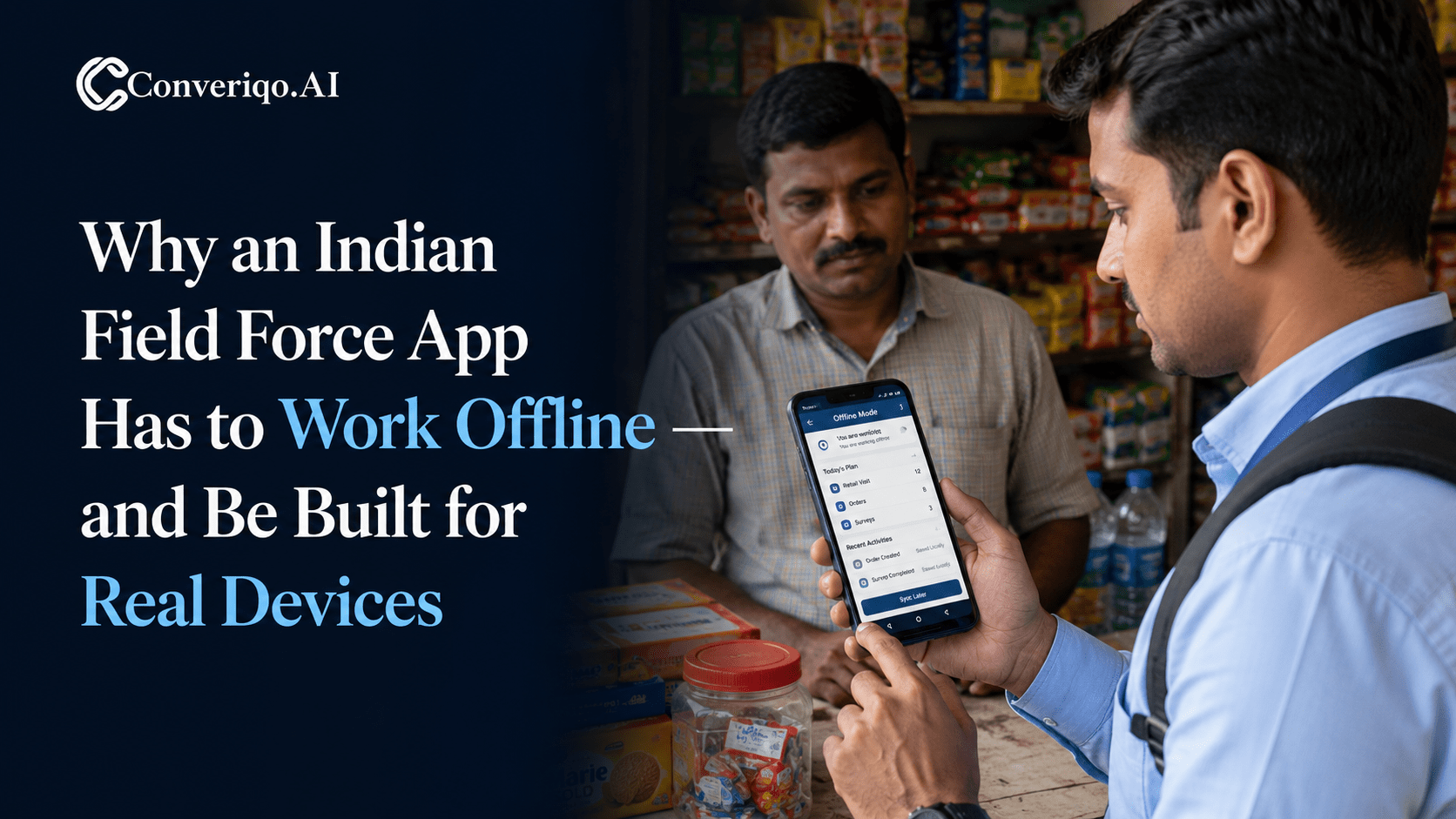
Why an Indian Field Force App Has to Work Offline - and Be Built for Real Devices
Field work in India happens where connectivity is intermittent. A field force app that assumes constant connectivity fails exactly where field work is done.