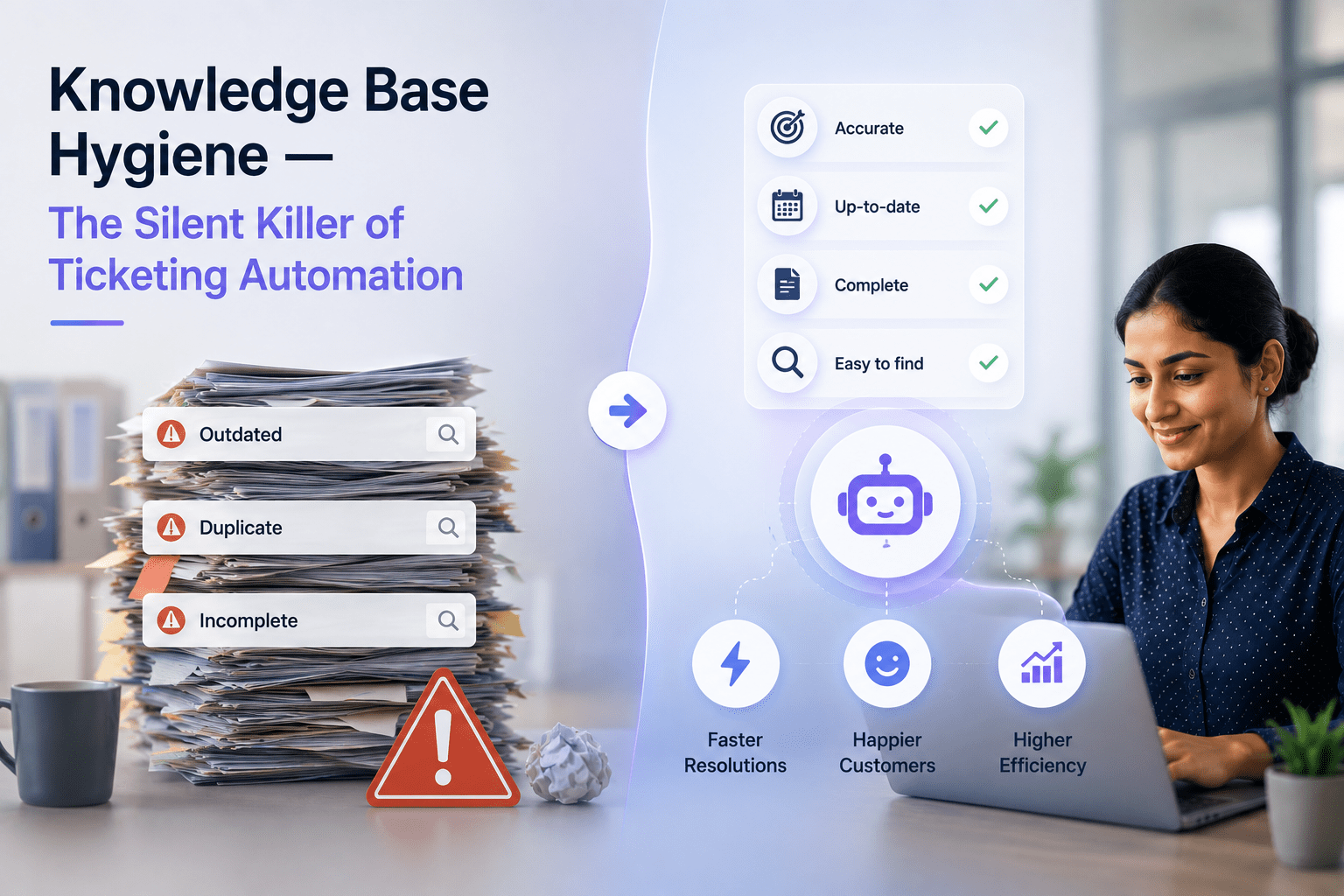
Most Indian operations have a knowledge base. The KB exists. The KB is referenced occasionally. The KB is mostly out of date. The KB degradation is the single largest reason ticketing automation deployments lose ground over time - auto-resolution rates that started at 45% drift down to 30% over 12 months, AI-assisted resolution suggestions that become less useful, agents who stop checking the KB because it is wrong as often as it is right.
The KB problem is not about content production effort. The KB problem is about feedback loops. Resolutions happen in tickets. The knowledge generated by those resolutions does not flow back to the KB. The KB stays anchored to the version it was when initially built, while the products and processes it documents evolve away from it.
Why most KBs go stale
Three structural reasons specific to how most Indian operations work.
Resolutions live with the resolvers. An agent figures out how to handle a new edge case, drafts a good response, sends it, closes the ticket, moves on. The knowledge is in the agent's head and in that one ticket's record. There is no systematic step that captures the resolution as KB candidate content.
Product changes do not trigger KB updates. The product team ships a new feature, a policy change, a UI update. The customer-facing documentation may get written. The internal KB that customer support relies on rarely gets updated in sync. The change happens; the KB catches up sporadically.
KB ownership is fragmented. The KB lives in Confluence or Notion or Zendesk help centre. It is owned partly by support, partly by product, partly by no one. Updates require cross-team coordination that nobody schedules. Stale articles accumulate.
What the KB feedback loop looks like
Mature ticketing automation deployments include a structural feedback loop from resolved tickets to KB updates. Three components.
Resolution capture. When a ticket is resolved - by AI auto-resolution or by human agent - the resolution content (problem description, root cause if known, fix applied, response language used) gets captured in structured form. Not just stored as ticket text; tagged and structured for downstream use.
KB candidate identification. The system identifies resolutions that are candidates for KB inclusion - high-frequency issue types, repeating patterns, novel resolutions that solved tricky cases. Candidates surface to the KB owner queue, not auto-published.
KB owner workflow. A designated owner (support lead, product knowledge manager, technical writer) reviews KB candidates and decides which to publish, update, or merge into existing articles. The decision and the resulting update are tracked. The KB stays current with reviewed and approved content rather than auto-publishing every resolution into permanent documentation.
The KB drift metric
What gets measured determines what gets improved. Most Indian operations do not measure KB drift, which is why it goes unmanaged. The drift metric is simple - for each KB article, when was it last reviewed against current product and process reality. Articles that have not been reviewed in 90 days flag for review. Articles that have not been reviewed in 180 days flag as likely stale. Articles that have not been reviewed in 365 days flag as definitely stale and likely doing more harm than good if the AI is relying on them.
The drift metric surfaces the KB hygiene gap that operations leaders typically do not see in their standard dashboards. Once visible, it becomes manageable. Coverage of stale articles can be assigned to KB owners. Review cadences can be set. The drift can be controlled.
Why this matters for auto-resolution rates
AI auto-resolution depends on the knowledge base for its routine ticket handling. The AI checks the KB for the answer, retrieves the relevant article, and resolves the ticket. If the KB article is current and accurate, the resolution is correct. If the KB article is stale, the AI may produce a resolution that was correct six months ago but is wrong now. The customer receives wrong information confidently delivered, which is a worse outcome than no automation at all.
Auto-resolution rate degradation over time is almost always a KB hygiene problem, not an AI capability problem. The AI continues to work as it did at launch. The KB the AI is reading has aged. The resolution accuracy falls. Auto-resolution rates fall because more tickets get escalated when the AI cannot find a current answer, or worse, the customer reports back that the AI's answer was wrong.
What this looks like in practice
A working KB-feedback-loop deployment in an Indian operation typically shows three patterns.
KB review cadence visible in operations metrics. The percentage of KB articles reviewed in the last 90 days is tracked. The target is 80%+ of high-traffic articles. The cadence is part of someone's job description, not an annual project.
Resolution-to-KB pipeline producing weekly candidates. Resolved tickets generate KB candidate suggestions. The KB owner reviews them weekly. The KB grows and evolves at the pace the operations actually change, not behind it.
Auto-resolution rate stable or improving over 12 months. The rate does not drift down because the KB drift is being managed. The deployment compounds rather than degrading
About the Author

Yash Soni
Ready to orchestrate your AI future?
Converiqo AI helps you design, deploy, and scale automation workflows that move your business faster, leveraging specialized solutions like our AI bot platform for lead generation, customer self-service AI bot platform, employee self-service AI bot platform, retail omnichannel automation, and our detailed guides on how agentic AI bot platforms work in enterprises and cost structure of enterprise AI bot platforms. Connect with our team to see the platform in action and co-create the next chapter of intelligent operations.
Read More Blogs
Discover more insights and product updates curated by the Converiqo AI team.

Real ROI of Field Force Automation - Beyond the Activity Dashboard
Four metrics that show real field force automation ROI in India - productivity, data reliability, throughput, and field attrition - not just the activity dashboard.

Beat Planning Is the Highest-Leverage Field Force Capability - Here Is Why
Beat planning decides coverage, call frequency, and whether field time is productive. Why it is the single highest-leverage field force automation capability.

Why an Indian Field Force App Has to Work Offline - and Be Built for Real Devices
Field work in India happens where connectivity is intermittent. A field force app that assumes constant connectivity fails exactly where field work is done.