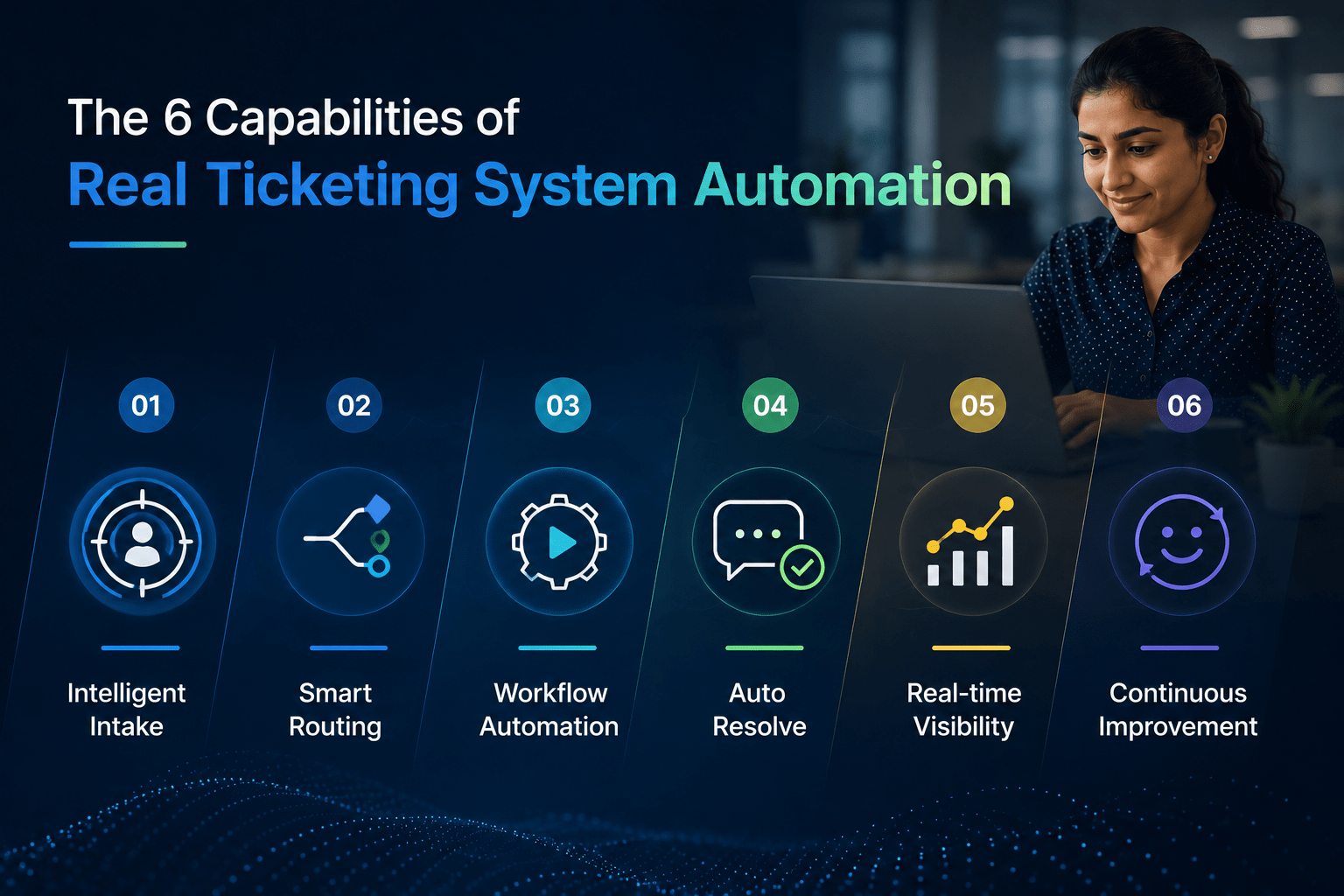
Real ticketing automation is six capabilities working together above the ticketing platform. Each one replaces a specific manual workflow that today either runs through agent effort or sits as an unsolved gap in the operations.
Capability 1 - Multi-channel ingestion
What it does. Creates tickets from any inbound channel - email, web forms, web chat, WhatsApp, voice calls (via transcription), system alerts, social media DMs, partner portal forms - unified into one ticket record. Channel attribution preserved. Duplicate detection - the same customer with the same issue across channels does not produce three separate tickets.
What it replaces. Manual ticket creation from WhatsApp messages where the agent reads the message and copies the content into Freshdesk. Email-only ticketing that misses chat and WhatsApp volume. Duplicate ticket records when the customer follows up on a different channel before the first ticket was answered.
What breaks when it is missing. WhatsApp volume that is now significant for most Indian operations either does not enter the ticketing system (becoming agent-handled outside the workflow) or enters via manual copy-paste (creating delay and data quality issues). The pipeline becomes channel-fragmented.
Capability 2 - Intelligent triage and classification
What it does. Classifies every ticket at ingestion - intent (what is the customer asking for), urgency (how time-sensitive), category (which team or skill needed), sentiment (frustration signal), customer context (high-value account, repeat issue, regulatory escalation). Classification feeds the next decision - auto-resolve or route to human.
What it replaces. First-touch human triage where an agent or supervisor reads every incoming ticket and decides what to do with it. Naive round-robin routing that ignores skill match. Static rule-based classification that fails on edge cases.
What breaks when it is missing. Routing inaccuracy. Tickets land on the wrong agents. SLA breaches happen on tickets that should have been prioritised. Skill match failures produce escalations and reassignments that compound resolution time.
Capability 3 - Auto-resolution for routine ticket types
What it does. Agentic AI handles end-to-end resolution for routine ticket types - password resets, order status, refund status, account information, basic configuration, common how-to queries. The customer interacts with the AI in the customer's channel and language. The AI accesses backend systems where needed, executes the resolution, confirms with the customer, and marks the ticket resolved with full transcript.
What it replaces. Agent hours on the most repetitive ticket categories. The 60% of ticket volume that consumes 40% of agent time and produces almost no learning or value beyond the resolution itself.
What breaks when it is missing. Routine tickets stay in human queues. Agents burn out on repetitive work. Auto-resolution rate stays at 0% or at the limited rate of basic chatbot bolt-ons. The largest single ROI lever in ticketing automation goes unused.
Capability 4 - Intelligent routing
What it does. For tickets requiring human handling, routing based on skill match, current agent workload, language preference, customer context, and SLA urgency. Re-routes if the assigned agent does not pick up within SLA window. Avoids overloading individual agents while others sit idle.
What it replaces. Static round-robin routing. Manual reassignment when load imbalance becomes obvious. Routing rules that work for the majority of tickets but break on edge cases - vernacular tickets, regulatory escalations, high-value customer issues.
What breaks when it is missing. Queue imbalances. Some agents at 60-ticket backlogs while others handle 20. SLA breaches concentrated on overloaded agents. Customer escalations because their ticket sat unattended on someone's leave day.
Capability 5 - AI-assisted resolution for human agents
What it does. When an agent opens a ticket, AI surfaces relevant context - similar resolved tickets, knowledge base articles, customer history, suggested response drafts. The agent stays in control of the resolution; the AI compresses the search-look-up-draft time.
What it replaces. Agents searching the knowledge base mid-resolution. Agents asking senior colleagues for similar past cases. Agents drafting response language from scratch when similar responses exist.
What breaks when it is missing. Resolution time stays anchored to agent search time. New agents take longer to ramp up because they cannot rely on AI assist to bridge experience gaps. Resolution quality varies more across the team than it would with consistent AI context surfacing.
Capability 6 - Automated follow-up, closure, and outcome tracking
What it does. Post-resolution automation. CSAT survey delivery. Follow-up to confirm resolution stuck. Ticket closure after no further response. Knowledge base updates from resolved ticket content where applicable. Root-cause tagging for recurring issues. SLA breach analysis for tickets that did breach. Insights surface back to the operations team.
What it replaces. Manual post-resolution follow-up. Tickets that stay open for days because no one closed them. Knowledge gained from a hard ticket resolution that stays with the agent and never reaches the KB. Recurring issues that recur because no one tagged them as recurring.
What breaks when it is missing. Ticket aging metrics inflate. KB staleness compounds. Recurring issues stay recurring. The feedback loop that should make the system better over time stays open and the system stagnates.
Why all six matter together
Strong triage without auto-resolution means well-classified tickets that still all go to humans. Strong auto-resolution without good ingestion means automation that misses the volume coming through WhatsApp and chat. Strong agent assist without the KB feedback loop means agents getting assistance from a knowledge source that ages out of relevance.
Ticketing automation works as a layer. Point tools at each capability leave seams. The seams are where the routine ticket volume escapes back to humans, where the resolutions do not feed back to the KB, and where the metrics show improvement on velocity but stagnation on quality.
About the Author

Ankur Singh
Ready to orchestrate your AI future?
Converiqo AI helps you design, deploy, and scale automation workflows that move your business faster, leveraging specialized solutions like our AI bot platform for lead generation, customer self-service AI bot platform, employee self-service AI bot platform, retail omnichannel automation, and our detailed guides on how agentic AI bot platforms work in enterprises and cost structure of enterprise AI bot platforms. Connect with our team to see the platform in action and co-create the next chapter of intelligent operations.
Read More Blogs
Discover more insights and product updates curated by the Converiqo AI team.
Real ROI of Field Force Automation - Beyond the Activity Dashboard
Four metrics that show real field force automation ROI in India - productivity, data reliability, throughput, and field attrition - not just the activity dashboard.
Beat Planning Is the Highest-Leverage Field Force Capability - Here Is Why
Beat planning decides coverage, call frequency, and whether field time is productive. Why it is the single highest-leverage field force automation capability.
Why an Indian Field Force App Has to Work Offline - and Be Built for Real Devices
Field work in India happens where connectivity is intermittent. A field force app that assumes constant connectivity fails exactly where field work is done.