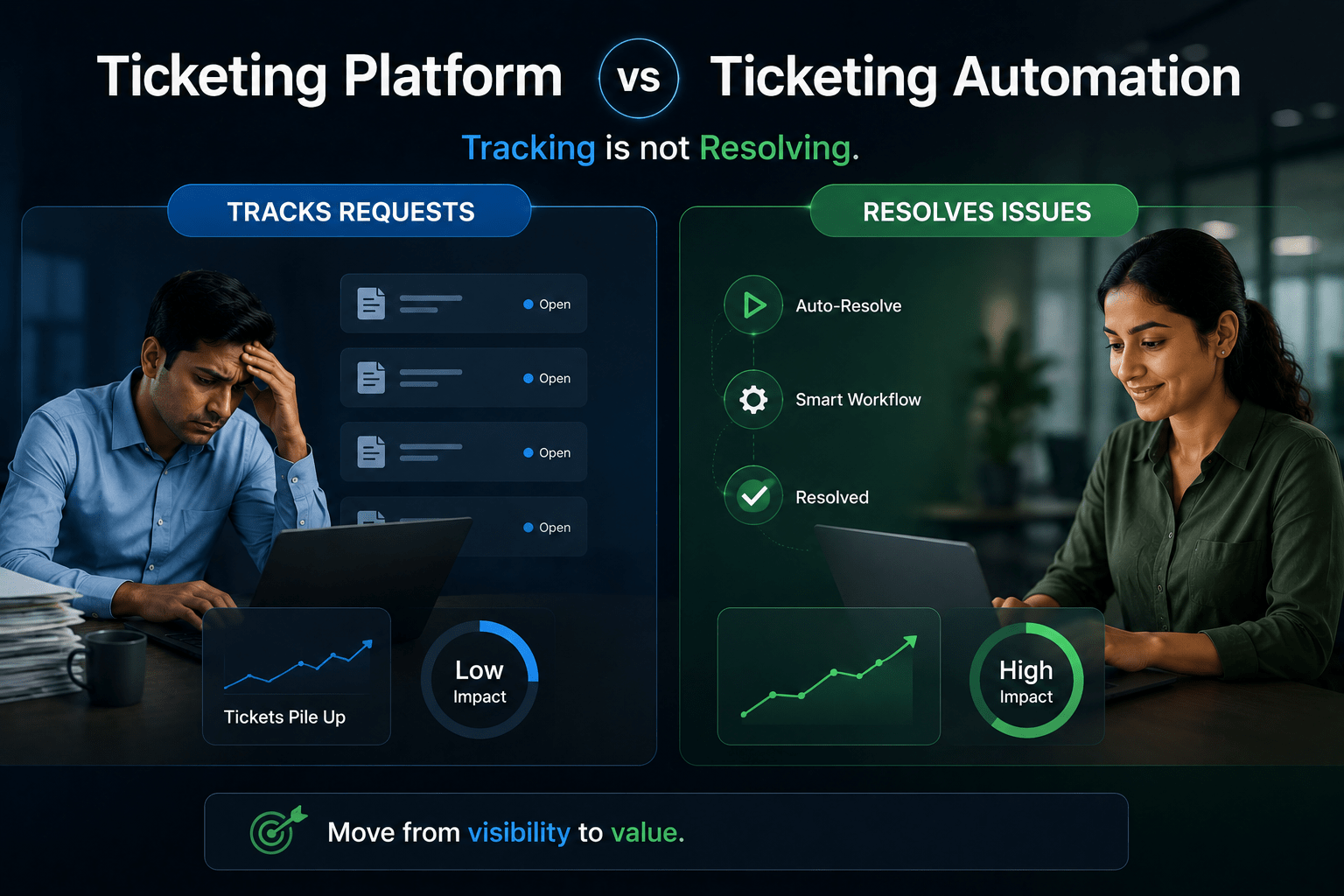
An Indian SaaS support function at 2,000 tickets a month and 18-hour resolution time runs Freshdesk. The head of support is asked whether the support function is automated. Yes - Freshdesk is automation.
Look at what Freshdesk is actually doing. Tickets arrive by email and chat. The platform creates the record. The platform assigns to the round-robin queue. The platform starts the SLA timer. The platform escalates on breach. The platform updates the dashboard. The agent opens the ticket, reads it, searches the knowledge base manually, drafts a response, sends it, marks the ticket as awaiting response, waits for the customer to come back, then closes. The platform tracked every stage. The platform did not resolve the ticket. The agent did.
The 'automation' the head of support is referring to is workflow tracking automation. Necessary. Important. Not the same category of capability as resolution automation. The conflation is producing buying decisions, training programs, and KPI structures that miss the actual category Indian service operations need in 2026.
What ticketing platforms actually do
Ticketing platforms are systems of record. They store the ticket, track its workflow state, time SLA breach risk, route through configurable queues, escalate when criteria are met, and report on velocity. Modern platforms include some AI features - sentiment classification, suggested responses, basic categorization - bolted onto the workflow tracking core. The bolt-ons are useful and limited; they do not change the fundamental nature of the platform as a tracking system.
The work of resolving the ticket - understanding what the customer needs, retrieving the right answer, drafting the response, handling clarifications, executing any transactions, confirming resolution, closing the loop - happens above the platform. Today, in most Indian operations, it happens entirely manually. The platform watches the work and times it. The platform does not contribute to the work.
What ticketing automation actually does
Ticketing automation is the orchestration above the platform that performs the work the platform tracks. Six capabilities - multi-channel ingestion, intelligent triage, auto-resolution, intelligent routing, AI-assisted resolution, automated follow-up and KB feedback - covered in the next supporting article.
Crucially, ticketing automation does not replace the platform. Freshdesk, Zendesk, ServiceNow, Jira Service Management, Zoho Desk - whichever the company runs stays as the system of record. The automation layer sits above and integrates bi-directionally. Tickets resolved by automation are recorded in the platform. Tickets created in the platform get triaged by automation. The platform investment is preserved; the orchestration is added.
Why the confusion persists
Three reasons specific to the Indian service operations market.
Vendor positioning. Modern ticketing platforms describe themselves as automation platforms. Their marketing pages list AI features, automated workflows, intelligent routing — language that conflates the platform's tracking capabilities with the resolution capabilities the buyer actually needs. The buyer purchases under the marketing language and discovers that the AI features cover narrow use cases while the actual resolution work remains manual.
Service operations history. Most Indian service ops leaders came up through an era when ticketing platforms were the leading edge of automation - they replaced manual logbooks, then later Excel sheets, then later siloed inbox-based ticket handling. Each generation of platform was a real improvement. The mental model of 'we use ticketing platforms because that is the automation' is anchored in that history. The fact that 2026 ticketing automation has moved past the platform layer is not yet widely internalised.
AI bolt-on overpromise. Most ticketing platforms now offer AI bolt-ons - chatbot widgets, suggested responses, sentiment analysis. The marketing positions these as the AI layer of the platform. Buyers expect that turning these on produces auto-resolution at meaningful rates. In practice the bolt-ons cover a narrow band of use cases, do not match the depth of orchestration that purpose-built ticketing automation provides, and frequently get switched off or ignored within months of the original launch.
What the gap costs
Three costs an operations head can quantify.
Agent hours on routine tickets. Most Indian operations have ticket category distributions where the top five categories represent 50% to 70% of volume - typically routine queries with well-defined resolutions. Agent hours on these categories are the largest single cost in most support operations. Automation that auto-resolves 30% to 50% of routine ticket volume directly releases these hours.
Resolution time variance. Manual resolution produces high variance in resolution time - depending on agent experience, current workload, ticket complexity, time of day. Some tickets resolve in 30 minutes; others sit for two days. The variance erodes customer experience invisibly because the average looks acceptable while specific customer experiences are bad.
Knowledge base degradation. Without a feedback loop from resolved tickets to the knowledge base, the KB ages faster than the products and processes it documents. Agents end up not using the KB because it is wrong. New agents take longer to ramp up because they cannot rely on the KB. Auto-resolution rates would degrade if they existed because the AI relies on the KB. The KB degradation is the silent compounding cost of tracking-without-resolving.
About the Author

Avni Chadha
Ready to orchestrate your AI future?
Converiqo AI helps you design, deploy, and scale automation workflows that move your business faster, leveraging specialized solutions like our AI bot platform for lead generation, customer self-service AI bot platform, employee self-service AI bot platform, retail omnichannel automation, and our detailed guides on how agentic AI bot platforms work in enterprises and cost structure of enterprise AI bot platforms. Connect with our team to see the platform in action and co-create the next chapter of intelligent operations.
Read More Blogs
Discover more insights and product updates curated by the Converiqo AI team.
Real ROI of Field Force Automation - Beyond the Activity Dashboard
Four metrics that show real field force automation ROI in India - productivity, data reliability, throughput, and field attrition - not just the activity dashboard.
Beat Planning Is the Highest-Leverage Field Force Capability - Here Is Why
Beat planning decides coverage, call frequency, and whether field time is productive. Why it is the single highest-leverage field force automation capability.
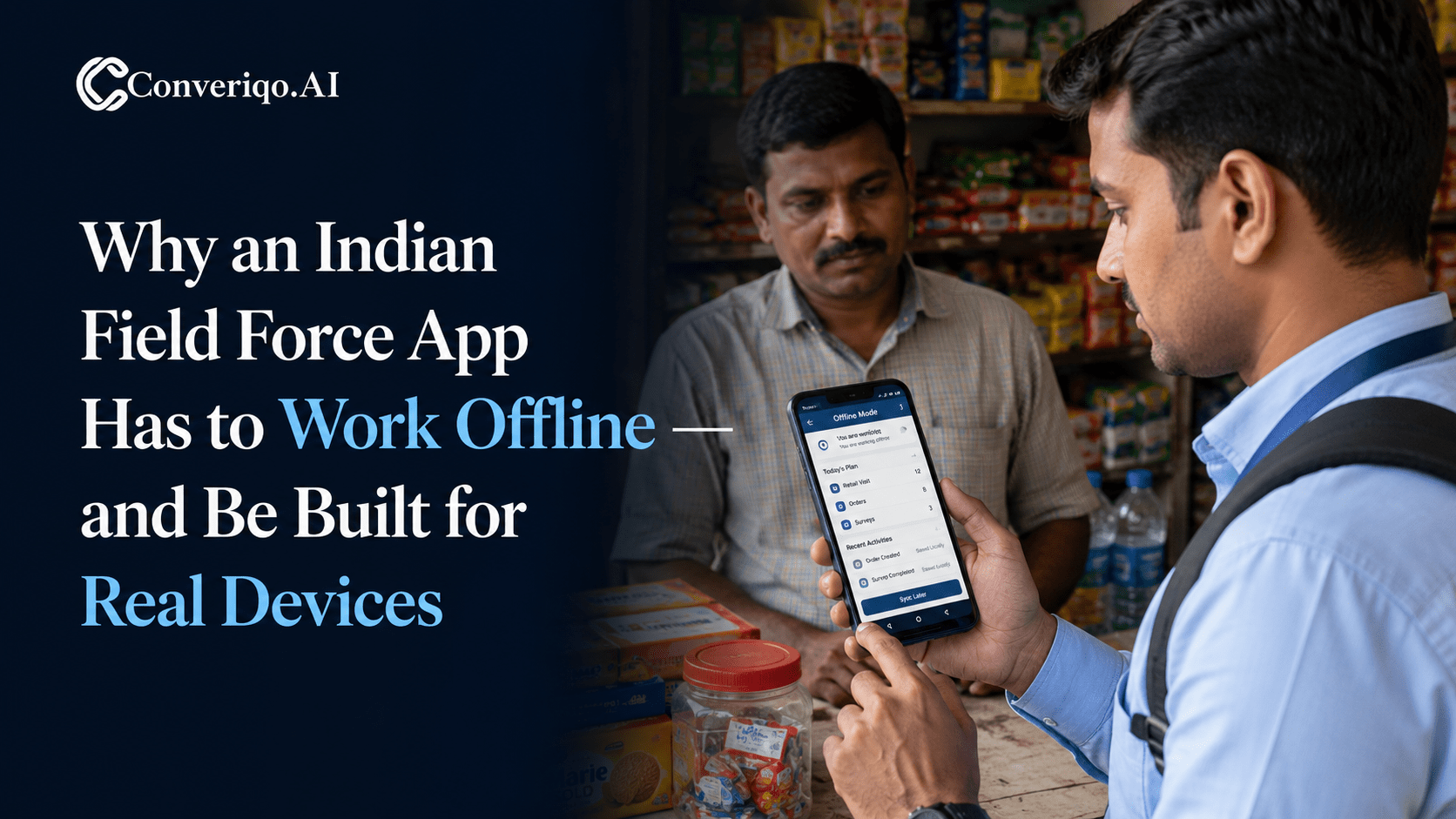
Why an Indian Field Force App Has to Work Offline - and Be Built for Real Devices
Field work in India happens where connectivity is intermittent. A field force app that assumes constant connectivity fails exactly where field work is done.