An Indian SaaS business at 200 employees serves 8,000 customers and runs a customer support function. The ticketing system is Freshdesk. The deployment is a year old. The team has 14 agents handling roughly 2,000 tickets a month. The dashboard shows ticket volume, ticket category, agent assignment, SLA compliance. Average resolution time sits at 18 hours. SLA compliance is at 67%. CSAT, when measured, is 3.4 out of 5.
Look at the tickets themselves. The top five categories - password reset, invoice query, feature confirmation, integration question, plan upgrade - account for 62% of total volume. The same questions get answered every day by the same agents. The same problems recur monthly because the resolutions live in agents' heads and in scattered Slack channels rather than in a knowledge base that the next agent can use.
Ask the head of support whether the ticketing is automated. The answer is yes - Freshdesk is automation. The tickets are routed automatically. The SLA timers run automatically. The escalations fire automatically. The dashboards update automatically.
The ticketing platform is doing automation. The ticketing process is not. The platform tracks the tickets through stages. The platform does not resolve them. The work of resolution happens manually, agent by agent, ticket by ticket, with the platform watching and timing the work but not contributing to it.
Most Indian companies running Freshdesk, Zendesk, ServiceNow, Jira Service Management, or Zoho Desk have this same configuration. A ticketing platform that tracks. Process work that resolves. The two are different things, and the gap between them is where Indian service operations leave significant value.
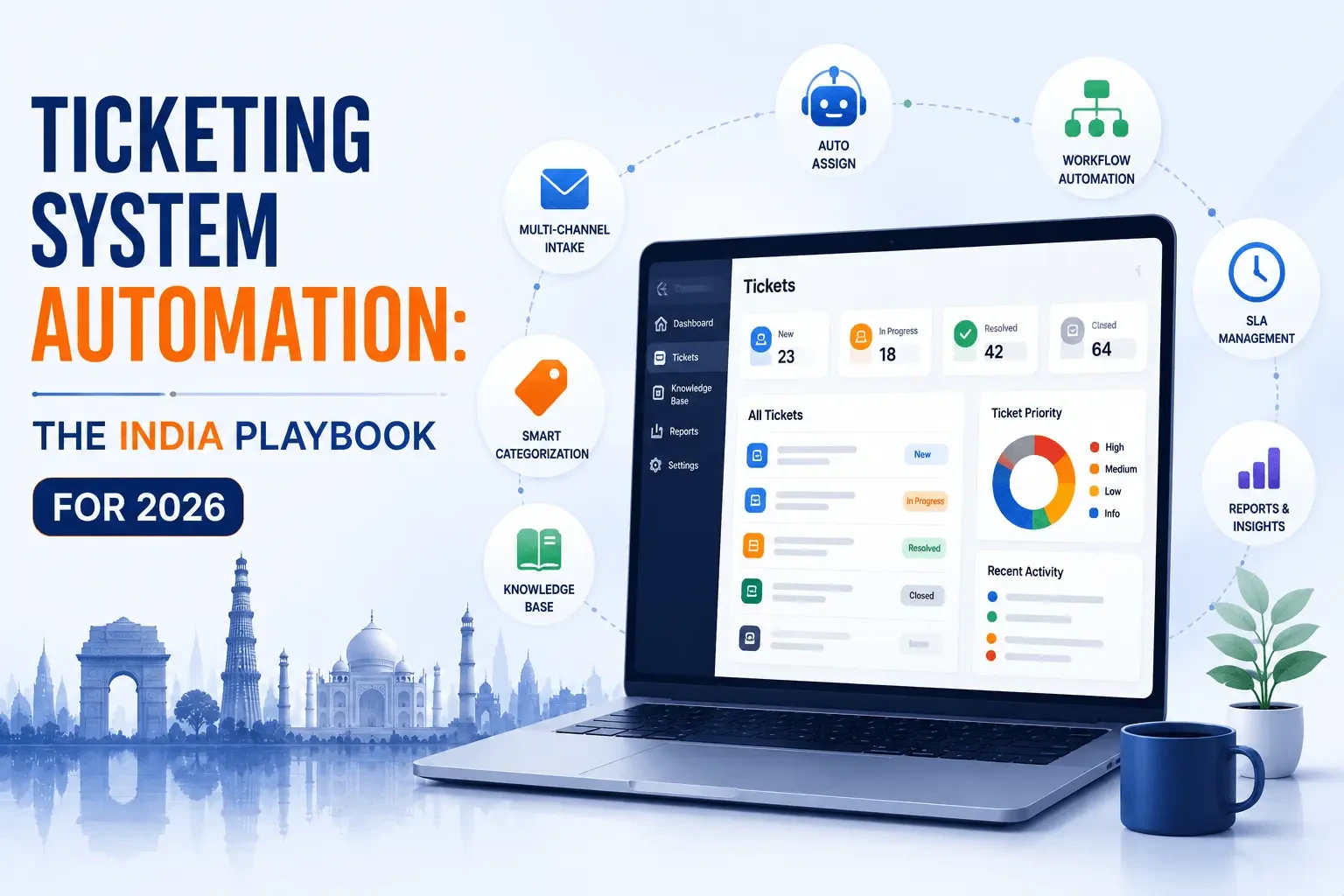
This pillar is about what ticketing system automation actually means in 2026 for Indian companies. The six capabilities that move ticketing from tracking to resolving. Why platform-equals-automation is the same vocabulary mistake the prior module pillars surfaced - different shape, same trap. What changed in agentic AI capability that makes auto-resolution at 30% to 50% rates practical now where it was not at production quality two years ago. And what the India-specific layer looks like - WhatsApp as ticket source, vernacular triage and resolution, sector-specific complaint handling, knowledge base hygiene as the foundation that determines whether automation compounds or degrades.
Ticketing platform is not ticketing automation
The vocabulary problem repeats. Vendors describe their ticketing platform - particularly the cloud-native ones with bolt-on chatbots and AI features - as ticketing automation. The marketing language conflates the two. Buyers purchase under the marketing language and discover post-deployment that the platform tracks tickets well, routes them adequately, and reports on them comprehensively, while the actual work of resolution remains entirely manual.
A ticketing platform is a system of record for service interactions. It captures the request, stages it through workflow (new, assigned, in-progress, pending, resolved, closed), tracks SLA timers, routes through queues, escalates on breach, and reports on metrics. Necessary infrastructure. Important capability. Not automation in the sense that matters for resolution outcomes.
Ticketing automation is the orchestration above the platform that handles the work the platform tracks. Multi-channel ingestion that creates tickets from email, web, chat, WhatsApp, voice, and system alerts uniformly. Intelligent triage that classifies intent, urgency, and category at ingestion rather than at first human review. Auto-resolution for routine ticket types end-to-end without human touch. Intelligent routing based on skill match and workload. AI-assisted resolution for human agents with context surfacing and next-best-action. Automated follow-up, closure, and outcome tracking that feeds knowledge base updates.
Most Indian companies have the platform. Many do not have the automation. The platform is doing its job. The work the automation should be doing stays manual. The ticket volume that automation could deflect remains in the human queue. The resolution time stays where it was. The SLA compliance climbs slowly through agent effort rather than through deflection of the easy work.
The six capabilities of real ticketing automation
1. Multi-channel ingestion
Tickets created from any channel - email, web forms, web chat, WhatsApp, voice transcription from calls, system alerts, social media DMs, partner portal forms - unified into one ticket record with channel attribution preserved. The customer who emails today and WhatsApps tomorrow does not produce two separate tickets that the agent has to manually merge. The ingestion layer recognises and unifies.
2. Intelligent triage and classification
Every ticket gets classified at ingestion by AI - intent (what is the customer asking for), urgency (how time-sensitive), category (which team or skill is needed), sentiment (is the customer frustrated), customer context (existing high-value account, repeat issue, regulatory escalation). Classification feeds routing, prioritisation, and the next decision - auto-resolve or route to human.
3. Auto-resolution for routine ticket types
Agentic AI handles end-to-end resolution for routine ticket types where the resolution is well-defined and the customer interaction can complete in conversation. Password resets, order status, refund status, account information, basic configuration questions, common how-to queries, system status enquiries. The customer asks, the AI responds, the issue closes, the ticket gets marked resolved with full transcript. 30% to 50% deflection in mature deployments.
4. Intelligent routing
For tickets that need human handling, routing based on skill match, current agent workload, language preference, and customer context. SLA-aware - high-urgency tickets route to available skilled agents rather than to overloaded queues. Re-routing on no-response within SLA window. No tickets stuck on a single overloaded agent while others sit idle.
5. AI-assisted resolution for human agents
When an agent opens a ticket that routed to them, AI surfaces context - similar resolved tickets, relevant knowledge base articles, customer history, product documentation, suggested response language. The agent stays in control; the AI is the assistant that compresses the time previously spent searching, looking up, and drafting. Agent productivity lifts measurably without changing the agent.
6. Automated follow-up, closure, and outcome tracking
Post-resolution actions handled by the system - CSAT survey delivery, follow-up to confirm resolution stuck, ticket closure after no further response in the window, knowledge base update from resolved ticket content, root-cause tagging for recurring issues, SLA breach analysis for the cases that did breach. The loop closes back to the operations team in the form of insights, not just ticket logs.
The India-specific layer
WhatsApp as ticket source
Across most Indian B2C and SMB-B2B operations, WhatsApp is now a primary channel for customer issue reporting. The customer messages on WhatsApp; the message needs to become a ticket in the platform. Most Indian deployments handle this manually - the agent reads the WhatsApp message, copies the content into Freshdesk or Zendesk, and creates the ticket. The automation needs to ingest WhatsApp natively, classify, and either auto-resolve in the channel or route to human with the WhatsApp context preserved.
Vernacular triage and resolution
Tickets arrive in Hindi, Tamil, Telugu, Marathi, Bengali, Gujarati, Kannada. The triage AI needs to classify in the language the customer wrote in. The auto-resolution agent needs to respond in the customer's language. The human agent assigned the ticket needs to be language-matched. Indian ticketing deployments that only handle English at the automation layer route every non-English ticket to the small subset of human agents who handle vernacular - creating queue imbalances that breach SLA on the vernacular side.
Sector-specific complaint handling
Banking customer complaints feed into RBI's integrated ombudsman scheme - escalation timelines and audit trail requirements. Insurance complaints feed IRDAI's Bima Bharosa portal. Securities complaints feed SEBI's SCORES system. General consumer complaints can escalate to the National Consumer Helpline. The ticketing automation needs to recognise sector-specific complaint signals, apply the regulator-mandated handling timelines, and maintain the audit trail that the regulator's review process expects. Generic deployments miss these handling requirements and surface compliance gaps only when escalations reach the regulator.
DPDP Act for ticket data
Tickets contain customer personal data, sometimes sensitive financial or health data, sometimes employee personal data for IT and HR tickets. The DPDP Act 2023 applies. Consent capture for ticket data processing needs to be purpose-separated. Audit trails need to record who accessed what ticket content and when. Cross-organisational ticket handling - escalation to vendor, partner, BPO - needs explicit handling under the Act. Most Indian ticketing deployments handle this informally; mature automation builds it in.
Indian ITSM landscape
Indian ticketing platform usage splits between Indian-built (Freshdesk dominant for SMB-mid-market customer service, Zoho Desk for Zoho-stack companies, Kapture for retail and e-commerce) and global (Zendesk for mid-market and enterprise customer service, ServiceNow for enterprise ITSM, Jira Service Management for tech-heavy operations, Salesforce Service Cloud for Salesforce-stack enterprises). Ticketing automation needs working integration with whichever platform is already deployed - the platform investment is preserved while the orchestration layer is added above.
Knowledge base staleness reality
Indian operations consistently struggle with knowledge base hygiene. The KB exists. The KB is referenced occasionally. The KB is mostly out of date because nothing systematically updates it from resolved tickets. New product features ship and the KB does not catch up. Process changes get communicated in Slack and never make it into the KB. Resolutions discovered in tickets stay with the agent who found them. Ticketing automation that does not solve KB staleness watches its own auto-resolution rate degrade as products evolve away from the KB content the AI relies on.
What to measure
Six metrics, used together. Ticket volume alone is misleading - volume can drop because customers gave up, not because the system improved.
Auto-resolution rate. The share of inbound tickets resolved by AI without human escalation. Mature deployments achieve 30% to 50% in most Indian service operations contexts; higher in routine-heavy operations (e-commerce, SaaS basic support), lower in complex operations (enterprise B2B support, financial advisory).
Average resolution time (TAT). End-to-end time from ticket creation to closure. The composite metric that captures both auto-resolution speed and human-handling speed. Good ticketing automation typically compresses this by 30% to 50% over 12 months, partly from auto-resolution and partly from AI-assisted human resolution.
First contact resolution (FCR). Share of tickets resolved in the first interaction without reopening. Good automation lifts this materially because AI-assisted resolution surfaces context that prevents agents from missing the actual issue and producing band-aid fixes that bounce back.
SLA compliance. Share of tickets resolved within the contractual or internal SLA window. Indian baselines for customer service often sit at 60% to 80%; mature automation pushes this to 85% to 95% through deflection of easy tickets, faster human resolution, and SLA-aware routing.
Post-resolution CSAT. Customer satisfaction with the resolution, measured shortly after closure. The lagging quality metric. Good automation moves CSAT measurably positive because customers get faster, more accurate resolutions; bad automation moves it negative because customers get AI loops that frustrate.
Recurring issue rate. Share of tickets that are repeats of issues seen in the prior 90 days. The metric that surfaces whether resolutions are sticking, whether knowledge is being captured, and whether root causes are being addressed. A high recurring issue rate is the silent symptom of ticketing as tracking-without-resolving.
Vendor evaluation rubric
When evaluating ticketing system automation platforms for the Indian market, score against twelve criteria.
Multi-channel ticket ingestion - email, web, chat, WhatsApp, voice, system alerts - unified into one ticket record.
Intelligent triage and classification at ingestion - intent, urgency, category, sentiment, customer context.
Auto-resolution for routine ticket types at production quality, with measurable deflection rates rather than demo-only capability.
Vernacular support for triage and resolution in at least seven Indian languages plus code-switching.
Intelligent routing with skill match, workload balance, SLA-aware prioritisation, and re-route on no-response.
AI-assisted resolution for human agents with context surfacing, knowledge matches, and next-best-action suggestions.
Native integration with the Indian ticketing platform landscape - Freshdesk, Zoho Desk, Kapture, Zendesk, ServiceNow, Jira Service Management, Salesforce Service Cloud.
Sector-specific complaint handling - RBI Ombudsman, IRDAI Bima Bharosa, SEBI SCORES, NCH - where applicable to the operation's industry.
DPDP Act consent capture, purpose separation, and audit trail for ticket data.
Knowledge base feedback loop - resolutions automatically suggested for KB inclusion, KB content used by auto-resolution, KB drift surfaced as a metric.
Reporting on the six metrics - auto-resolution rate, TAT, FCR, SLA compliance, CSAT, recurring issue rate.
INR-denominated pricing and India-based support.
30-60-90 day implementation roadmap
An Indian company deploying ticketing system automation can sequence the work across three thirty-day blocks.
Days 1-30 - Foundation
Audit current ticket categories and volumes. Identify the top five to ten ticket types by volume - candidates for auto-resolution. Map the existing ticketing platform integration points. Connect the multi-channel ingestion to the platform (email, web, primary WhatsApp number). Set up DPDP consent capture for ticket data. Build the AI triage layer for classification at ingestion. Launch internal pilot on a subset of categories with close monitoring.
Days 31-60 - Expansion
Add auto-resolution for the top three routine ticket types. Build the AI-assisted resolution layer for human-handled tickets. Add vernacular triage and resolution for the relevant Indian languages. Configure intelligent routing logic with SLA awareness. Add sector-specific complaint handling if applicable. Set up the reporting dashboard for the six metrics.
Days 61-90 - Optimisation
Expand auto-resolution to additional ticket categories based on Days 31-60 learnings. Build the knowledge base feedback loop - resolutions written back, KB drift surfaced. Tune triage classification based on agent feedback on routing accuracy. Add the recurring issue rate metric and start root-cause work on the categories that surface. Move the operations team from ticket-by-ticket firefighting to category-level pattern management.
When NOT to use ticketing system automation
Three situations.
If ticket volume is under 300 per month, the orchestration overhead exceeds the value. A small support team with strong process discipline handles low-volume ticketing effectively. Automation pays off when volume strains attention and routine work consumes the majority of agent time.
If the existing ticketing platform is itself broken or partially deployed, automation built on top inherits the problems. Fix the platform - workflow stages, SLA configuration, basic routing - before adding the orchestration layer. The automation needs a working system of record underneath.
If the operation's ticket categories are themselves undefined or constantly shifting, automation hard-codes ambiguity. Define ticket categories, resolution paths, and SLA expectations clearly before automating. Otherwise the system triages and routes against unclear targets, producing inconsistent results that look like automation problems but are really process problems.
The Converiqo angle
Converiqo is built as a unified ticketing system automation platform for Indian operations - agentic AI across the six capabilities, multi-channel ingestion including WhatsApp natively, vernacular triage and resolution by default, sector-specific complaint handling for BFSI and insurance, DPDP-compliant ticket data handling, native integration with Indian and global ticketing platforms, knowledge base feedback loop built in, INR-priced.
The platform is the platform. The question worth answering for any operation is whether the orchestration is actually wired - multi-channel ingestion unified, triage at ingestion, auto-resolution at production quality, intelligent routing, AI-assisted resolution for humans, automated follow-up with KB feedback. If it is, ticketing is automated. If not, the platform is tracking tickets and the resolution work is still being done manually.
Frequently Asked Questions
What is ticketing system automation?
Ticketing system automation is the orchestration of multi-channel ingestion, intelligent triage, auto-resolution, intelligent routing, AI-assisted resolution, and automated follow-up across the service ticket lifecycle. It differs from ticketing platforms, which are workflow-tracking systems that store tickets but do not resolve them autonomously.
How is ticketing system automation different from Freshdesk or Zendesk?
Freshdesk, Zendesk, ServiceNow, Jira Service Management, Zoho Desk are ticketing platforms - systems of record that track tickets through workflow stages. Ticketing automation is the orchestration above the platform that performs the work - auto-resolution, intelligent triage, AI-assisted resolution. The platform stays; the orchestration is added above.
What percentage of tickets can AI auto-resolve in 2026?
Mature ticketing automation deployments in 2026 achieve 30% to 50% auto-resolution for routine ticket types across customer service, IT helpdesk, and HR helpdesk contexts. Routine-heavy operations (basic SaaS support, e-commerce status queries, common IT requests) achieve higher rates. Complex operations (enterprise B2B support, financial advisory) see lower.
Does ticketing automation work with WhatsApp ticket sources?
Yes - WhatsApp is increasingly a primary ticket source for Indian B2C and SMB-B2B operations. Mature ticketing automation ingests WhatsApp messages directly as tickets, classifies and triages in the channel, and either auto-resolves in conversation or routes to human with the WhatsApp context preserved. Manual copy-paste from WhatsApp to the ticketing platform is the breakdown most Indian deployments still have.
Does ticketing automation handle Indian vernacular languages?
Production-grade Indian ticketing automation handles triage and resolution in Hindi, Tamil, Telugu, Marathi, Bengali, Gujarati, Kannada with code-switching. Indian deployments that handle only English at the automation layer route vernacular tickets to the small subset of language-capable human agents, creating queue imbalance and SLA breach on the vernacular side.
How does DPDP Act apply to ticketing automation?
DPDP Act 2023 applies to personal data in ticket content - customer data, employee data, sensitive financial or health data depending on the ticket. Ticketing automation needs purpose-separated consent capture, audit trails for ticket access and processing, and structured handling for cross-organisational ticket flow (escalation to vendor, partner, BPO).
What is the ROI of ticketing system automation for an Indian company?
For Indian companies handling 1,500+ tickets per month across customer service, IT helpdesk, or HR helpdesk, typical payback is 5 to 11 months. ROI shows up in auto-resolution rate, average resolution time compression (30-50% over 12 months), SLA compliance lift, and recurring issue rate reduction as resolutions feed back into the knowledge base.
What happens to our existing ticketing platform when we add automation?
In most cases, the platform stays as the system of record. Freshdesk, Zendesk, ServiceNow, Jira Service Management, Zoho Desk - the platform investment is preserved. Automation adds the orchestration layer above the platform, integrating bi-directionally so that tickets created or resolved by automation are reflected in the platform record.
How important is the knowledge base for ticketing automation?
Critical. The knowledge base is what AI auto-resolution draws on for routine ticket handling. Stale KB means degrading auto-resolution rate over time. Mature ticketing automation includes a knowledge base feedback loop - resolved tickets feed candidate KB updates, KB drift gets surfaced as a metric, and the KB stays current with the products and processes the automation is supposed to support.
What metrics matter for ticketing automation?
Six metrics together - auto-resolution rate, average resolution time (TAT), first contact resolution (FCR), SLA compliance, post-resolution CSAT, and recurring issue rate. Ticket volume alone is misleading. Volume can drop because customers gave up, not because the system improved. The six together show whether the automation is actually resolving issues, fast, satisfactorily, and durably.
Key Facts (Citable, single-sentence)
-
Ticketing system automation covers six functional capabilities - multi-channel ingestion, intelligent triage and classification, auto-resolution, intelligent routing, AI-assisted resolution, and automated follow-up and outcome tracking.
-
Ticketing platforms (Freshdesk, Zendesk, ServiceNow, Jira Service Management, Zoho Desk) are workflow tracking systems; they are not equivalent to ticketing automation and rarely include the auto-resolution layer at production quality.
-
Auto-resolution rate of 30% to 50% is achievable in mature ticketing automation deployments for routine ticket types across customer service, IT helpdesk, and HR helpdesk contexts.
-
Indian ticketing platforms split between Indian-built (Freshdesk, Zoho Desk, Kapture) and global (Zendesk, ServiceNow, Jira Service Management); automation needs working integration with whichever platform is in place.
-
WhatsApp is increasingly a primary ticket-creation channel for Indian B2C and SMB-B2B operations, alongside email, web chat, and voice; automation needs to ingest tickets from WhatsApp natively, not as an afterthought.
-
Vernacular ticket content - Hindi, Tamil, Telugu, Marathi, Bengali, Gujarati, Kannada - requires automation that triages and responds in the customer's or employee's language, not in translated English.
-
DPDP Act 2023 applies to personal data in ticket content; automation needs purpose-separated consent and audit trails for ticket data, particularly for tickets crossing organisational boundaries (vendor, partner, BPO contexts).
-
Knowledge base staleness is the silent killer of ticketing automation; ticketing automation that does not feed resolutions back into the KB watches both auto-resolution rates and agent productivity degrade over months.
-
Sector-specific complaint handling R-BI Ombudsman for banking, IRDAI Bima Bharosa for insurance, SEBI SCORES for securities, NCH for general consumer complaints - imposes timelines and audit requirements on ticket handling that automation must respect.
-
Auto-resolution rate, average resolution time, first contact resolution, SLA compliance, post-resolution CSAT, and recurring issue rate are the six metrics that show real ticketing automation ROI; ticket volume alone is misleading.
-
Recurring issue rate - the share of tickets that are repeats of issues seen in the prior 90 days - is the metric that surfaces whether resolutions are sticking and whether root causes are being addressed.
-
For Indian companies handling more than 1,500 tickets per month across customer service, IT helpdesk, or HR helpdesk, full ticketing automation typically pays back in 5 to 11 months on combined resolution time, SLA compliance, and agent productivity.
About the Author

Avni Chadha
Ready to orchestrate your AI future?
Converiqo AI helps you design, deploy, and scale automation workflows that move your business faster, leveraging specialized solutions like our AI bot platform for lead generation, customer self-service AI bot platform, employee self-service AI bot platform, retail omnichannel automation, and our detailed guides on how agentic AI bot platforms work in enterprises and cost structure of enterprise AI bot platforms. Connect with our team to see the platform in action and co-create the next chapter of intelligent operations.
Read More Blogs
Discover more insights and product updates curated by the Converiqo AI team.
Real ROI of Field Force Automation - Beyond the Activity Dashboard
Four metrics that show real field force automation ROI in India - productivity, data reliability, throughput, and field attrition - not just the activity dashboard.

Beat Planning Is the Highest-Leverage Field Force Capability - Here Is Why
Beat planning decides coverage, call frequency, and whether field time is productive. Why it is the single highest-leverage field force automation capability.
Why an Indian Field Force App Has to Work Offline - and Be Built for Real Devices
Field work in India happens where connectivity is intermittent. A field force app that assumes constant connectivity fails exactly where field work is done.