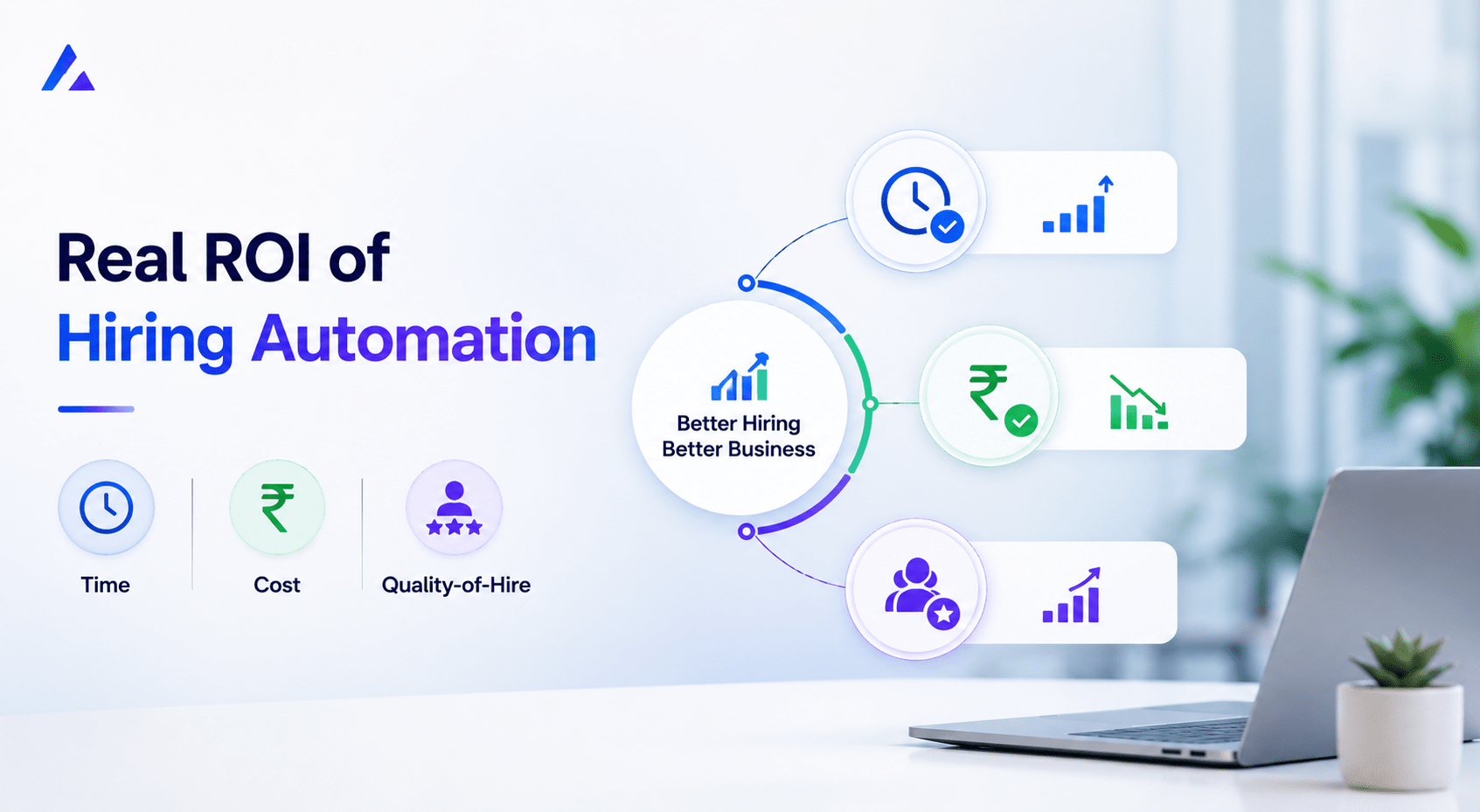
Most ROI calculations for hiring automation that Indian HR functions see during vendor evaluations track two metrics - time-to-hire and cost-per-hire. Show that both went down, declare ROI. This is incomplete in a specific and important way. Time-to-hire and cost-per-hire can both improve while quality-of-hire degrades, and the company is worse off.
The three metrics belong together. Tracking any two without the third leaves a blind spot the next quarter's performance reviews will surface.
Metric 1 - Time-to-hire
Calendar days from job opening to signed offer. The standard hiring metric. The metric that most often shows up in HR dashboards and quarterly reviews.
Indian baselines vary widely. SMB roles often close in 25 to 35 days. Mid-market roles in 45 to 75 days. Enterprise roles in 60 to 120 days. Niche or senior roles can stretch to 90 to 180 days.
Good hiring automation compresses time-to-hire by 25% to 40% in most Indian contexts. The compression comes from removing scheduling lag (days saved), reducing qualification delay (days saved between application and meaningful contact), and accelerating offer-stage paperwork (days saved between decision and offer delivery).
What lowers time-to-hire artificially. Aggressive screening that filters candidates out faster but leaves the wrong shortlist. Single-stage interviews that ship decisions on insufficient data. Lower quality bars to close roles faster. These produce lower time-to-hire numbers and higher quality-of-hire problems six months later.
Metric 2 - Cost-per-hire
Total recruitment cost - platform subscriptions, sourcing platform fees, recruiter time, advertising, agency fees where used - divided by number of hires. The unit economics of the recruitment function.
Indian baselines range from INR 15,000 to 50,000 for entry-level roles, INR 50,000 to 2 lakh for mid-level, and INR 2 lakh to 10 lakh or more for senior roles. Variance comes from agency dependence, sourcing platform mix, and role difficulty.
Good hiring automation typically reduces cost-per-hire by 20% to 35% through recruiter productivity (more hires per recruiter per quarter), reduced dependence on paid sourcing (better in-house sourcing), and lower agency usage (better mid-funnel conversion means fewer roles escalated to agencies).
What lowers cost-per-hire artificially. Increased candidate ghosting that reduces hires and skews the divisor. Lower compensation offers that close the role at lower cost but produce flight-risk hires. Reduced sourcing diversity that closes faster but narrows the talent pool.
Metric 3 - Quality-of-hire
The metric most Indian companies skip. The metric that determines whether the hiring is actually working.
Standard composition. 90-day retention (did the hire stay through onboarding). First performance review rating (typically at the 6-month or 1-year mark). One-year retention (did the hire stay through the first full cycle). For senior roles, two-year retention and contribution to team performance.
Quality-of-hire requires linking recruitment system data to HRMS data over time. Most Indian companies do not have this link cleanly. The recruitment team measures up to offer; the HR operations team measures from joining onwards; the data does not connect. Quality-of-hire becomes a manual annual review exercise rather than a continuous metric.
Good hiring automation improves quality-of-hire by improving candidate-role fit discovery in the screening and qualification stages — the right candidates make it through, the wrong-fit candidates self-deselect earlier. The mechanism is conversational depth in screening, which surfaces context that keyword screening misses, allowing better hiring decisions.
Indian baseline. 90-day retention is typically 85% to 95% in mid-market hiring; below 85% is a quality-of-hire problem. One-year retention varies more widely by industry - 65% to 85% is common. Good hiring automation should lift retention numbers measurably over 12 to 18 months.
The hidden costs vendors do not mention
Three.
Implementation effort. Most platforms quote license fees and skip integration cost. Real implementation includes ATS integration, sourcing platform integration, BGV integration, assessment platform integration, role-family configuration, language tuning, recruiter training, and hiring manager training. For an Indian mid-market company, this is typically 120 to 250 hours of internal effort plus INR 3 to 8 lakh of consulting in the first 90 days.
Ongoing tuning. Screening thresholds need adjustment based on actual recruiter and hiring manager feedback. Qualification flows need iteration as role definitions evolve. Plan for 10 to 16 hours per month of internal effort on platform tuning, typically the recruitment operations or talent ops role.
Platform-specific costs that scale. WhatsApp Business API conversation pricing. Assessment platform per-test fees. BGV per-candidate fees. Agency overflow when automation does not close roles fast enough. The license fee is rarely the whole picture. TCO over 18 months at projected volume is the right framing.
Payback period
For Indian companies hiring 50 or more positions per year, typical payback is 6 to 12 months. Variance comes from current baseline time-to-hire and quality-of-hire (worse baseline means bigger improvement), volume (higher volume means faster amortisation of fixed implementation cost), and platform fit (off-the-shelf India-built platforms have shorter payback than customised global platforms).
Below 25 hires per year, the orchestration overhead typically exceeds the value, and manual hiring with discipline delivers comparable or better outcomes. Between 25 and 50 hires per year, automation pays off if the recruitment function has the operational maturity to use it well. Above 50 hires per year, automation becomes essential for any kind of consistent quality and candidate experience.
About the Author

Ankur Singh
Ready to orchestrate your AI future?
Converiqo AI helps you design, deploy, and scale automation workflows that move your business faster, leveraging specialized solutions like our AI bot platform for lead generation, customer self-service AI bot platform, employee self-service AI bot platform, retail omnichannel automation, and our detailed guides on how agentic AI bot platforms work in enterprises and cost structure of enterprise AI bot platforms. Connect with our team to see the platform in action and co-create the next chapter of intelligent operations.
Read More Blogs
Discover more insights and product updates curated by the Converiqo AI team.

Real ROI of Field Force Automation - Beyond the Activity Dashboard
Four metrics that show real field force automation ROI in India - productivity, data reliability, throughput, and field attrition - not just the activity dashboard.

Beat Planning Is the Highest-Leverage Field Force Capability - Here Is Why
Beat planning decides coverage, call frequency, and whether field time is productive. Why it is the single highest-leverage field force automation capability.
Why an Indian Field Force App Has to Work Offline - and Be Built for Real Devices
Field work in India happens where connectivity is intermittent. A field force app that assumes constant connectivity fails exactly where field work is done.