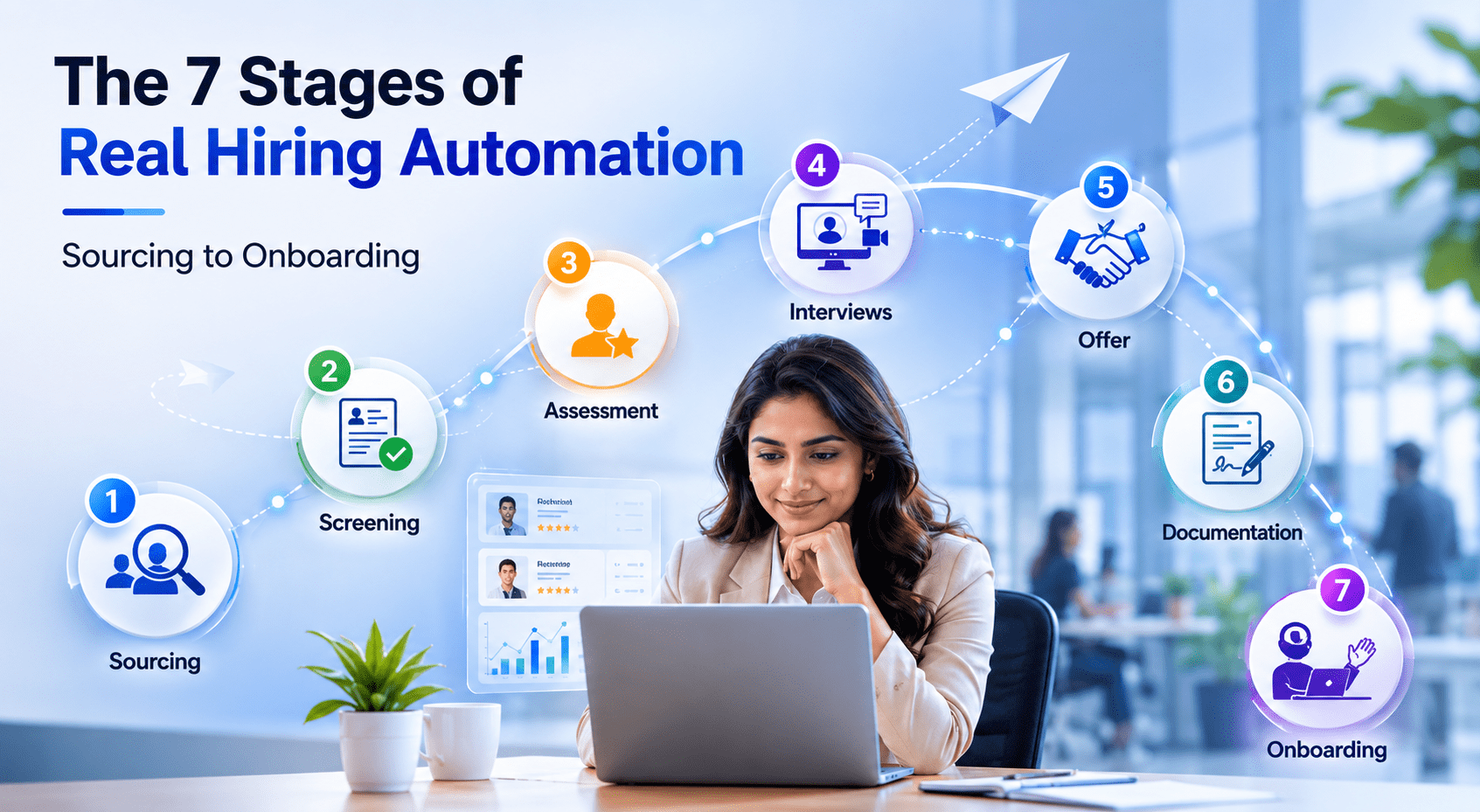
Hiring automation is seven stages connected end-to-end. Each stage has its own job. Each stage can fail independently. A platform missing any one of them leaves a manual bottleneck that drags the whole funnel.
Stage 1 - Sourcing
The job. Discover candidates across the platforms where Indian candidates actually live - Naukri, LinkedIn, Indeed, Hirect, Internshala, Instahyre, the company careers page, and WhatsApp referral networks. Unify candidates into one record per person regardless of how many platforms surfaced them. Preserve source attribution for downstream reporting.
Failure mode. Sourcing as manual search across platforms. The recruiter spends hours each day running queries on multiple sites, downloading CVs, uploading them to the ATS. The same candidate appears as three records. Source attribution is lost or imprecise. Recruiter hours go to discovery rather than judgement.
Stage 2 - Screening
The job. Evaluate candidates beyond keyword match. Context-aware reading of CV content - does the candidate's actual experience match the role requirement, even if the vocabulary differs. Behavioural signals - how the candidate applied, what they engaged with, whether they tailored their application. Edge cases route to human review rather than algorithmic rejection.
Failure mode. Keyword-match as the only filter. Good candidates whose CV vocabulary differs from the JD vocabulary get filtered out. Candidates who optimised their CV for keyword matching get filtered in. The shortlist the recruiter starts with is already wrong on both ends.
Stage 3 - Qualification
The job. Conduct the first qualifying conversation with the candidate in their preferred channel and language, gathering what the CV does not say - current notice period, salary expectation, interest in the specific role, willingness to relocate, availability for interview. Surface candidate context that determines whether deeper recruiter time is worth investing.
Failure mode. Phone screen as the qualification mechanism. The recruiter schedules a 30-minute call. Half the calls get rescheduled or no-show. The half that happen produce notes that may or may not be searchable later. Days pass between application and qualification call. Recruiter time scales linearly with candidate volume.
Stage 4 - Interview scheduling
The job. Coordinate multi-stakeholder calendars - candidate, hiring manager, panel members, sometimes the HRBP. Show the candidate real availability across the panel. Handle reschedules without breaking the chain. Send reminders the day before and the hour before. Make sure meeting links work on Indian mobile networks.
Failure mode. Email-based scheduling. Recruiter offers three slots. Candidate replies with one. Hiring manager's slot is no longer available. Two more emails. Three days pass. Candidate has moved on. Or: scheduling tool that does not handle multi-panel or that uses links that break on the candidate's network.
Stage 5 - Assessment
The job. Trigger assessments at the right stage - technical tests, video interviews, work samples, structured interview rubrics. Integrate with platforms like HackerEarth, HackerRank, video tools, take-home assignment platforms. Write results back to the candidate record. Present assessment context alongside interview feedback when the hiring manager reviews.
Failure mode. Assessment as a disconnected step. Recruiter emails the candidate a separate platform link. Score comes back to recruiter inbox. Recruiter manually updates the ATS. Hiring manager opens the candidate record and does not see the assessment context. The decision is made without the data the assessment was supposed to provide.
Stage 6 - Offer and pre-onboarding
The job. Generate offer letters from approved templates with role-specific data populated automatically. Route through approval workflow where needed. Trigger background verification with the company's BGV provider. Coordinate reference checks. Deliver offer to candidate within 24 to 48 hours of decision. Track acceptance and respond to negotiation cleanly.
Failure mode. Offer stage as paperwork. Decision made on Monday. Approval routing takes two days. Template needs updating. Compensation calculator on someone's laptop. Offer goes out Friday. Candidate has interviewed elsewhere meanwhile. Acceptance rate quietly drops.
Stage 7 - Onboarding handoff
The job. Hand off accepted candidates to the onboarding workflow with full context. Interview notes, assessment scores, manager feedback, expectations discussed, joining date confirmed, IT requirements, location, reporting structure. HR operations, IT provisioning, manager preparation, pre-joining communication all fire from the same record.
Failure mode. Context loss at handoff. Onboarding starts on day one with the new joiner having to re-explain what they were told in interviews. Manager has not prepared. IT has not provisioned. The first-week experience signals that what was promised in interviews and what the company actually does are different things.
Why all seven matter together
Each stage compounds with the ones around it. Strong sourcing with weak screening fills the pipeline with the wrong candidates. Strong qualification with weak scheduling loses qualified candidates between the call and the interview. Strong assessment with weak offer-stage produces decisions that take too long to act on.
Hiring automation is a stack. Buying it as point tools - a sourcing tool here, an assessment tool there, a scheduling tool somewhere else - leaves seams. The seams are where candidates drop and where recruiters lose hours.
About the Author

Md Ashik Alam
Ready to orchestrate your AI future?
Converiqo AI helps you design, deploy, and scale automation workflows that move your business faster, leveraging specialized solutions like our AI bot platform for lead generation, customer self-service AI bot platform, employee self-service AI bot platform, retail omnichannel automation, and our detailed guides on how agentic AI bot platforms work in enterprises and cost structure of enterprise AI bot platforms. Connect with our team to see the platform in action and co-create the next chapter of intelligent operations.
Read More Blogs
Discover more insights and product updates curated by the Converiqo AI team.

Real ROI of Field Force Automation - Beyond the Activity Dashboard
Four metrics that show real field force automation ROI in India - productivity, data reliability, throughput, and field attrition - not just the activity dashboard.

Beat Planning Is the Highest-Leverage Field Force Capability - Here Is Why
Beat planning decides coverage, call frequency, and whether field time is productive. Why it is the single highest-leverage field force automation capability.
Why an Indian Field Force App Has to Work Offline - and Be Built for Real Devices
Field work in India happens where connectivity is intermittent. A field force app that assumes constant connectivity fails exactly where field work is done.