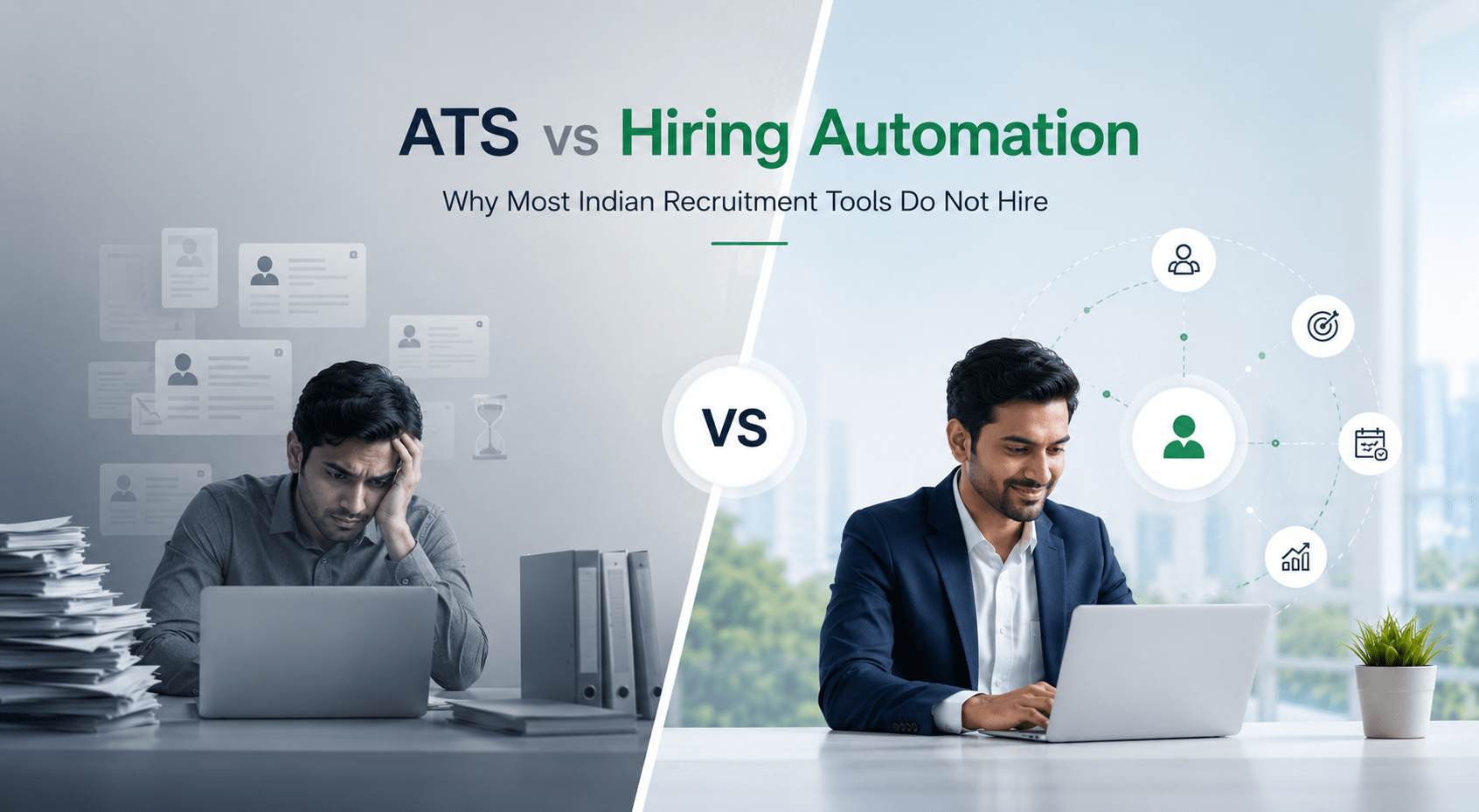
Walk into any Indian mid-market or enterprise HR function and ask whether they have hiring automation. Most will say yes. Some will name their ATS - Zoho Recruit, Naukri RMS, Keka, GreytHR, Workday, SAP SuccessFactors, or one of the international ATS platforms. The ATS appears on the technology budget. The team uses it daily. The dashboard shows pipeline movement.
Then look at what the ATS actually does. It stores resumes uploaded by recruiters. It moves candidate records through workflow stages - applied, screening, interviewed, offered, hired, rejected. It records interview feedback. It generates reports on funnel velocity and conversion rates. It enforces process - no candidate moves to offer without recorded interview feedback, no candidate joins without completed paperwork.
Necessary work. Important infrastructure. Not automation in the sense the marketing claims.
The category error
An applicant tracking system is a system of record. It tracks. It does not act. The decisions and engagement that drive the funnel - which candidates to source, which to screen out, which to qualify deeper, when to schedule, what to assess, how to communicate, when to make the offer - all happen outside the ATS, in the recruiter's daily work.
Hiring automation is the orchestration layer that acts on those decisions and engagement points. It sources candidates across platforms by query rather than by manual search. It screens beyond keyword match by understanding role context. It qualifies candidates in conversation rather than by form submission. It schedules across stakeholder calendars without requiring 14 email exchanges. It triggers assessments. It generates offers. It hands off to onboarding.
The ATS stores what hiring automation produces. The two together form a complete system. An ATS alone is recruitment infrastructure with manual orchestration. Hiring automation alone, without ATS storage, is incomplete on the record-keeping side. Most Indian companies have the storage and call it the automation, because the vendor pitch positioned it as automation and the buyer never had a reference point for what real automation looks like.
What gets noticed when only the ATS is in place
Four patterns recurring across Indian companies.
Keyword-match screening as the primary filter. The recruiter runs queries against the ATS database - '5 years AWS, Bangalore' - and the system returns matches based on keyword presence. Candidates whose CVs describe the same competencies in different language get filtered out. Candidates who have padded their CVs with keywords get filtered in. The human review starts with the wrong shortlist.
Email as the candidate communication channel by default. Application acknowledgement, screening invitation, interview scheduling, offer communication - all by email. Response rates are low, candidates miss messages, calendar links break, the lifecycle stalls between every stage. The ATS records each step; it does not improve any of them.
Scheduling by manual email exchange. The recruiter emails the candidate with three time slots. The candidate replies with one. The recruiter checks the hiring manager's calendar. The slot is no longer available. Two more email exchanges. By the time the interview is confirmed, three days have passed since the screening. Some candidates have already moved on.
Offer paperwork as the silent killer of acceptance rates. The decision is made. The offer letter requires three sign-offs. The compensation calculator is on someone's local Excel. The template is from last quarter and needs updating. Days pass. The candidate has interviewed elsewhere in the meantime. The acceptance rate drops not because the offer was wrong, but because the process took too long.
What changes when orchestration is added
The ATS stays. The orchestration layer is added above it. The candidate-facing experience changes first. Acknowledgement within minutes. Conversational screening on WhatsApp within hours. Interview slots that work the first time on mobile. Assessment links that work. Offers within 48 hours of decision. Onboarding that starts before day one.
The recruiter-facing experience changes second. Less time on data entry. Less time on scheduling coordination. Less time on candidate chasing. More time on the work that actually requires recruiter judgment - sourcing strategy for hard-to-fill roles, hiring manager partnership, candidate experience improvements, employer brand work. The recruiter is freed for the work that compounds.
The metrics change third. Time-to-hire compresses. Cost-per-hire reduces because more hires close per recruiter quarter. Quality-of-hire lifts because the screening surface-rather-than-filter approach exposes better candidates. Candidate experience improves because the touch points happen at speed and in the channels candidates prefer.
The diagnostic
Three questions an HR head can answer to know which side of the line they are on.
When a candidate applies, what happens in the next four hours? If the answer is 'their record enters the ATS and a recruiter will review it within a week,' the orchestration is missing. If the answer is 'they receive an acknowledgement within an hour, a conversational screening message that fits their channel and language within four hours, and a clear next step,' the orchestration is working.
When an interview needs to be scheduled across the candidate, hiring manager, and one or two panel members, how many calendar days pass? If the answer is two or three, the scheduling layer is manual. If the answer is hours, the scheduling layer is automated.
When the decision to offer is made, how many days pass before the candidate receives the formal offer? If the answer is more than three days, the offer-stage workflow is the silent acceptance-rate killer. If the answer is one to two days, the offer-stage is operating as a feature of the hiring automation rather than as a paperwork stage.
Three slow answers means the ATS is in place and the orchestration is not. Adding orchestration above the existing ATS is the typical path forward; replacing the ATS is rarely required and usually creates more disruption than benefit.
About the Author

Avni Chadha
Ready to orchestrate your AI future?
Converiqo AI helps you design, deploy, and scale automation workflows that move your business faster, leveraging specialized solutions like our AI bot platform for lead generation, customer self-service AI bot platform, employee self-service AI bot platform, retail omnichannel automation, and our detailed guides on how agentic AI bot platforms work in enterprises and cost structure of enterprise AI bot platforms. Connect with our team to see the platform in action and co-create the next chapter of intelligent operations.
Read More Blogs
Discover more insights and product updates curated by the Converiqo AI team.

Real ROI of Field Force Automation - Beyond the Activity Dashboard
Four metrics that show real field force automation ROI in India - productivity, data reliability, throughput, and field attrition - not just the activity dashboard.

Beat Planning Is the Highest-Leverage Field Force Capability - Here Is Why
Beat planning decides coverage, call frequency, and whether field time is productive. Why it is the single highest-leverage field force automation capability.
Why an Indian Field Force App Has to Work Offline - and Be Built for Real Devices
Field work in India happens where connectivity is intermittent. A field force app that assumes constant connectivity fails exactly where field work is done.