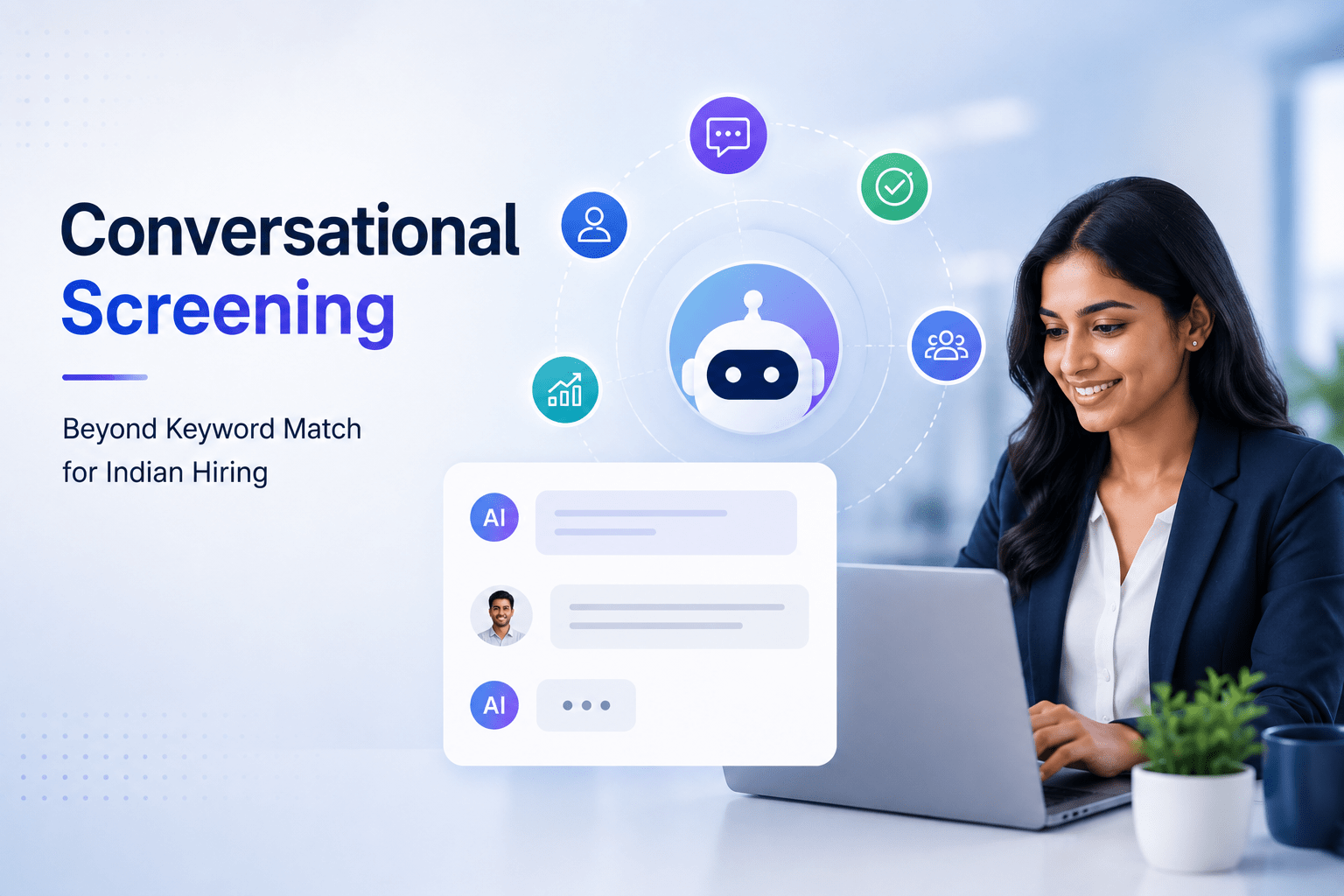
The keyword-match screening that runs by default in most Indian ATSes was designed for an era when applications arrived in tens, not in hundreds or thousands per role. At low volume, keyword filters are imperfect but acceptable - the recruiter can review the borderline cases. At Indian hiring volumes in 2026, keyword filters become the primary decision-making layer for most candidates, and the recruiter only sees what the keyword filter let through.
This produces two failure modes that recruiters quietly accept as normal.
False negatives - the good candidates filtered out
A candidate has built their career describing payment systems work as 'transaction processing' and 'reconciliation engines.' The JD asks for 'fintech experience.' Keyword filter excludes them. The candidate had directly relevant work. The recruiter never sees the CV.
A candidate has done customer-facing operational work in Hindi, Marathi, and English. The JD asks for 'customer success' experience. The CV uses 'customer relationship management' as the role title. Keyword filter excludes. The recruiter never sees the CV.
A candidate from a Tier 2 city has done strong work in a domain the company is hiring for but has not used the same buzzwords the JD uses. Keyword filter excludes. The recruiter never sees the CV.
False negatives compound because the candidates filtered out are often the candidates the company most needs - strong skills, weaker self-presentation, less keyword-optimised. The pipeline narrows toward candidates whose CVs are tuned for keyword matching, which often correlates with candidates who hop jobs and tune CVs for every application.
False positives - the keyword-padded candidates filtered in
A candidate has worked adjacent to a technology but not deeply with it. Their CV lists the technology in the skills section. Keyword filter includes them. The recruiter spends 20 minutes on a phone screen discovering the candidate's actual depth is far below what the CV implied.
A candidate has applied to 200 roles with the same CV. They have keyword-optimised for every common requirement. Keyword filter includes them. The phone screen reveals they are spray-applying and have no specific interest in this role. The recruiter time was wasted.
False positives waste recruiter hours and produce poorer-quality shortlists for hiring managers. They are the visible cost of keyword screening. False negatives are the hidden cost - the candidates who would have been excellent fits but were filtered out before any human saw them.
What conversational screening does instead
Conversational AI conducts a structured but adaptive conversation with each candidate. The conversation reads the CV and identifies what to ask about - gaps, transitions, claimed expertise, recent work. The candidate's responses fill in context the CV does not provide. The system surfaces candidates based on combined CV-plus-conversation data, not on CV keywords alone.
The candidate who described their work as 'transaction processing' gets asked about their work history and explains the fintech context. The candidate who works in Tier 2 cities in vernacular contexts gets the conversation in their preferred language and describes their experience without the language barrier filtering them out. The keyword-padded candidate gets surfaced when their conversational answers do not match the depth their CV claims.
Conversational screening is not better screening because AI is smart. It is better screening because the conversation surfaces information the CV alone cannot provide. The same human recruiter, given conversational screening data alongside the CV, makes better decisions than the recruiter who only has the CV.
How conversational screening works in India in 2026
Three patterns to look for in working conversational screening.
Channel match. The conversation happens in the candidate's preferred channel - WhatsApp for most non-elite hiring, web chat for those who applied via the careers page, voice for candidates who prefer it. The platform decides based on the candidate's signal, not on a one-channel-fits-all default.
Language match. The conversation happens in the candidate's preferred language with code-switching handled gracefully. The AI does not break when the candidate switches between English and Hindi mid-sentence. Vernacular candidates get the same depth of qualification as English-fluent candidates.
Surface, not filter. Borderline candidates get flagged for human review rather than auto-rejected. The recruiter sees the conversation transcript, the AI's assessment of fit, and the specific concerns the AI surfaced. The human makes the final call on edge cases. The AI handles volume on clear cases.
What this changes downstream
Recruiter phone-screen time reduces because the basics are already qualified. Phone screens shift from data-gathering to depth conversations on the candidates worth depth time. Hiring manager interview time produces stronger decisions because the assessment of candidates is grounded in conversation data, not just CV review. Candidate experience improves because every applicant gets a meaningful interaction rather than algorithmic silence.
The metrics shift visibly. Time-to-qualification compresses from days to hours. Candidate response rate to first contact lifts. Shortlist quality reported by hiring managers improves. The keyword-filter false negatives - the candidates the system would have lost - appear in the funnel at a healthier rate.
About the Author

Himani Chaudhary
Ready to orchestrate your AI future?
Converiqo AI helps you design, deploy, and scale automation workflows that move your business faster, leveraging specialized solutions like our AI bot platform for lead generation, customer self-service AI bot platform, employee self-service AI bot platform, retail omnichannel automation, and our detailed guides on how agentic AI bot platforms work in enterprises and cost structure of enterprise AI bot platforms. Connect with our team to see the platform in action and co-create the next chapter of intelligent operations.
Read More Blogs
Discover more insights and product updates curated by the Converiqo AI team.

Real ROI of Field Force Automation - Beyond the Activity Dashboard
Four metrics that show real field force automation ROI in India - productivity, data reliability, throughput, and field attrition - not just the activity dashboard.

Beat Planning Is the Highest-Leverage Field Force Capability - Here Is Why
Beat planning decides coverage, call frequency, and whether field time is productive. Why it is the single highest-leverage field force automation capability.
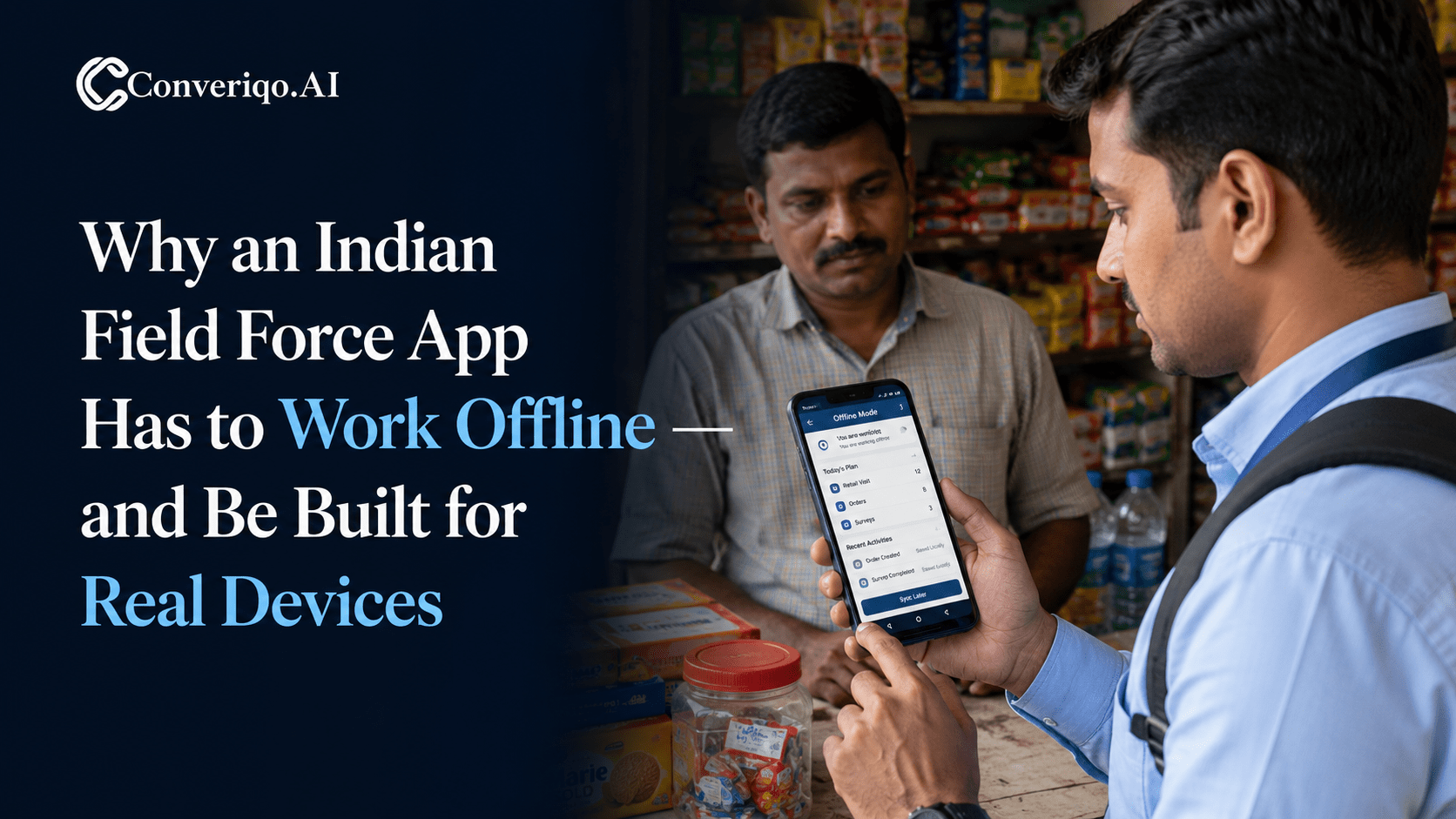
Why an Indian Field Force App Has to Work Offline - and Be Built for Real Devices
Field work in India happens where connectivity is intermittent. A field force app that assumes constant connectivity fails exactly where field work is done.