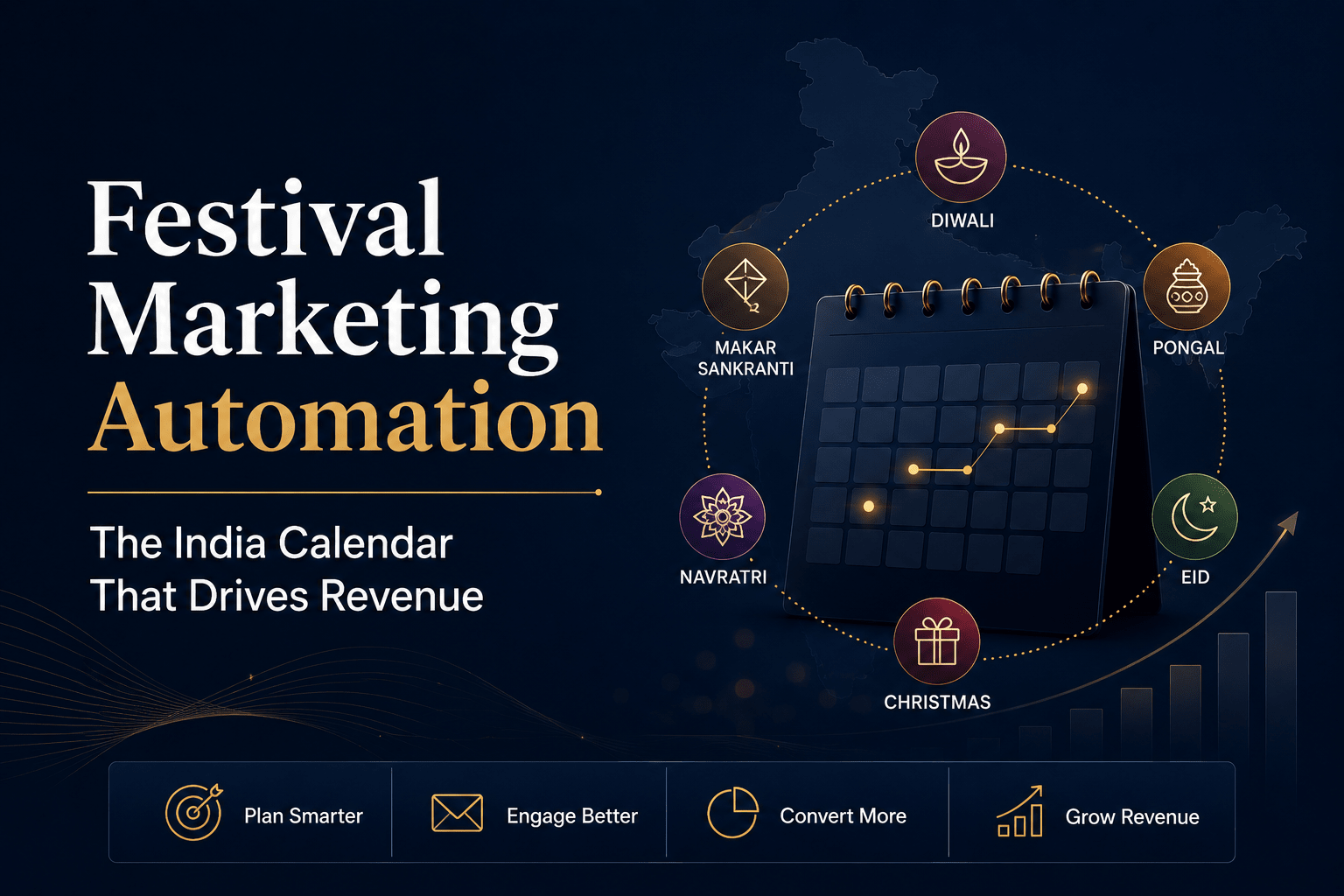
Indian marketing revenue does not distribute evenly across the year. It concentrates in festival and event windows - Diwali, Holi, Eid, Onam, Pongal, Durga Puja, Christmas, year-end. It concentrates in IPL season. It concentrates in monsoon for certain categories, wedding season for others, year-end financial planning windows for yet others.
Global marketing automation platforms typically assume an evenly distributed calendar. Western journey templates assume the prospect's purchase intent is steady across months. India does not work that way. Marketing automation built for India needs festival-calendar awareness as a first-class design principle, not a customisation layer added later.
The festival journey shape
A festival campaign in India follows a predictable shape that marketing automation can encode.
Pre-window (4 to 6 weeks before peak). Awareness content. Wishlist building. Email subscription growth. Anticipation building. Catalogue or collection previews. The marketing automation system runs nurture flows that prepare the audience without yet selling hard.
Approach (2 weeks before peak). Offer revelation begins. Early access for engaged segments. Loyalty tier benefits. The marketing automation system shifts to conversion-leaning content for high-intent segments while still nurturing the rest.
Peak (the festival window - typically 3 to 10 days). Full-pressure conversion campaigns. Daily offers. Time-limited promotions. Cart abandonment flows fire frequently. WhatsApp becomes the primary channel for many segments because urgency communication works best there.
Post-peak (1 to 2 weeks after). Wind-down with relationship messaging. Post-purchase thank-yous. Cross-sell to recent purchasers. Re-engagement for contacts who showed intent but did not convert. The marketing automation system shifts from sell-mode back to relationship-mode.
Off-window. Light marketing presence. Educational content. List health activities - re-engagement, suppression of dormant contacts, hygiene work. The off-window is for building the database that the next festival window will monetise.
The festival calendar segmentation problem
Diwali is celebrated across most of India but not all. Onam matters in Kerala. Pongal matters in Tamil Nadu. Durga Puja matters in Bengal. Christmas matters across Indian Christian communities and increasingly across urban India broadly. Eid matters across Indian Muslim communities. Sending the Diwali campaign to every contact treats India as monolithic and undermines the personalization the marketing automation is supposed to deliver.
Festival-aware marketing automation segments contacts by festival calendar - which festivals are relevant to each contact based on region, religion if known and appropriate to ask, or stated preference. Campaigns route based on the festival the contact actually celebrates. The system suppresses Diwali marketing for contacts who do not celebrate Diwali and replaces it with the equivalent campaign for the festival they do celebrate.
This sounds operationally heavy. With marketing automation orchestrating it, the work is in the segmentation design once; the execution recurs automatically year after year.
The event calendar layer
Beyond religious festivals, Indian marketing automation works with an event calendar - IPL season for sports-adjacent categories, monsoon for relevant categories like umbrellas and waterproofing, wedding season for jewellery and bridal categories, exam result windows for education categories, year-end and quarter-end for B2B financial decisions, Bollywood movie releases for entertainment-adjacent categories.
Each event window has its own pre-approach-peak-post shape. The marketing automation system holds the calendar as data - events, windows, relevant segments - and triggers campaigns when the calendar moves into each phase. A monsoon flow for a waterproofing brand fires from May through August. An IPL flow for a snacks brand fires across the IPL window. A wedding-season flow for a jewellery brand fires from October through February in the relevant regions.
What festival-aware marketing automation looks like in practice
Three patterns.
A working festival journey library - Diwali, Holi, Onam, Pongal, Durga Puja, Eid, Christmas - pre-built with the four-phase shape, ready to be tuned each year rather than rebuilt from scratch. Year-over-year continuity allows learning what works and what does not.
Festival-tagged content library. The Diwali content from last year is tagged and findable. The team revisits, refreshes, and reuses. New content gets added; old content gets retired. The cumulative library is an asset that compounds.
Reporting on festival-window MIR. Marketing-influenced revenue across festival windows year over year. The CFO can answer the question of whether last Diwali's marketing investment outperformed the year before, and decide budget allocation for the upcoming Diwali on data.
About the Author

Himani Chaudhary
Ready to orchestrate your AI future?
Converiqo AI helps you design, deploy, and scale automation workflows that move your business faster, leveraging specialized solutions like our AI bot platform for lead generation, customer self-service AI bot platform, employee self-service AI bot platform, retail omnichannel automation, and our detailed guides on how agentic AI bot platforms work in enterprises and cost structure of enterprise AI bot platforms. Connect with our team to see the platform in action and co-create the next chapter of intelligent operations.
Read More Blogs
Discover more insights and product updates curated by the Converiqo AI team.
Real ROI of Field Force Automation - Beyond the Activity Dashboard
Four metrics that show real field force automation ROI in India - productivity, data reliability, throughput, and field attrition - not just the activity dashboard.

Beat Planning Is the Highest-Leverage Field Force Capability - Here Is Why
Beat planning decides coverage, call frequency, and whether field time is productive. Why it is the single highest-leverage field force automation capability.
Why an Indian Field Force App Has to Work Offline - and Be Built for Real Devices
Field work in India happens where connectivity is intermittent. A field force app that assumes constant connectivity fails exactly where field work is done.