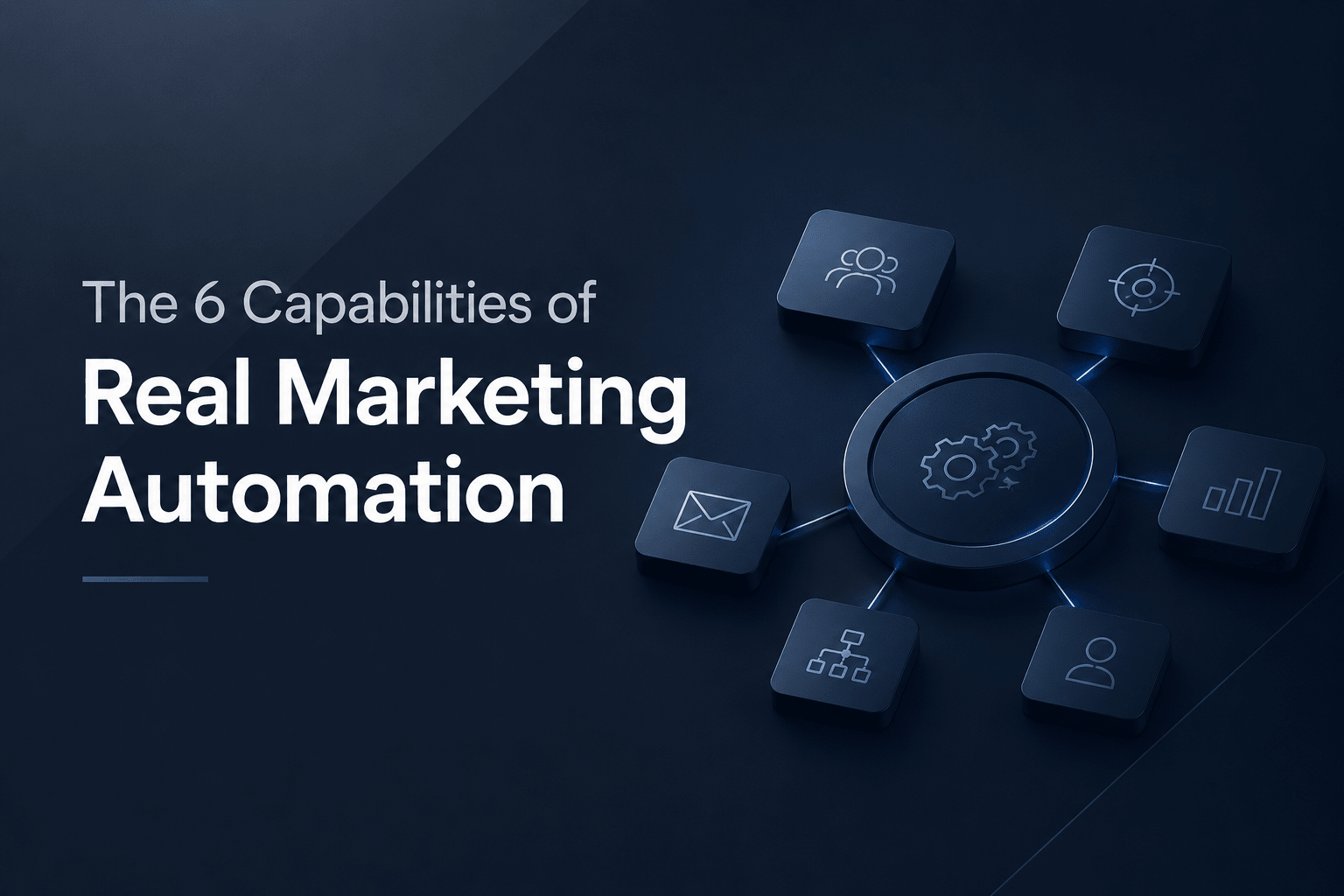
The 6 Capabilities of Real Marketing Automation - and What Each One Replaces
Real marketing automation is six capabilities working together. Each one replaces a specific manual or partial-automation workflow that most Indian businesses currently run. Walking through each - what the capability does, what it replaces, and what breaks when it is missing.
Capability 1 - Audience segmentation
What it does. Maintains a unified contact database with segments that combine firmographic, demographic, behavioural, preference, and lifecycle data. Segments update dynamically - a contact who completes a key action moves into the relevant segment automatically.
What it replaces. The list-export-to-Excel workflow. The 'pull a fresh segment for each campaign' approach. The duplicate-records-across-channels problem. The 'we ran the campaign and then realised we missed the right segment' postmortem.
What breaks when it is missing. Every campaign starts from scratch. Segments defined for email do not work for WhatsApp. Contacts get hit twice or missed entirely. The marketing team spends more time pulling lists than building campaigns.
Capability 2 - Content management and matching
What it does. Holds a tagged content library - emails, WhatsApp templates, landing pages, ad copy, gated assets - with metadata for segment fit, language, channel, lifecycle stage. The system matches content to context automatically rather than relying on humans to remember which asset is right for which moment.
What it replaces. The shared Google Drive folder where assets live. The 'CMO knows which asset to use' bottleneck. The 'rewrite the same email for every campaign' inefficiency. The 'wrong asset attached to the campaign' mistake.
What breaks when it is missing. Content reuse is low. Personalization at the asset level is impossible. Different team members produce divergent versions of similar assets. Festival campaigns repeat content from previous years because no one can find what worked.
Capability 3 - Multi-channel campaign orchestration
What it does. Executes campaigns in coordinated sequence across channels rather than parallel silos. Sequences which channel hits first, what to do based on response, which channel hits next. Suppression rules prevent overlap.
What it replaces. The 'we did an email campaign and also a WhatsApp campaign and also an SMS campaign for Diwali' approach where all three blast simultaneously. The 'we don't know if WhatsApp delivered before we also sent email' problem. The 'customers complain we're spamming them' feedback.
What breaks when it is missing. Contacts get hit multiple times for the same offer. The brand is perceived as noisy. Unsubscribes spike during campaign windows. WhatsApp Business Account quality rating drops because of message frequency.
Capability 4 - Behavioural triggers and journey logic
What it does. Fires next-best actions based on what contacts do, with conditional branches in journey flows. Cart abandoned, content downloaded, pricing viewed, demo requested - each behaviour can trigger a different sequence, and each sequence has branches for engaged, quiet, and opted-out paths.
What it replaces. The 'we send the same monthly newsletter to everyone' approach. The 'we noticed three weeks later that someone abandoned the cart' lag. The 'we keep emailing people who haven't opened in six months' habit.
What breaks when it is missing. Marketing communicates on the business's schedule, not the prospect's behaviour. The most engaged moments are missed because the system doesn't know they happened. Dormant contacts stay in active sends and drag down engagement metrics.
Capability 5 - Personalization at scale
What it does. Personalizes message content, channel, timing, and offer per contact based on language preference, region, festival calendar, channel preference, lifecycle stage, and price sensitivity. The personalization is structural - built into the orchestration logic, not a merge field bolted on top.
What it replaces. The first-name merge field as the only personalization. The 'we send in English to everyone because translating is expensive' assumption. The 'the Diwali campaign goes to everyone including non-celebrating contacts' default. The 'we don't know which channel each contact prefers' gap.
What breaks when it is missing. Personalization is theatre. Indian Tier 2 and Tier 3 contacts get English content. Non-celebrating contacts get festival promotions. The brand looks like it doesn't know its customers.
Capability 6 - Measurement and attribution
What it does. Reports on outcomes - marketing-influenced revenue, journey completion rates, unsubscribe-to-engagement ratio, cost per engaged contact - alongside activity metrics. Multiple attribution models available for the same period to test sensitivity.
What it replaces. The dashboard that shows opens and clicks but not revenue. The 'we don't know which campaign drove that deal' answer to the CFO. The 'we run reports in spreadsheets pulled from three systems' weekly grind.
What breaks when it is missing. Marketing cannot answer the revenue question. Budget decisions get made on activity, not impact. Optimisation focuses on opens and clicks because those are what the dashboard shows.
Why all six matter together
Each capability compounds with the next. Strong segmentation with weak content matching produces well-targeted but generic messages. Strong orchestration with weak measurement runs campaigns that no one can prove worked. Strong personalization with weak triggers fires the right content at the wrong moment.
Marketing automation is a layer, not a tool. Buying point tools for each capability leaves seams between them. The seams are where the orchestration breaks down and the automation becomes activity rather than outcome.
About the Author

Avni Chadha
Ready to orchestrate your AI future?
Converiqo AI helps you design, deploy, and scale automation workflows that move your business faster, leveraging specialized solutions like our AI bot platform for lead generation, customer self-service AI bot platform, employee self-service AI bot platform, retail omnichannel automation, and our detailed guides on how agentic AI bot platforms work in enterprises and cost structure of enterprise AI bot platforms. Connect with our team to see the platform in action and co-create the next chapter of intelligent operations.
Read More Blogs
Discover more insights and product updates curated by the Converiqo AI team.
Real ROI of Field Force Automation - Beyond the Activity Dashboard
Four metrics that show real field force automation ROI in India - productivity, data reliability, throughput, and field attrition - not just the activity dashboard.

Beat Planning Is the Highest-Leverage Field Force Capability - Here Is Why
Beat planning decides coverage, call frequency, and whether field time is productive. Why it is the single highest-leverage field force automation capability.
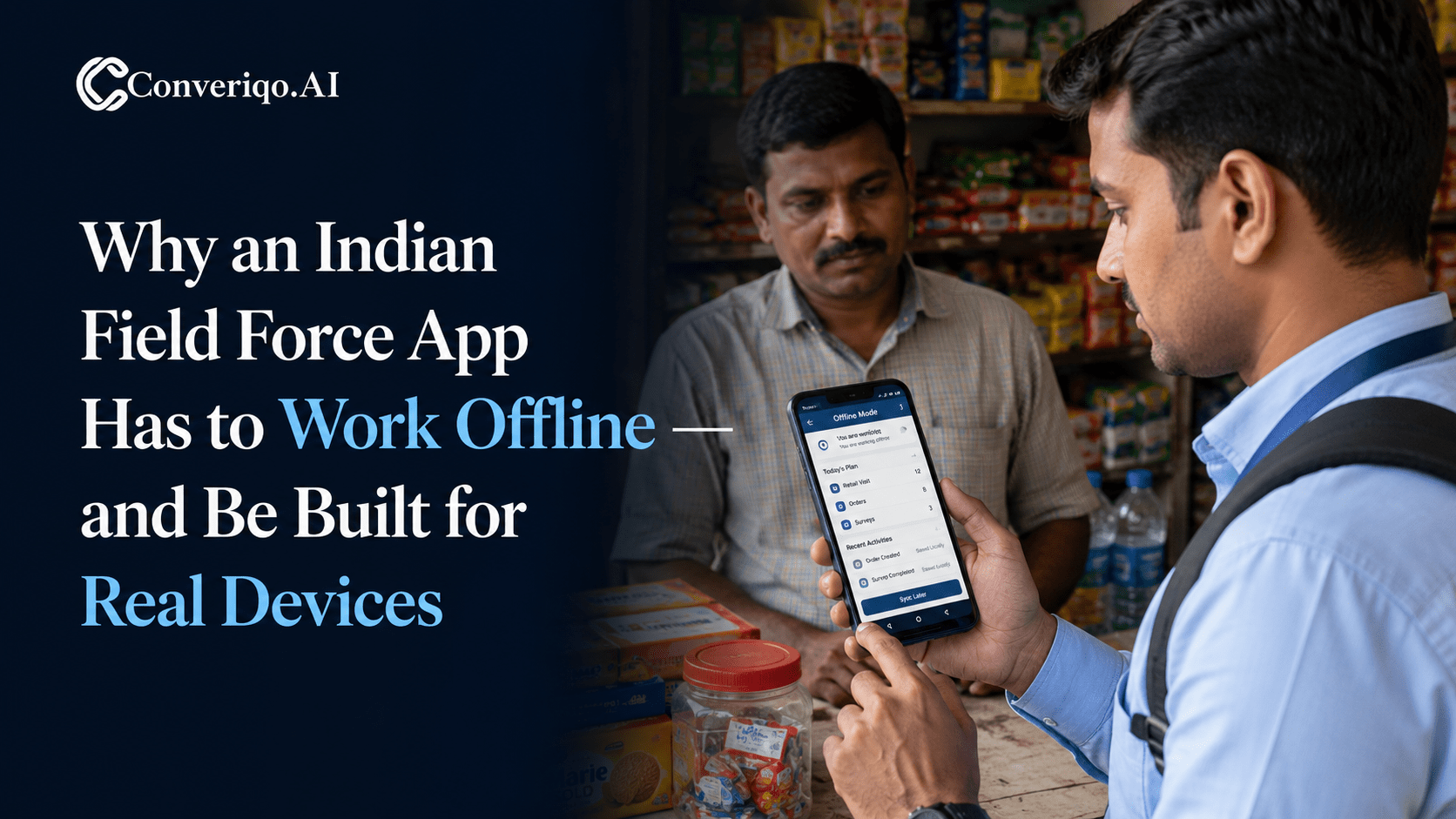
Why an Indian Field Force App Has to Work Offline - and Be Built for Real Devices
Field work in India happens where connectivity is intermittent. A field force app that assumes constant connectivity fails exactly where field work is done.