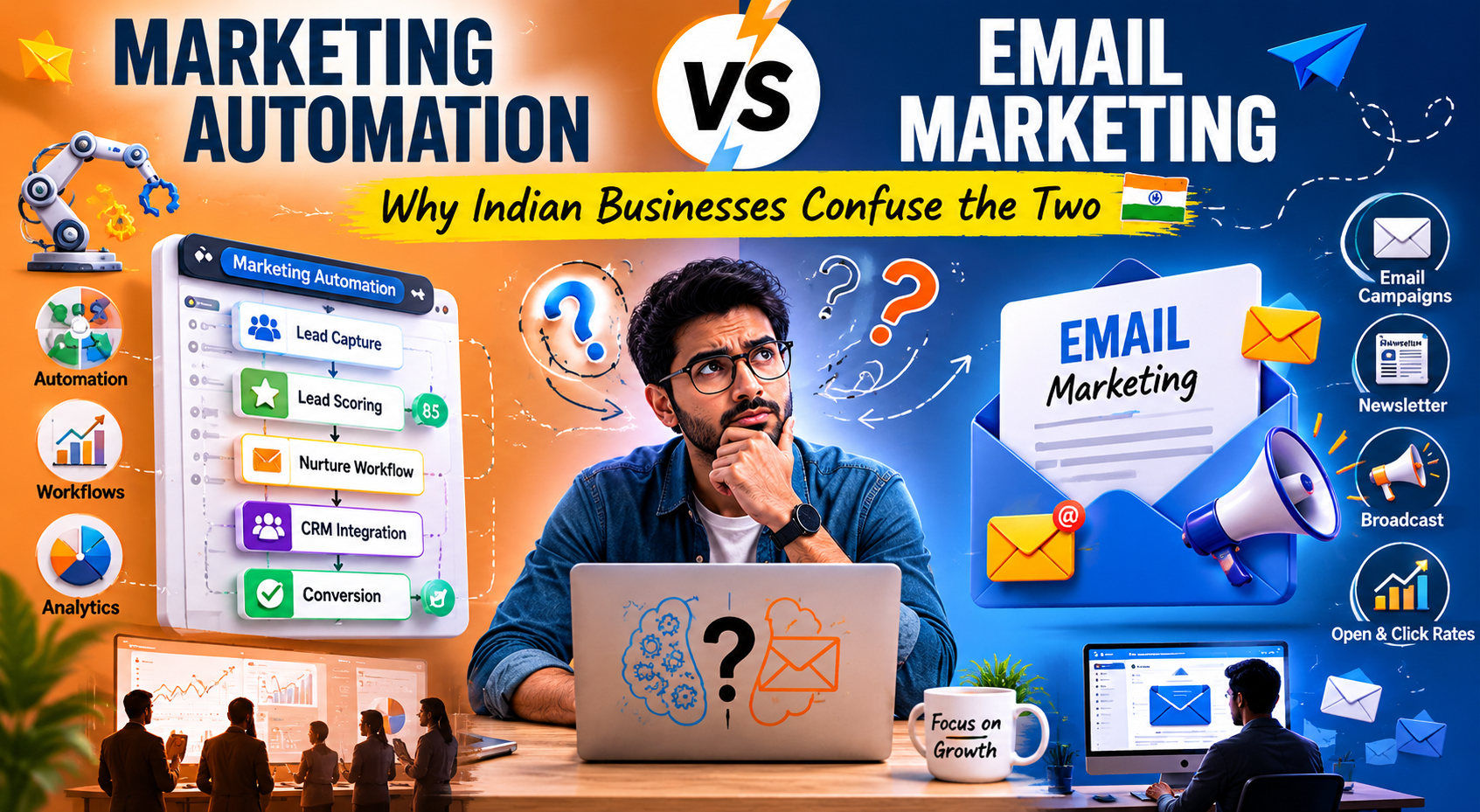
An Indian SaaS business runs Mailchimp. Sends a monthly newsletter. Has tags for source attribution. Uses the built-in drip sequence for new sign-ups. The marketing head, asked in any pitch deck or quarterly review whether the business has marketing automation, says yes.
The business has email marketing. With a small drip feature attached. Marketing automation is something else.
The vocabulary problem
Email marketing is a channel. The work is - define the audience, write the email, schedule the send, look at opens and clicks. A good email marketing tool makes this easier and adds segmentation, A/B testing, deliverability hygiene, and templated drips for the common flows.
Marketing automation is an orchestration layer that runs above channels - email, WhatsApp, SMS, push, web. The work is - define the audiences once and use them everywhere; match the right content to the right segment at the right moment; sequence channels intelligently so the prospect gets the right channel at the right step; fire journey progression based on what the prospect actually does; personalize at the contact level beyond merge fields; measure outcomes that tie back to revenue, not just activity.
A tool that does only the email side, even with a drip builder, is email marketing. A system that does all six, across channels, is marketing automation. Most Indian marketing automation purchases are tools sold with orchestration screenshots in the demo and never actually wired up after purchase.
What this looks like in practice
Consider a contact who downloads a pricing guide on the website.
In the email marketing world, the contact gets added to a 'downloaded pricing' list, receives a templated thank-you email, and possibly enters a 5-email drip sequence over the next 14 days. If they reply, a human notices and responds. If they don't, the sequence runs to completion and they sit in the database.
In the marketing automation world, the contact's profile updates with the download as a behavioural signal. The segment they are in updates dynamically - they may now qualify as a high-intent prospect. A behavioural trigger fires the next-best action based on their lifecycle stage and channel preference. If their preferred channel is WhatsApp, a templated message lands there within the hour. If their CRM record shows an open opportunity, the sales owner gets notified with full context. The journey they enter has conditional branches - if they engage, accelerate; if they go quiet, downshift to re-engagement; if they unsubscribe, suppress and log. Marketing-influenced revenue tracking watches whether this download eventually attributes to a closed deal.
The diagnostic
Three questions a marketing head can answer to know which side of the line they are on.
When a contact downloads a pricing guide on the website, what happens in the next 60 minutes - automatically, without anyone touching the system? If the answer is 'they get added to a list and maybe a templated email,' the system is email marketing. If the answer is 'a behavioural trigger fires that selects the next-best action based on the contact's lifecycle stage, segment, channel preference, and recent activity, and executes across the right channel within minutes,' the system is marketing automation.
When the CFO asks what marketing produced in revenue last quarter, can the answer be backed by attribution data from the system? If the answer requires a spreadsheet pulled from multiple sources by a person, the measurement capability of marketing automation is not active.
When a campaign goes out, does the system know not to also send the same offer in another channel that day, and does it know which contacts have already opted out of which purpose? If the answer is no, the orchestration layer is not running.
The shift from email marketing to marketing automation is not a tool upgrade. It is a discipline upgrade - a different way of thinking about what marketing does. Most Indian businesses make the tool purchase and skip the discipline shift. The tool then performs as email marketing because that is what its operators are using it for.
About the Author

Ankur Singh
Ready to orchestrate your AI future?
Converiqo AI helps you design, deploy, and scale automation workflows that move your business faster, leveraging specialized solutions like our AI bot platform for lead generation, customer self-service AI bot platform, employee self-service AI bot platform, retail omnichannel automation, and our detailed guides on how agentic AI bot platforms work in enterprises and cost structure of enterprise AI bot platforms. Connect with our team to see the platform in action and co-create the next chapter of intelligent operations.
Read More Blogs
Discover more insights and product updates curated by the Converiqo AI team.

Real ROI of Field Force Automation - Beyond the Activity Dashboard
Four metrics that show real field force automation ROI in India - productivity, data reliability, throughput, and field attrition - not just the activity dashboard.

Beat Planning Is the Highest-Leverage Field Force Capability - Here Is Why
Beat planning decides coverage, call frequency, and whether field time is productive. Why it is the single highest-leverage field force automation capability.
Why an Indian Field Force App Has to Work Offline - and Be Built for Real Devices
Field work in India happens where connectivity is intermittent. A field force app that assumes constant connectivity fails exactly where field work is done.